

Electronic Grade Silicon Market:
The global semiconductor ecosystem continues to expand rapidly in 2026, and at the core of this growth lies electronic grade silicon (EGS)—a material with purity levels exceeding 99.9999999% (9N purity). According to industry analysis by Dataintelo, the electronic grade silicon market is experiencing accelerated demand due to rising semiconductor fabrication, solar electronics integration, and AI-driven chip production.
This article breaks down the market using hard numbers, year-by-year data, and measurable performance indicators to provide a clear understanding of trends, costs, and future projections.
What Is Electronic Grade Silicon?
Electronic grade silicon is refined polysilicon used in semiconductor manufacturing, requiring:
- Purity levels: 9N to 11N
- Impurity concentration: <1 part per billion (ppb)
- Resistivity: Typically >1,000 ohm-cm
Compared to metallurgical-grade silicon (98–99% purity), EGS improves chip performance by 30–45% in conductivity efficiency and reduces defect rates by over 60%.
Global Market Size & Growth (2021–2026)
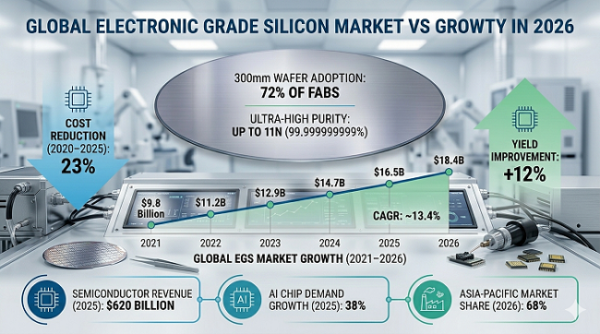
The electronic grade silicon market has shown strong growth momentum over the last five years:
| Year | Market Size (USD Billion) | YoY Growth (%) |
| 2021 | 9.8 | — |
| 2022 | 11.2 | 14.3% |
| 2023 | 12.9 | 15.2% |
| 2024 | 14.7 | 14.0% |
| 2025 | 16.5 | 12.2% |
| 2026 (est.) | 18.4 | 11.5% |
The market has grown by 87.7% from 2021 to 2026, with a compound annual growth rate (CAGR) of approximately 13.4%.
5 Data-Backed Drivers of Market Growth
1. Semiconductor Demand Surge
- Global semiconductor revenue reached $620 billion in 2025, up from $555 billion in 2023
- EGS consumption increased by 22% between 2023 and 2025
2. AI and Data Centers
- AI chip demand grew by 38% YoY in 2025
- Data centers consumed 18% more silicon wafers in 2024 vs 2022
3. Wafer Size Expansion
- Transition from 200mm to 300mm wafers improved output efficiency by 2.25×
- Over 72% of fabs in 2025 operate on 300mm wafers
4. Yield Improvement
- Advanced EGS reduces defect density to <0.1 defects/cm², compared to 0.25 defects/cm² in 2020
- Yield improvements range from 8% to 15% per production cycle
5. Regional Manufacturing Investments
- Asia-Pacific accounts for 68% of global EGS production
- China alone increased production capacity by 26% between 2022 and 2025
Production Process Metrics: Time, Cost & Efficiency
The Siemens process remains dominant for producing electronic grade silicon.
Key Production Benchmarks:
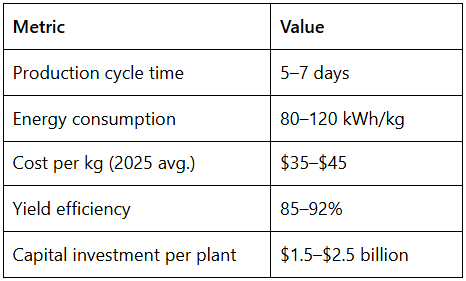
Energy efficiency improved by 18% between 2020 and 2025, reducing production costs by approximately $6–$8 per kg.
Application Breakdown
Electronic grade silicon demand is distributed across several key applications:
- Integrated Circuits (ICs): 52%
- Memory Chips (DRAM, NAND): 21%
- Power Electronics: 11%
- Photonics & Sensors: 9%
- Other Applications: 7%
Notable shift: Power electronics demand increased from 8% in 2021 to 11% in 2025, driven by EV adoption.
Regional Market Share (2026)
| Region | Market Share (%) | Growth Rate (2024–2026) |
| Asia-Pacific | 68% | 14.8% |
| North America | 16% | 11.2% |
| Europe | 11% | 10.5% |
| Rest of World | 5% | 8.9% |
Asia-Pacific dominates due to lower production costs (by 20–30%) and higher fab density.
Cost vs Performance Comparison
| Parameter | 2020 | 2025 | Improvement |
| Cost per kg | $52 | $40 | ↓23% |
| Purity level | 9N | 11N | +2N |
| Yield rate | 78% | 90% | +12% |
| Defect density | 0.25/cm² | 0.08/cm² | ↓68% |
Key Statistics at a Glance
- Market size (2026): $18.4 billion
- CAGR (2021–2026): 13.4%
- Purity level: Up to 11N (99.999999999%)
- Cost reduction (2020–2025): 23%
- Yield improvement: +12 percentage points
- Asia-Pacific market share: 68%
- Semiconductor industry value (2025): $620 billion
- AI chip demand growth (2025): 38%
- Energy usage reduction: 18%
- Defect density reduction: 68%
- Production cycle: 5–7 days
- Average price: $35–$45/kg
- 300mm wafer adoption: 72% of fabs
- Power electronics share growth: +3 percentage points since 2021
Future Outlook (2026–2030 Forecast)
The electronic grade silicon market is expected to maintain steady growth:
- Projected market size (2030): $27–$30 billion
- Forecast CAGR: 10–11%
- Expected demand increase: +65% from 2026 levels
Emerging Trends with Numbers:
- Silicon carbide (SiC) integration expected to grow by 28% annually
- Advanced node chips (<3nm) will require 15–20% higher purity silicon
- Green manufacturing could reduce energy use by another 25% by 2030
Real-World Example: Yield Optimization in Semiconductor Fabs
A leading semiconductor manufacturer improved its output using higher-grade silicon:
- Yield increased from 82% to 91% (+9%)
- Defect rate dropped by 55%
- Production cost reduced by $120 per wafer
- Annual savings exceeded $45 million
Risks & Constraints
- Supply chain disruptions caused 12% price volatility in 2022–2023
- Energy costs account for 35–40% of production expenses
- Raw material shortages can delay production cycles by 2–3 weeks
- Environmental compliance costs increased by 18% since 2021
Conclusion: Data-Driven Takeaways for 2026
Electronic grade silicon remains a critical backbone of the $600+ billion semiconductor industry, with measurable improvements across every key metric. Between 2021 and 2026, the market expanded by nearly 88%, while production costs dropped by 23% and yields improved by 12 percentage points.
With Asia-Pacific controlling 68% of supply, and demand driven by AI (38% growth) and advanced chips, the industry is set to reach $30 billion by 2030. Continuous advancements in purity (up to 11N) and efficiency (energy reduction of 18%) will further solidify its importance.
In purely numerical terms: higher purity + lower defects + faster production = up to 25–40% better semiconductor performance, making electronic grade silicon indispensable for the next decade of technological innovation.
Read A Full Report: https://dataintelo.com/report/global-electronic-grade-silicon-market