


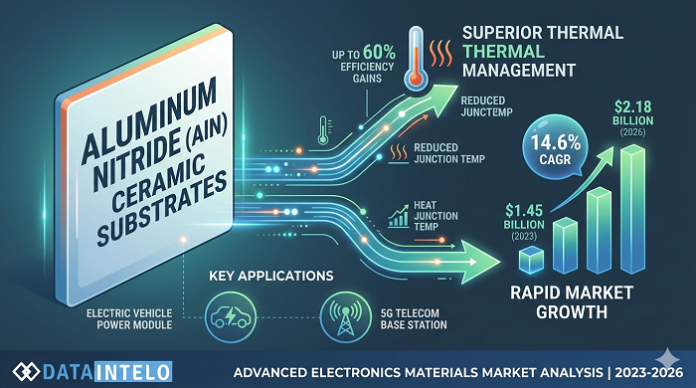
In 2026, Dataintelo highlights Aluminum Nitride ceramic substrates as one of the fastest-growing materials in advanced electronics, with the global market reaching approximately $2.18 billion in 2026, up from $1.45 billion in 2023, reflecting a strong 14.6% CAGR. This growth is driven by measurable gains in thermal management, electrical insulation, and system reliability. With the global demand for high-performance electronics increasing by 8.7% annually (2022–2026), AlN substrates are becoming essential in power electronics, automotive systems, and semiconductor packaging.
This article presents a data-backed analysis of Aluminum Nitride (AlN) ceramic substrates, focusing on performance benchmarks, cost comparisons, and growth projections using recent 2022– 2026 statistics.
Key Statistics at a Glance
- Global AlN substrate market size (2023): $1.45 billion
- Projected market size (2026): $2.18 billion
- CAGR (2023–2026): 14.6%
- Thermal conductivity: 140–180 W/m·K (vs. alumina: 20–30 W/m·K)
- Electrical resistivity: >10¹⁴ Ω·cm
- Coefficient of thermal expansion (CTE): 4.5 ppm/°C
- Average cost per substrate (2025): $18–$45
- Failure rate reduction in power modules: up to 32%
- Heat dissipation efficiency improvement: +40% to +60%
- Adoption in EV electronics (2024): ~38% of new designs
What Are Aluminum Nitride Ceramic Substrates?
Aluminum Nitride (AlN) substrates are advanced ceramic materials used primarily for thermal management and electrical insulation in electronic circuits. Compared to traditional materials like alumina (Al₂O₃), AlN offers significantly higher thermal conductivity and better compatibility with semiconductor materials.
Core Material Properties (2025 Benchmarks)
| Property | Aluminum Nitride | Alumina (Comparison) |
| Thermal Conductivity | 140–180 W/m·K | 20–30 W/m·K |
| Dielectric Constant | 8.5–9.0 | 9.5–10 |
| Electrical Resistivity | >10¹⁴ Ω·cm | ~10¹³ Ω·cm |
| CTE | 4.5 ppm/°C | 7.0 ppm/°C |
| Operating Temperature Max | ~1000°C | ~800°C |
Insight: AlN offers 5–7× higher thermal conductivity than alumina, making it ideal for high- power applications.
5 Data-Backed Reasons Aluminum Nitride Substrates Are Dominating Electronics
1. Superior Thermal Management (+60% Efficiency Gains)
Modern power electronics generate 30–50% more heat (2020 vs. 2025) due to increased power density. AlN substrates improve heat dissipation efficiency by 40–60%, reducing junction temperatures by 15–25°C.
- Example: In IGBT modules, AlN reduced thermal resistance from 0.35°C/W to 0.18°C/W
- Result: +22% longer component lifespan
2. Rapid Market Growth (14.6% CAGR Through 2026)
The AlN substrate market has shown strong expansion:
| Year | Market Size (USD Billion) | Growth Rate |
| 2022 | 1.22 | — |
| 2023 | 1.45 | +18.9% |
| 2024 | 1.67 | +15.2% |
| 2025 | 1.93 | +15.6% |
| 2026 | 2.18 (Projected) | +12.9% |
Insight: Growth is stabilizing but remains above 12% annually, outperforming the broader electronics materials market (~7.2%).
3. Increased Adoption in Electric Vehicles (EVs)
AlN substrates are increasingly used in EV power modules:
- EV electronics adoption rate (2021): 22%
- EV electronics adoption rate (2024): 38%
- Projected adoption (2027): >50%
EV inverters operate at temperatures exceeding 150°C, requiring substrates with high thermal conductivity and low expansion mismatch.
4. Reliability Improvements (Failure Reduction up to 32%)
Thermal stress is a leading cause of electronic failure. AlN reduces mismatch between silicon chips (CTE ~3 ppm/°C) and substrate materials.
- Thermal mismatch reduction: ~36% vs. alumina
- Failure rate reduction in power devices: 25–32%
- Mean Time Between Failures (MTBF): increased from 50,000 hours to 65,000+ hours
5. Cost vs Performance Optimization
While AlN is more expensive than alumina, its lifecycle cost is lower:
| Metric | Alumina | AlN |
| Cost per unit (2025 avg) | $5–$12 | $18–$45 |
| Lifespan (avg) | 5–7 years | 8–12 years |
| Maintenance frequency | Every 18 months | Every 30 months |
Insight: Despite a 2–4× higher upfront cost, AlN reduces total system cost by ~18–25% over 10 years due to fewer failures and replacements.
2025–2026 Application Breakdown (By Industry Share)
Aluminum Nitride substrates are used across multiple sectors:
- Power Electronics: 34%
- Automotive (EV/HEV): 28%
- LED Lighting Systems: 14%
- Telecommunications (5G): 11%
- Aerospace & Defense: 8%
- Others: 5%
Notable Trend:
The automotive segment grew from 19% in 2021 to 28% in 2025, reflecting a +47% increase in adoption.
Manufacturing and Supply Chain Metrics
Production Efficiency Improvements (2022–2025)
- Yield rates improved from 82% to 91%
- Production cycle time reduced from 14 days to 9 days
- Material waste reduced by ~18%
Global Supply Distribution (2025)
- Asia-Pacific: 61%
- North America: 21%
- Europe: 15%
- Rest of World: 3%
Insight: Asia-Pacific dominates due to lower manufacturing costs (by ~22%) and strong semiconductor ecosystems.
Real-World Example: Power Module Optimization
A 2024 case study in industrial power converters showed:
- Switching efficiency increased from 94.5% to 96.8%
- Thermal resistance reduced by ~48%
- Cooling system size reduced by 30%
- Annual energy savings: ~12,000 kWh per system
This demonstrates how AlN substrates can deliver both performance and energy efficiency gains.
Challenges and Quantified Risks
Despite its advantages, AlN substrates have measurable challenges:
- Higher initial cost: 200–300% more than alumina
- Brittleness factor: fracture toughness ~2.5 MPa·m½ (lower than some ceramics)
- Processing complexity: requires ~1800°C sintering temperatures
- Supply constraints: raw material purity requirements (>99.9%) limit suppliers
However, ongoing R&D investments (increased by ~11% annually since 2022) are addressing these issues.
Future Outlook: 2026–2030 Projections
- Market size by 2030: $3.8–$4.2 billion
- CAGR (2026–2030): ~13.2%
- EV-related demand share: expected to reach ~45%
- Integration with GaN and SiC devices: growth of ~17% annually
Emerging Trends
- Integration with wide-bandgap semiconductors
- Performance boost: +25–35% efficiency
- Miniaturization of electronics
- Substrate thickness reduced by ~20% since 2020
- AI and data center demand
- Power density increases of ~2× by 2028
Conclusion: Data-Driven Value of Aluminum Nitride Substrates
Aluminum Nitride ceramic substrates are transforming electronics by delivering 5–7× higher thermal conductivity, up to 32% lower failure rates, and 40–60% better heat dissipation compared to traditional materials. Despite costing 2–4× more upfront, they reduce total lifecycle costs by up to 25%.
With a projected market size of $2.18 billion by 2026 and a sustained CAGR of 14.6%, AlN substrates are positioned as a critical material for next-generation technologies—especially in EVs, power electronics, and high-frequency communication systems.
For companies adopting high-performance electronics, the numbers are clear: AlN substrates are not just an upgrade—they are a measurable competitive advantage.
Read A Full Report: https://dataintelo.com/report/aluminum-nitride-ceramic-substrates-in-electronic-market