


Automation has transformed modern manufacturing. Robotic assembly lines, automated material handling, machine vision systems, and predictive maintenance software have all helped factories improve consistency, increase throughput, and reduce manual intervention. Yet despite these advances, automation alone is rarely the deciding factor behind a high-performing operation.
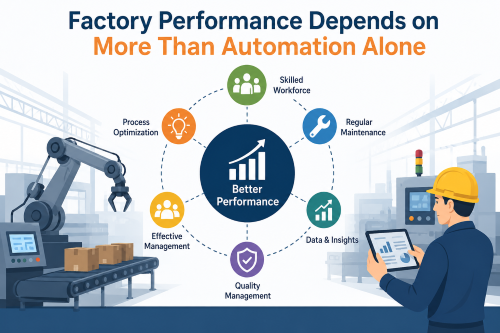
The factories that consistently outperform their competitors understand that technology is only one part of a much larger system. Workforce expertise, process engineering, environmental control, maintenance strategy, and workplace safety all influence whether automated equipment achieves its full potential. Sustainable productivity comes from designing every aspect of the production environment to work together.
Automation Is Only as Good as the Process Behind It
It’s tempting to think of automation as a shortcut to higher productivity, but automated equipment simply executes the process it’s given. If workflows are inefficient, production bottlenecks exist, or materials arrive inconsistently, automation can amplify those problems rather than eliminate them.
Before investing in new equipment, manufacturers should carefully evaluate process flow, product movement, cycle times, and quality control. Lean manufacturing principles remain just as relevant in highly automated facilities because removing waste delivers benefits regardless of how sophisticated the machinery becomes.
Successful automation starts with designing efficient processes, not simply purchasing advanced equipment.
The Working Environment Directly Affects Productivity
Factory performance is often measured through metrics such as output, downtime, and reject rates, but the physical environment has a significant influence on all three. Airborne dust, welding fumes, oil mist, chemical vapours, excessive heat, and poor airflow can affect both employee wellbeing and equipment performance if left unmanaged.
Effective environmental engineering should therefore be viewed as part of the production system rather than a standalone health and safety requirement. Properly designed local exhaust ventilation captures contaminants at source, helping maintain cleaner working conditions while supporting operational efficiency. A bespoke LEV system design considers factors such as contaminant type, process layout, airflow requirements, ductwork, and discharge arrangements to ensure hazardous substances are effectively controlled for the specific manufacturing environment.
Skilled People Remain a Competitive Advantage
Even in highly automated facilities, people continue to make the decisions that determine long-term success. Engineers optimise production lines, maintenance teams diagnose complex faults, operators identify subtle process variations, and production managers balance efficiency with quality.
The most successful manufacturers invest continuously in workforce development rather than assuming automation reduces the need for skilled employees. Cross-functional knowledge allows teams to respond more quickly when production challenges arise, reducing downtime and improving overall resilience.
Technology performs tasks. People improve systems.
Preventive Maintenance Protects Productivity
Automated equipment represents a significant capital investment, making reliability essential. Unexpected failures can quickly erase any productivity gains by bringing entire production lines to a halt.
A comprehensive maintenance strategy combines scheduled servicing, condition monitoring, predictive analytics, and regular inspections to identify issues before they develop into costly failures. Rather than reacting to breakdowns, leading manufacturers increasingly focus on preventing them.
This proactive approach extends equipment lifespan while improving production planning, reducing unplanned interruptions, and helping manufacturers get the maximum return from their equipment investments.
Continuous Improvement Never Stops
Perhaps the biggest difference between average factories and exceptional ones is their attitude towards improvement. High-performing organisations rarely assume a process has reached its optimum state. Instead, they encourage regular reviews, employee feedback, process audits, and incremental changes that accumulate over time.
Continuous improvement doesn’t always require major investment. Small adjustments to layouts, workflows, maintenance schedules, training, or environmental controls can collectively deliver significant gains in productivity and reliability.
Factories that maintain a culture of learning are typically better equipped to adapt to changing customer expectations, evolving regulations, and new technologies.
Conclusion
Automation has undoubtedly reshaped modern manufacturing, but it is only one component of a successful production strategy. Lasting factory performance depends on integrating advanced technology with skilled people, efficient processes, preventative maintenance, environmental engineering, and a commitment to continuous improvement. Manufacturers that recognise these interdependencies build facilities that are not only more productive, but also safer, more resilient, and better positioned for long-term growth. Rather than viewing automation as the complete solution, they understand that operational excellence comes from designing every element of the factory to work together.