

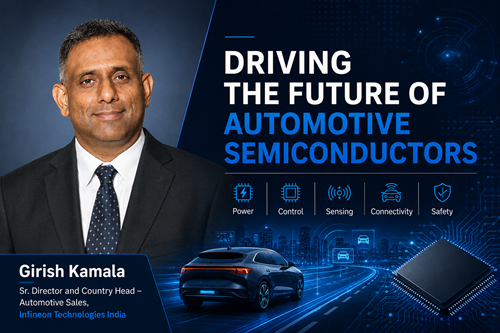
As the automotive industry accelerates toward electrification, software-defined vehicles, and AI-powered mobility, Automotive semiconductor innovation has become the backbone of next-generation transportation.
In this exclusive interaction with Infineon Technologies, Mr. Girish Kamala, Sr. Director and Country Head – Automotive Sales, shares how the company is maintaining its leadership in automotive semiconductors, adapting to regional market demands, and preparing for the future of Edge AI, ADAS, and autonomous driving. From power semiconductors to AI-enabled microcontrollers, he explains the technologies shaping tomorrow’s vehicles.
Infineon has held the top position in automotive semiconductors for six consecutive years—what are the core factors behind this sustained leadership? Which specific product segments have contributed the most to your number one position?
Girish Kamala: Infineon’s leadership in automotive semiconductors is the result of a very deliberate, long‑term strategy. We have consistently invested in the three pillars that matter most to automotive customers—power semiconductors, microcontrollers, and sensors—and, importantly, how these work together at a system level.
Our strength does not come from one product line alone. It comes from our ability to combine power, control, sensing, connectivity, and safety into scalable automotive platforms. This is particularly important as vehicles move toward software‑defined architectures.
Even in a challenging environment for high‑voltage e‑mobility, we continue to outperform key competitors. That tells us our customers value long‑term reliability, system expertise, and technology roadmaps that align with where the industry is going.
Infineon has made key acquisitions including that of Cypress Semiconductors, GAN Systems, Marvell’s automotive Ethernet business to name a few that are very well aligned for our long-term growth and completement our existing portfolio.
Our unmatched product quality and reliability, long-term supply commitments and a strong commitment to scale and maturity of our processes with customers needs in mind have helped us retain our leadership position in the automotive semiconductor market.
What major differences do you observe between markets where Infineon holds the number one position versus other regions? Do customer expectations or adoption of technologies like EVs and ADAS differ significantly between these regions?
Girish Kamala: Infineon is very successful in all major automotive regions of the world, holding either the number one or the number two position. However, what we see very clearly is that automotive markets evolve at different speeds, and customer expectations differ accordingly. In more mature automotive markets, adoption of software‑defined vehicles, advanced ADAS, and electrification is happening faster.
In growth markets like India, the opportunity is enormous, but the requirements are different. Customers here focus strongly on robustness, cost efficiency, and solutions that are tailored to local operating conditions. That’s why ecosystem partnerships, local application development, and close customer collaboration are so critical for us.
We don’t take a one‑size‑fits‑all approach. Our strategy is to bring the same global technology leadership but adapt solutions to regional needs—whether that is EV powertrain solutions, motor control, or ADAS deployment.
Regions where Infineon is strongest typically have higher semiconductor content per vehicle and customer requirements that favour proven quality, functional safety, and long-term supply stability. This is most visible where electrification is advanced and power electronics content is high. This includes markets with higher penetration of HEV/PHEV/BEV and 48V systems, that have requirements for high-value power semiconductors (MOSFET/IGBT/SiC), power modules, and gate drivers. In more ICE-heavy or price sensitive markets like India, the demand is skewed more towards low-voltage and PD products, where competition is stiffer and price pressure is higher.
ADAS adoption also differs from market to market. In US and Western Europe, there is a higher emphasis on safety cases, reliability, and controlled change management. Whereas, in China customers move faster on feature adoption and platform refresh, putting more weight on speed, integration, scaling, and local support.
Customer expectations vary by markets: priority for the advanced markets are automotive-grade qualification, traceability, and long lifecycle support. Faster-growth or more cost-driven regions tend to prioritize price, time-to-market, and localization.
These region/market specific requirements affect which technologies ramp first and how quickly OEMs shift to new vehicle electrical architectures. This can change the balance of opportunities across our wide portfolio.
With the rise of robotaxis and Level 4 autonomy, how is Infineon preparing its technology roadmap? What are the biggest semiconductor challenges in achieving fully autonomous driving at scale?
Girish Kamala: At Infineon, we look at autonomous driving as a step‑by‑step journey. Our focus today is on enabling software‑defined vehicles and advanced ADAS, which are the foundation for higher levels of automation.
From a semiconductor perspective, the key challenges are very clear: power efficiency for high compute loads, functional safety, reliability over the vehicle lifetime, and scalable system integration.
We actively collaborate with automotive ecosystems and institutions, including work around ADAS and automated emergency braking, to support both technology development and regulatory readiness.
Robotaxis would require at a minimum Level 4 ADAS and our products find a strong use case by strengthening the platform enablers around autonomous compute: high-efficiency power conversion and distribution, safety-capable control and supervision, secure hardware for fleet operation. In addition, our portfolio of robust connectivity/networking components are able to handle high data rates reliably in automotive environments, that gives us an edge over our competition.
Many companies are now combining MCUs with Neural Processing Units (NPUs)—what is Infineon’s take on this?
Girish Kamala: We clearly see AI algorithms are moving into the vehicle, and that’s why Infineon has extended its microcontroller portfolio with dedicated AI acceleration.
In our AURIX™ TC4x family, we have integrated an NPU in the form of a Parallel Processing Unit (PPU). This allows us to efficiently cover the majority of automotive AI use cases, while still meeting the stringent requirements around safety, determinism, and real time performance.
Our approach is very measured. In automotive, it’s not just about adding compute—it’s about integrating AI in a way that works reliably within a safety critical, real time system. By embedding AI acceleration directly into our MCU architecture, we enable customers to deploy AI without compromising functional safety or system robustness.
Edge AI is transforming the automotive industry—how is Infineon integrating AI capabilities into its semiconductor portfolio?
Girish Kamala : Edge AI is picking up very strongly in automotive, and we see this across a wide range of real, production level applications—such as rain sensing, car access systems, battery management state of charge estimation, power conversion, motor control, and many more.
Infineon’s microcontroller portfolio is designed to support this breadth of Edge AI use cases. We offer a wide range of AI performance possibilities, and importantly, all our MCU product families are AI-enabled—including PSoC™, TRAVEO™, and AURIX™.
What differentiates us is that we don’t treat AI as a standalone feature. We integrate AI capabilities together with power efficiency, sensing, connectivity, and automotive-grade safety. This system level approach allows our customers to deploy Edge AI exactly where it adds value—reliably, efficiently, and at scale.