

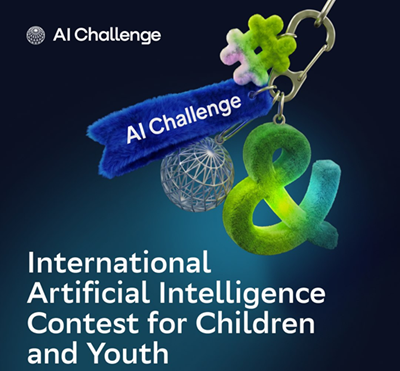
AI Competition for Students 2026 – The annual international artificial intelligence contest for children and young people (https://aiijc.com/en/?utm_source=india) has kicked off. It offers participants from Russia and other countries a chance to dive into the world of AI and sharpen their skills on real-world challenges from the tech business. The contest will appeal both to beginners and to confident AI users. Registration closes on 15 September 2026.
Contest assignments were formulated by Sber teams and partners, as well as by the AI Alliance companies. Participants will be able to test their skills in developing autonomous general-purpose AI agents for information security, image restoration systems, citizen request processing solutions, detecting hidden AI-powered image manipulations, and many other cutting-edge challenges.
Alexander Vedyakhin, First Deputy Chairman of the Executive Board of Sberbank:
“AI Challenge brings together talented and driven young people who will create new technologies and products and transform entire industries. Every year, we make the contest challenges even more difficult—and each time, the participants rise to the occasion. Dealing with real-world business cases helps school and university students grow rapidly as professionals, gaining the knowledge and skills needed to work at leading technology companies. AI Challenge is a springboard to the future—both for the participants and for Russia as a whole.”
Participants will compete in three categories.
- Beginners: an individual track for children aged 13 and under. Basic knowledge of Python programming and classical machine learning is required.
- School students: an individual and team track for participants aged 18 and under, including school students, graduates, and vocational school students. Contestants must be confident AI users and Python coders, versed in classical machine learning and familiar with deep learning basics.
- University students: an individual and team track for university and vocational school students up to the age of 25. Participation requires solid knowledge of AI and classical machine learning.
The contest will be held in three stages:
- Qualification (1 June – 15 September): individual challenges and team formation for the main stage
- Main stage (1 July – 17 September): problem solving individually or in teams
- Final stage (12 October – 26 October): more complex challenges and solution refinement into product prototypes.
The strongest participants will be awarded at the Artificial Intelligence Journey (AI Journey) international conference in Moscow. The prize pool is RUB 15.6 million. AI Challenge winners will have an opportunity to take part in an educational program to train the Russian national school team for the International Olympiad in Artificial Intelligence (IOAI) in 2027.
Many contestants have been taking part in the competition for several years and will compete again this year. Here is what the winners and finalists of AI Challenge 2025 recall about their participation.
Diana Komarova, School Students category:
“Winning AI Challenge was a life-changing event. The competition is unique— everything about it is special: the challenges, the environment, the vibe. You don’t feel nervous; instead, you feel calm and supported by the most sincere people. You see real opportunities and prospects for the future. I always looked forward to moving to the next stage so I could refine my solution as the assignment got harder. I remember leaving for competitions during the final stage, taking my laptop, and using every spare moment to work on the assignment. Participating in the contest taught me that you always have to go all the way, even if takes a long time to achieve anything. You have to squeeze out the maximum score with your last ounce of strength and keep pushing forward despite the fierce competition.”
Nika Smirnova, School Students category:
“AI Challenge has very interesting and singular assignments. You get plenty of time to find the solution, so you can try out different creative approaches. The task gets harder at each stage, so you have to keep leveling up your skills.”
Georgy Bogdanov, Beginners category:
“AI Challenge brings together two things I’m really passionate about: math and programming. I didn’t just want to solve a problem—I wanted to see how I think, whether I can find unconventional solutions. You get enough attempts and enough time to arrive at a great result through trial and error. You’re not just participating—you’re growing. The contest taught me how to pick a strong idea and see it through. I learned that in such competitions, the winner is the one who can manage their time, quickly discard weak approaches, and focus on what truly matters. Winning AI Challenge became my entry into serious, international‑level tech competitions and a clear path into the world of real artificial intelligence.”
Fyodor Stepin, Beginners category:
“Taking part in the contest gives you unique experience in solving unconditional problems, lets you test your abilities, compete, and connect with other participants. Unlike other olympiads, AI Challenge participants work on real‑world cases from major companies. The tasks span dozens of industries, from metallurgy and agriculture to fintech and generative art. I used to lack the skill to present my work from a technical perspective—I could only do it from a user’s point of view. This contest taught me how to do it.”
Ilya Paklin, Beginners category:
“The contest helped me feel the true spirit of competition—that desire to give it your all and keep up with others. It’s great that anyone who wants to can take part, not just those who get selected through some complicated criteria.”
In 2025, 10,000 school and university students from 75 countries took part in the competition, including Algeria, Uzbekistan, Kazakhstan, India, France, Germany, and others. In August 2025, the Russian national AI school team—trained by a joint team from Central University and the AI Alliance on the SberUniversity platform—won six gold medals and took first place at the IOAI in Beijing.