

World most powerful supercomputers – HPE builds supercomputers that empower its customers to push the limits of what’s possible in high performance computing (HPC). On the June 2026 TOP500, HPE-built systems have claimed 6 spots out of the top 10 list of the world’s fastest supercomputers and three of those are among the only five that are verified exascale supercomputers, and those are El Capitan at Lawrence Livermore National Laboratory, Frontier at Oak Ridge National Laboratory, and Aurora at Argonne National Laboratory. Having the greatest performance share on the TOP500, HPE designed and built systems that deliver more than 11.4 exaflops collectively. Additionally, HPE continues to excel on energy efficiency with 4 of the top 10 most energy-efficient supercomputers on the June 2026 Green500 list, showcasing HPE’s innovative direct liquid-cooling technology.
To enable such significant performance, HPE continuously develops advanced computing solutions, tailored for the era of converged artificial intelligence (AI), HPC and quantum computing. In support of this convergence, HPE introduced new supercomputing programming software to simplify customers’ experiences, and for the first time, the software is available to HPE ProLiant Compute servers, offering consistency across HPE systems. HPE also introduced multi-tenant capabilities within networking and storage for high-performance computing, creating one of the industry’s broadest portfolios of end-to-end supercomputing solutions for national labs’ sovereign AI research. Lastly, new financial services improve customers’ control, security and oversight in retiring their advanced, air-cooled computing infrastructure.
Demonstrated supercomputing performance empowers research and industrial applications
HPE designs, constructs and maintains large-scale infrastructure solutions that drive scientific breakthroughs, foster innovation, and enable enterprise transformation.
The TOP500 list names 6 HPE-built systems among the 10 most powerful supercomputers in the world, including:
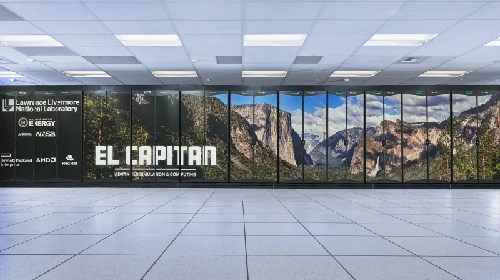
- No. 2 – El Capitan
Lawrence Livermore National Laboratory’s (LLNL) El Capitan at 1.809 exaflops is the world’s second fastest supercomputer. El Capitan also ranks No. 1 on the HPL-MxP benchmark that measures mixed-precision calculations typical in systems that run both traditional HPC and AI workloads. Funded by the National Nuclear Security Administration (NNSA) and dedicated to NNSA mission applications, El Capitan is built on the HPE Cray Supercomputing EX system, powered by AMD. The system enables new milestones in extreme-scale modeling and simulation, AI and emerging hybrid workflows. Recent work includes AI-enabled fusion target design studies using AI agents, the largest fluid dynamics simulation ever performed, and a 2025 ACM Gordon Bell Prize-winning real-time tsunami early-warning framework developed by LLNL, the University of Texas at Austin and UC San Diego. El Capitan is also supporting exploratory hybrid classical-quantum algorithm development for next-generation magnets. For all its might, El Capitan is also energy-efficient, ranking No. 28 on the Green500 list.
- No. 3 – Frontier
Built for Oak Ridge National Laboratory (ORNL) in collaboration with AMD, Frontier takes the No. 3 rank on the latest TOP500 list with a performance of 1.353 exaflops. Frontier also ranks No. 2 on the HPL-MxP benchmark. As the first verified exascale system in 2022, Frontier continues to utilize its year-over-year performance to drive advancements in nuclear-specific AI models, jet engine performance and turbulent fluctuations, and does so while maintaining energy-efficiency, which has earned it the No. 20 spot on the Green500 list.
- No. 4 – Aurora
Delivering 1.012 exaflops, the HPE-built and Intel-powered Aurora supercomputer at Argonne National Laboratory has proven performance with the No. 4 ranking. Aurora also ranks No. 3 on the HPL-MxP benchmark. The supercomputer empowers scientists with the ability of exascale speed to execute further scientific discovery, including greater understanding the plasma conditions to make fusion a practical energy source and testing whether dark energy may change over time, a possibility that could reshape the standard model of cosmology.
- No. 6 – HPC7
Premiering on the TOP500 list and boasting a processing capacity of 571.5 petaflops to take the No. 6 spot, HPC7 supercomputer is a highly advanced system developed specifically for industrial applications for major energy tech company, Eni. Ranking as the highest performing enterprise system on this year’s list, HPC7 is used, among other things, to optimize the operations of industrial facilities, improve the accuracy of geological and fluid dynamic studies for CO2 storage, and to develop higher-performance batteries. Eni’s HPC7 will also enable AI implementation and the development of domain-specific models for the energy sector.
- No. 8 – HPC6
Exhibiting 477.9 petaflops to take the No. 8 spot, HPC6 supercomputer is a highly advanced system for industrial applications used by Eni to improve the company’s operations.
- No. 10 – Alps
Built for the Swiss National Supercomputing Centre, Alps utilizes 434.9 petaflops to support large-scale high-performance computing and simulation workloads in fields such as health research, climate science, materials science and engineering. Alps also serves as the computational backbone of the Swiss AI Initiative, involving more than 1,200 researchers from institutions across Switzerland.
Making supercomputing more sustainable: 4 of the top 10 most energy-efficient supercomputers are HPE-built systems
With more than 50 years of leadership in advancing energy efficiency, HPE offers supercomputing customers 100% fanless, direct liquid-cooling systems architecture to help establish new energy efficiency benchmarks in the industry. The HPE-built systems among the top 10 of the Green500 list are:
- No. 4 – Isambard-AI: Built and managed by Bristol Centre for Supercomputing, a part of University of Bristol, Isambard-AI is the flagship compute for the UK Government’s AI Research Resource (AIRR), created to power the country’s cutting-edge AI development. The supercomputer utilizes HPE’s 100% fanless, direct liquid-cooling technology to deliver up to 90% reduction in cooling power consumption, contributing to a No. 2 ranking on the Green500 at its launch.
- No. 7 – SSC-24 Energy Module: Built for Samsung Electronics, this supercomputer is the most energy-efficient enterprise-owned system.
- No. 8 – Helios GPU: Created for the Academic Computer Centre Cyfronet AGH, Helios GPU remains Poland’s fastest supercomputer, ranked at No. 116 on the TOP500.
- No. 10 – Portage: A benchmarking system designed by HPE to evaluate real-world HPC and AI workloads for HPE and its clients, Portage is ranked No. 85 on the TOP500 list.
HPE-built DAEDALUS debuts as Greece’s fastest system
Built for the National Infrastructures for Research and Technology (GRNET S.A.), and in collaboration with the Ministry of Digital Governance and EuroHPC JU, the new supercomputer DAEDALUS entered the TOP500 list at No. 31 with 85.69 petaflops of performance, marking a historic milestone as the first Greek system of this magnitude included in the ranking and the fastest supercomputer in the country up to this day. The advanced system is the computing core of the AI Factory Pharos. It aims to boost research and innovation in the fields of AI, medicine, meteorology, big data analysis and the development of smart transport systems and more. The infrastructure focuses on sustainability by using renewable energy sources and advanced cooling systems that significantly reduce energy consumption, and as a result, is also featured in this year’s Green500 list, ranking No. 23.
For more information visit: https://www.hpe.com/.