

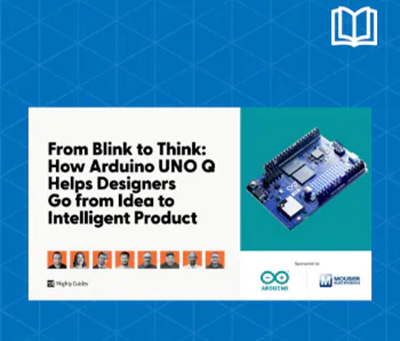
Arduino UNO Q Board – Mouser Electronics, Inc., the industry’s leading New Product Introduction (NPI) distributor with the widest selection of semiconductors and electronic components, today announces a new eBook in collaboration with Arduino – From Blink to Think: How Arduino UNO Q Helps Designers Go from Idea to Intelligent Product.
As embedded systems increasingly require AI inference, computer vision, advanced connectivity, and real-time data processing, engineering teams are often forced to choose between the simplicity of microcontroller development and the complexity of Linux-based edge computing platforms. This can create development bottlenecks that lead to significant hardware and software redesigns. The new eBook explores how developers can bridge this gap using the UNO Q platform, enabling a smoother transition from proof-of-concept designs to intelligent edge products.
The UNO Q combines a Linux-capable microprocessor with a dedicated real-time microcontroller in the familiar UNO form factor. This dual-brain architecture enables developers to implement AI workloads, computer vision, and advanced software applications while maintaining deterministic control of sensors, actuators, and other time-critical functions.
The eBook brings together perspectives from product leaders, embedded software developers, AI engineers, educators, and robotics specialists to examine the challenges of developing increasingly intelligent embedded systems and the tools available to simplify that process. Through interviews, technical discussions, and practical application scenarios, the eBook highlights how engineers can leverage the UNO Q platform, Arduino® App Lab environment, and Arduino® Bridge Library to combine a Debian Linux environment with real-time control. It also examines rapid AI prototyping, computer vision integration, and the transition from proof of concept to production.
Key topics covered in the eBook include:
- Designing intelligent systems using hybrid microprocessor/microcontroller architectures
- Integrating AI inference and computer vision into embedded designs
- Combining Python, C++, Debian Linux development workflows with Arduino App Lab
- Preserving existing Arduino codebases, shields, and development investments while scaling to more advanced systems
- Applying the UNO Q platform across maker, educational, and professional development environments
- Creating a practical pathway from proof of concept to production-ready products using the Arduino open-source hardware ecosystem
For more information visit: https://www.mouser.com.