

Modern vehicles are less mechanical and more digital than ever before—and Automotive Integrated Circuits (ICs) lie at the heart of that transformation. According to Dataintelo, from safety systems to infotainment, from electric powertrains to autonomous sensors, these chips have become indispensable. This data-driven article quantifies the trends, growth, costs, and market dynamics shaping Automotive ICs between 2020 and the early 2030s.
What Are Automotive ICs?
Automotive Integrated Circuits are semiconductor chips designed specifically for use in vehicles. They include microcontrollers, analog ICs, power management units, processors, and sensor interfaces that handle:
- Safety systems (e.g., ADAS)
- Powertrain and battery management
- In-vehicle networking (e.g., CAN, Ethernet)
- Infotainment and autonomous driving logic
ICs are distributed throughout modern vehicles and control hundreds to thousands of functions.
Key Statistics at a Glance
| Metric | Value & Year |
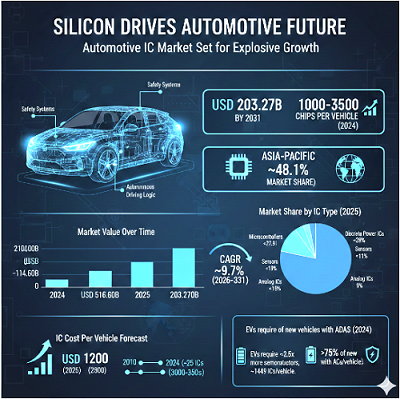
| Average semiconductor content per vehicle | 1,000–3,500 chips (2024) |
| Global Automotive IC market size | USD 59.03B (2024) |
| Automotive IC market (Mordor) | USD 116.60B (2025) |
| Projected market value by 2031 | USD 203.27B |
| CAGR (2026–2031) | ~9.7% |
| Asia-Pacific share (2024) | ~48.1% |
| EV share of automotive semiconductors | ~54% (2025) |
| EV IC count per vehicle | ~1,459 (2024) |
| IC cost per vehicle forecast | $600 → $1,200 by 2030 |
| ADAS feature penetration | >75% of vehicles (2024) |
| Microcontrollers market share | ~27.9% (2025) |
1. The Explosive Growth of Automotive IC Usage
Chip Count Per Vehicle
The average number of semiconductor chips per vehicle has surged:
- 2010: ~20–25 ICs per vehicle
- 2024: ~1,000–1,500 ICs per passenger car
- Luxury/Electric models: ~3,000–3,500 chips
Interpretation: Over roughly a decade, the IC count per vehicle has increased by ~60x to 150x, driven by electrification and advanced safety systems.
Electric Vehicles & Chips
Electric Vehicles (EVs) require ~2.5x more semiconductor content than traditional vehicles, with an average of ~1,459 ICs handling powertrain, battery, and control systems.
Because EV systems rely on complex power electronics, digital control, and connectivity modules, IC demand correlates directly with EV adoption rates.
2. Automotive IC Market Size & Forecast
Market Value Over Time
Multiple reputable sources point to rapid market expansion:
- USD ~47.8B (2024) projected by some analysts
- USD 59.03B (2024) estimated by IMARC
- USD 116.60B (2025) forecast by Mordor Intelligence
- USD 203.27B by 2031 (Mordor CAGR ~9.7%)
Compound annual growth ranges between ~8.5% to ~9.8% across different forecasts, emphasizing a sustained expansion through the early 2030s.
3. Regional and Segment Insights
Geographic Distribution (2025)
- Asia-Pacific: ~48.12% of global revenue
- North America: Significant but trailing Asia, driven by local EV and advanced electronics initiatives
- Europe: Strong niche usage in safety and luxury segments
The dominance of the Asia-Pacific region (nearly half the market) stems from integrated manufacturing, EV growth in China, and large auto production volumes.
Market Segmentation by IC Type (2025)
| IC Type | % Market Share (2025) |
| Microcontrollers | ~27.9% |
| Discrete Power ICs | ~28% (dominant in EV nodes) |
| Sensors | ~19% |
| Memory ICs | ~11% |
| Analog ICs | ~9% |
This breakdown shows that processor and power segments account for ~55% of revenue, reflecting heavy investment in computational and power management capabilities.
4. Cost Trends: Chips Per Vehicle
The average cost of semiconductor chips per vehicle is projected to nearly double—from USD 600 in 2025 to USD 1,200 by 2030.
This increase reflects:
- Higher IC complexity
- More safety and autonomous tech
- Greater connectivity demand
- Larger computational power requirements
Therefore, by 2030, chips could represent a significant portion of total vehicle electronics cost, especially in EVs and autonomy-enabled models.
5. Application-Level Data
ADAS & Safety
- >75% of new vehicles in major markets are equipped with ADAS systems that require sophisticated ICs (e.g., radar, vision processing).
- ADAS and safety ICs accounted for ~24% of overall automotive IC shipments in 2023, and penetration continues rising.
In-Vehicle Networking
- Network ICs (CAN, LIN, Ethernet) saw shipments to ~80 million vehicles in 2024, helping data flows among multiple controllers.
Powertrain, Battery & SoC
- Powertrain and battery management ICs experienced ~35% growth alongside EV sales.
- Leading automotive SoCs using advanced nodes (e.g., 3nm processes) began rolling out in late 2024.
6. Future Forecasts: Through the 2030s
| Timeframe | Forecast | CAGR |
| 2025–2031 | USD 127.93B → USD 203.27B | ~9.72% |
| 2025–2033 | USD 59.03B → USD 128.11B | ~8.54% |
While individual estimates vary, all projections consistently show market values nearly doubling by the early 2030s with CAGRs between ~8% and ~10%.
Risks Quantified
Supply Chain Sensitivity
Although demand remains strong, automotive chip demand has been volatile due to inventory mismatches and global supply chain risks. For example:
- Some automotive chipmakers forecast soft demand in early 2025, with automotive revenue down ~6% in certain segments.
Geographic Dependencies
- ~88% of automotive chips originate in East Asia, exposing global vehicle supply chains to regional disruptions (2025 data).
Conclusion: Numbers Driving Tomorrow’s Cars
The automotive world is transforming at quantitatively staggering rates:
- Chip content per vehicle has jumped from ~25 in 2010 to >1,000 by 2024.
- By 2031, the Automotive IC market may surpass USD 200 billion.
- Semiconductor cost per vehicle could double by 2030.
- The Asia-Pacific region accounts for nearly half of all global Automotive IC revenue.
These figures underscore one fact: Practical modern vehicles are powered more by silicon than steel. The next decade will see ICs drive performance, safety, autonomy, and user experience, while reshaping global supply chains and automotive economics.
Read A Full Report: https://dataintelo.com/report/global-automotive-ic-market