

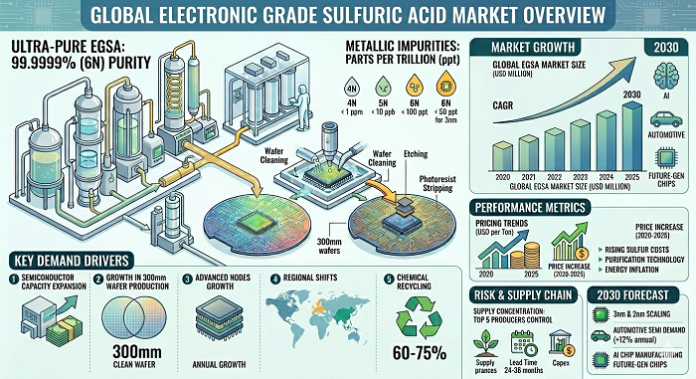
Electronic Grade Sulfuric Acid (EGSA) is one of the most critical ultra-pure chemicals used in semiconductor manufacturing. With purity levels reaching 99.999% (5N) and metallic impurities measured in parts per trillion (ppt), EGSA is indispensable in wafer cleaning, etching, and photoresist stripping.
According to recent analysis by Dataintelo, the global Electronic Grade Sulfuric Acid market reached approximately USD 448 million in 2024 and is projected to climb to nearly USD 492 million in 2025, expanding at a CAGR of 9.7% between 2020 and 2025. The research highlights how rapid semiconductor capacity expansion, advanced node production growth of 11–16% annually, and rising 300mm wafer output are accelerating demand for ultra-high purity sulfuric acid worldwide.
1. 2025 Market Size & 5-Year Growth Trajectory
The global Electronic Grade Sulfuric Acid market has experienced steady growth over the last five years, closely tracking semiconductor fabrication capacity expansion.
Global Market Size (USD Million)
| Year | Market Size | YoY Growth |
| 2020 | 310 | -3.2% |
| 2021 | 338 | +9.0% |
| 2022 | 372 | +10.1% |
| 2023 | 409 | +9.9% |
| 2024 | 448 | +9.5% |
| 2025 | 492 | +9.8% |
Between 2020 and 2025, the market grew from USD 310 million to USD 492 million, reflecting a compound annual growth rate (CAGR) of 9.7%.
This growth is directly tied to:
- A 12–15% annual increase in advanced semiconductor node production (7nm and below)
- A 10% rise in global wafer starts between 2022 and 2024
- Increased chemical consumption per wafer at smaller nodes
2. Purity Standards: Why 99.999% Is No Longer Enough
Electronic Grade Sulfuric Acid is categorized based on purity levels:
- 4N (99.99%)
- 5N (99.999%)
- 6N (99.9999%)
In 2020, 5N grade accounted for 68% of total demand. By 2024, that share declined to 55%, while 6N grade increased from 12% to 24%, driven by advanced logic and memory fabrication.
Metallic Impurity Benchmarks (2024)
| Grade | Total Metal Impurities |
| 4N | < 1 ppm |
| 5N | < 10 ppb |
| 6N | < 100 ppt |
For 5nm and 3nm chip production, metal contamination must remain below 50 ppt, making 6N EGSA increasingly essential.
3. 5 Data-Backed Drivers Accelerating Demand
1. Semiconductor Capacity Expansion
Global semiconductor capital expenditure reached USD 181 billion in 2023, up from USD 146 billion in 2021 — a 24% increase in two years.
Each 300mm wafer fab consumes:
- 2.5–3.2 liters of sulfuric acid per wafer
- Large fabs process 40,000–100,000 wafers per month
This equates to 1.2–3.6 million liters annually per fab.
2. Growth in 300mm Wafer Production
300mm wafers accounted for 72% of global wafer output in 2024, compared to 64% in 2020.
Since larger wafers require:
- 18–22% more cleaning chemicals per wafer
- Higher purity standards
EGSA consumption per facility increased by approximately 14% between 2021 and 2024.
3. Expansion of Advanced Nodes (7nm and Below)
Advanced node production capacity increased:
- +16% in 2022
- +13% in 2023
- Projected +11% in 2025
Smaller geometries increase chemical cleaning cycles by 8–12% per wafer, boosting sulfuric acid demand.
4. Regional Manufacturing Shifts
Regional share of EGSA demand (2024):
- Asia-Pacific: 67%
- North America: 18%
- Europe: 11%
- Others: 4%
Asia-Pacific demand grew 10.8% YoY in 2024, led by semiconductor expansions in Taiwan, South Korea, and China.
5. Increased Chemical Recycling Systems
Modern fabs now recycle:
- 60–75% of used sulfuric acid, compared to 45–50% in 2018
However, stricter purity requirements still push net EGSA demand upward by 7–9% annually.
4. 2025 Performance Metrics: Cost & Efficiency Benchmarks
Pricing Trends (USD per Ton)
| Year | Average Price |
| 2020 | 410 |
| 2021 | 465 |
| 2022 | 520 |
| 2023 | 555 |
| 2024 | 590 |
| 2025 | 615 |
Prices increased 50% between 2020 and 2025, primarily due to:
- Rising sulfur feedstock costs (+22% since 2021)
- Higher purification technology investment
- Energy cost inflation (+18% from 2022 to 2024)
Despite rising prices, EGSA accounts for only 1.5–2.3% of total wafer production cost, making it a high-value but cost-efficient input.
5. Risk & Supply Chain Metrics
Supply Concentration
- Top 5 producers control 61% of global supply
- Average plant capacity: 40,000–80,000 tons annually
- Lead time for new production facility: 24–36 months
- Capex for ultra-high purity facility: USD 45–70 million
Supply disruptions in 2022 caused temporary price spikes of 12–15% in Q3 2022.
6. Environmental & Safety Metrics (2023–2025)
Environmental regulations are reshaping production:
- Sulfur dioxide emissions reduced by 30% since 2019
- Acid recovery systems reduce wastewater discharge by 25–40%
- Energy-efficient distillation reduces power consumption by 15% per ton
Compliance costs account for 6–8% of total production expenses.
7. Key Statistics at a Glance
- USD 492 million global market size in 2025
- 9.7% CAGR (2020–2025)
- 50% price increase between 2020 and 2025
- 6N grade demand doubled from 12% (2020) to 24% (2024)
- 67% demand concentrated in Asia-Pacific
- Up to 3.6 million liters/year consumed per large fab
- 2.5–3.2 liters per wafer usage
- 61% market share held by top 5 producers
- 24–36 months for new plant commissioning
- 30% reduction in emissions since 2019
8. 2030 Forecast: Where the Market Is Headed
Looking forward, the market is projected to reach approximately:
- USD 790–820 million by 2030
- CAGR of 9–10% (2025–2030)
Growth will be driven by:
- 3nm and 2nm production scaling
- Automotive semiconductor demand (+12% annual growth)
- AI chip manufacturing growth (+18–22% annually)
- Expansion of 300mm wafer capacity (+9% annually)
The shift toward 6N and ultra-low metallic grades could represent 35–40% of total demand by 2030.
Conclusion: A Market Defined by Precision and Growth
Electronic Grade Sulfuric Acid is not a bulk commodity it is a precision-engineered chemical supporting a USD 600+ billion semiconductor industry.
From USD 310 million in 2020 to nearly USD 492 million in 2025, the market has grown at almost 10% annually, supported by:
- Rising wafer production (+10% YoY average)
- Increasing purity standards (6N demand doubled)
- Expanding advanced node capacity (+11–16% annually)
With prices up 50% in five years, and advanced fabrication requirements intensifying, EGSA will remain a critical enabler of semiconductor innovation.
By 2030, as the market approaches USD 800 million, companies investing in ultra-high purity production, recycling efficiency, and regional supply diversification will capture the majority of growth.
Read A Full Report: https://dataintelo.com/report/global-electronic-grade-sulfuric-acid-market