

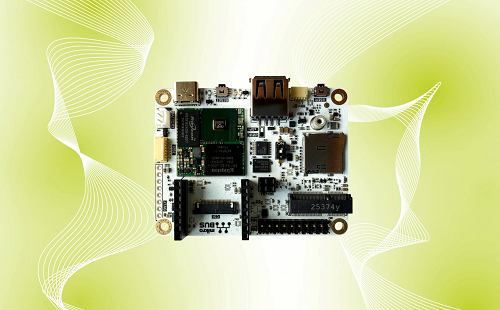
Grinn, a leading specialist in embedded systems and IoT design, is proud to announce its role in the hardware design and development of the new, limited-edition Synaptics Coral Dev Board, architected to bring AI-accelerated, multimodal applications to life.
The Synaptics Coral Dev Board is purpose-built to run advanced Edge AI applications across wearables, hearables, robotics, and smart home appliances and hubs.
Feature highlights:
- Compute: Synaptics Astra SL2619 SoC featuring a 1 TOPS NPU for efficient on-device inference.
- Memory: 2GB DDR4 with MicroSD support for mass storage.
- Vision & Audio: Dedicated MIPI CSI (Camera) and DSI (Display) interfaces, I2S2/I2S3 digital audio I/O.
- Extensibility: A rich suite of connectors including a mikroBUS header, Qwiic Connect System, and an M.2 expansion slot for Wi-Fi/Bluetooth connectivity.
- Production-Ready: All user connectors are positioned on a single side to facilitate easy enclosure integration, and the board features dedicated shunt resistors for precise power measurement of Edge AI workloads.
The Synaptics Coral Dev Board integrates the production-grade Grinn AstraSOM-261x system-on-module. Developers can design and validate their applications on the Synaptics Coral Dev Board and move to production by easily integrating the Grinn AstraSOM-261x into the final product. This architectural continuity significantly reduces engineering risk and shortens time to market.
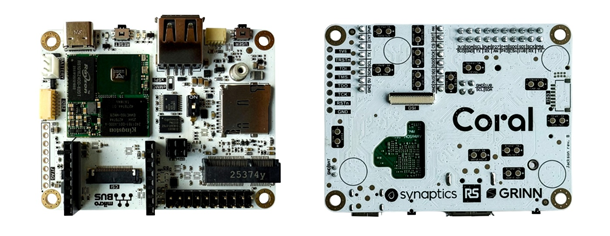
The Coral Dev Board supports Synaptics Torq Edge AI software platform, which hosts the industry’s first implementation of the Coral NPU by Google Research. The tiered inferencing architecture allows the hardware to handle diverse Edge AI workloads—from traditional computer vision to modern generative tasks—with extreme power efficiency.
The Torq toolchain uses the MLIR-based open-source framework, providing a unified development experience from model optimization to deployment. When coupled with Gemma, Google’s open-source model family for the Edge, the combined hardware and software stack offers a powerful, open foundation for building efficient, transformer-capable Edge AI applications.
“While developing the hardware for this project, we focused on keeping it compact, while integrating all the essential interfaces developers need to prototype, test, and build Edge AI solutions. This is AI-first hardware designed from the silicon up to handle complex multimodal tasks within power-constrained environments,” said Robert Otreba, CEO of Grinn Global. “With the Astra SL261x, we were able to rapidly build a developer-ready platform that balances performance, power efficiency, and openness. Combined with the Google Research collaboration, this partnership delivers a truly compelling foundation for Edge AI innovation.” You can see the Synaptics Coral Dev Board in action at Synaptics’ (Hall 4A | #259) and Grinn’s booth (Hall 4 | #260) at Embedded World 2026.