


EEPROM is a mature NVM technology with important properties for today’s cutting-edge applications. Sylvain Fidelis, Multi-market Business Line Director, Connected Security at STMicroelectronics, the world’s largest supplier of EEPROM ICs and a leading innovator of products and processes, explains the core strengths of the technology and why it’s the memory of choice for engineers now and into the future.
With almost 40 years since its first product development, EEPROM remains the designer’s preferred non-volatile memory (NVM) in many new designs. Chosen in applications that demand byte-level granularity, high power efficiency, extended read/write cycle life, and long data retention, EEPROM is easy to use and brings great flexibility and scalability.
Moreover, recent innovations such as Unique ID (UID) EEPROM and Page EEPROM enhance support for current design trends such as AI edge processing, brand protection, and sustainability.
In general, EEPROM manufacturers continue to advance the technology and refine the production processes, continually increasing storage density, read/write performance, and power efficiency, as well as quality and reliability.
Key Strengths and Applications
Today’s designers can choose from a rich selection of NVM types that offer diverse strengths. These include the high speed of discrete serial NOR Flash, bill-of-materials savings thanks to embedded Flash in microcontrollers, and the very fast writing of FRAM (ferroelectric RAM).
On the other hand, EEPROM’s byte-write granularity is a key characteristic that stands out in comparison with these alternatives, ensuring superior performance for tasks such as data logging. In smartphones, where designers face extreme space constraints and EEPROM emulation in embedded Flash appears the best for storing data and parameters, this granularity secures EEPROM’s place on the board. In addition, low power consumption meets the needs of battery-operated applications like smart sensors, smartwatches, smartphones, health and fitness trackers, and other wearables.
Additionally, by offering extended read/write cycle life and long data retention, EEPROM delivers the extreme reliability needed to fulfill datalogging needs in automotive applications. Typical uses include storing important parameters for the application to use and recording digitalized information from multiple sensing channels in automated driving systems. With data retention of 100 years or more, EEPROM can easily guarantee performance throughout the lifetime of the vehicle.
Designers also appreciate the flexibility that EEPROM allows during system development. Memory requirements can be difficult to predict when the project starts and are usually expected to increase significantly as the design progresses. Serial EEPROMs of various densities can share a common package type and pinout, which lets storage scale easily by choosing a device of higher capacity without changing the board layout. Manufacturers offer ICs of various densities, from low-cost 1Kbit devices to 4-Mbit, and more in popular 8-pin surface-mount SO-8 and various other packages. Finalizing a design for production is barely more complicated than sending instructions to the purchasing department.
Two important recent developments show how EEPROM is adapting with the priorities of the modern world, particularly the demands of edge AI applications, protection for brands and consumers against product counterfeiting, and sustainability concerns that highlight the virtues of repairable electronics.
Page EEPROM: breaking the glass ceiling of data storage
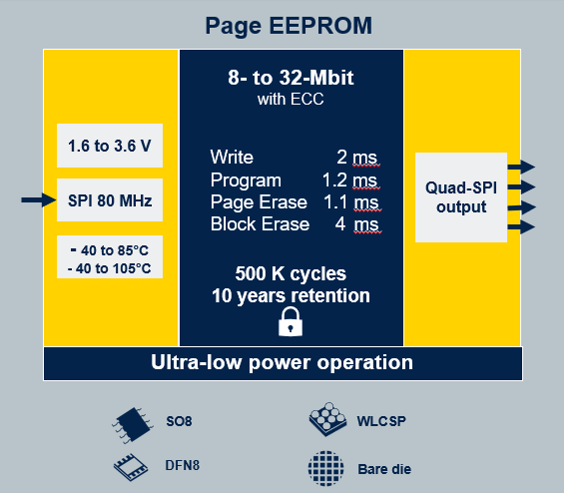
Over the past 40 years, the amount of data stored in our customer applications has relentlessly and consistently increased, the users of electronic devices having a growing appetite for more data and for more accurate product settings. In the 2000s using an EEPROM above 256-Kbit looked unthinkable, as did using a 2-Mbit in the early 2020ss. The value proposition of Serial EEPROMs is that developers need only allocate a small 8-pin package to data storage in their application and then have the flexibility to select any memory density.
By introducing Page EEPROMs, ST has broken the glass ceiling by being able to fit up to 32-Mbit of reliable data storage in a small 8-pin package.
Page EEPROM is an innovation by STMicroelectronics. It primarily targets applications that need the storage capacity and speed of Flash – particularly its ability to handle over-the-air (OTA) firmware updates quickly and efficiently – with EEPROM’s power efficiency and durability. Suited for smart meters, which demand extremely low power, byte-level data logging, and small size, it’s also just right for data-hungry edge-AI devices. Typical applications here include industrial sensors for applications such as asset tracking and intelligent condition monitoring, e-bikes, and healthcare devices. Some of the first applications for this novel hybrid memory were in behind-the-ear hearing aids and GPS trackers.
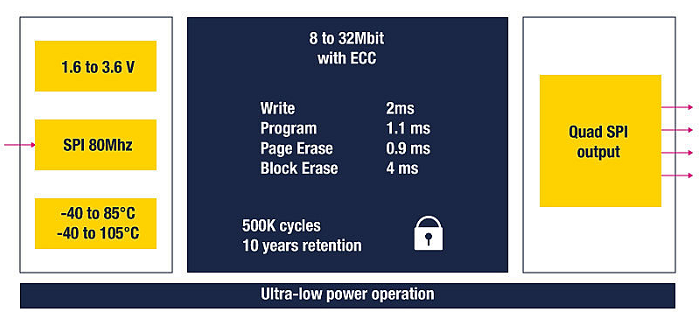
When introduced in 2024, Page EEPROM was available with storage densities of 8 Mbits,
16 Mbits, and 32 Mbits. The devices support byte-level write operations, which makes them perfect for data logging, while page/sector/block erase and page programming facilitate Over The Air (OTA) firmware management. In addition, buffer loading optimizes initial programming.
The data-read speed, at 320 Mbit/s, is faster than standard EEPROM and comparable with serial NOR Flash. On the other hand, write-cycle endurance of 500,000 cycles is several times higher than conventional serial Flash and data retention is 100 years. Also, the overall demand on the battery can be 10 times lower. While write current is at the same level as many conventional EEPROMs, there is also a deep power-down mode with fast wakeup that reduces the current to below 1 µA.
A further, novel feature of these devices is the peak-current control that restricts the maximum consumption to below 3 mA. This effectively stabilizes the power consumption and minimizes power supply noise, while in principle allowing smaller batteries and longer runtimes.
UID EEPROM
Unique ID EEPROMs contain a 128-bit read-only unique identity (UID) that’s pre-programmed when the device is manufactured and then permanently locked. Since the ID cannot be changed, OEMs can use this feature like an entry-level secure element to provide basic product identification and clone detection. The UID also permits traceability which, in turn, allows accurate product-reliability analysis and can simplify re-use and repair of equipment to support sustainability goals.
The UID is provided in addition to conventional EEPROM user-memory space, with up to 2-Mbit available for parameter storage and data logging. Reliability is assured, with write endurance of four million cycles and data retention of 200 years, and power consumption is extremely low. The devices also support I2C communication up to 1MHz fast-mode plus and allow random and sequential read modes while providing a write-protect mode for the entire memory array.
The Position Today
The overall global market is valued at about $800 million annually. STMicroelectronics began producing EEPROM ICs in 1987 and is currently the world’s largest supplier; a position held since 2005. In total, the Company has shipped about 44 billion devices to date and has a portfolio that contains over 400 different part numbers including UID and Page EEPROM ICs. The many different variants offer the widest portfolio of storage density and package options, performance parameters, and temperature grades on the market, as well as support for standard operating voltages from 1.2V to 5V, supporting high-volume trends.
All devices benefit from ST’s product longevity program, which ensures availability of commercial- and industrial-grade EEPROMs for 10 years, and 15 years for automotive-grade devices. The Company’s IDM (integrated device manufacturer) model gives control over all stages of the product lifecycle, including design, production, and marketing. Close in-house cooperation helps deliver reliable products more quickly and drives product and process development based on real customer feedback.
As EEPROM technology has evolved, the typical bit-cell area is now more than 500 times smaller than the first-generation architecture, while memory density has increased by 1,000 times on the same die size. Endurance is also greatly increased, with the toughest devices achieving 4 million cycles and ensuring zero-failure data retention.
The Memory of the Future
EEPROM continues to offer a strong value proposition, alongside Flash technologies and FRAM, in applications that need robust and reliable, high-performance NVM. While recent innovations bring important new capabilities, ongoing technological development further extends EEPROM’s underlying attributes. In today’s AI-centric, sustainability-conscious world, the latest EEPROMs are ready to meet the needs of engineers targeting new designs into the future.
More info at www.st.com/eeprom