

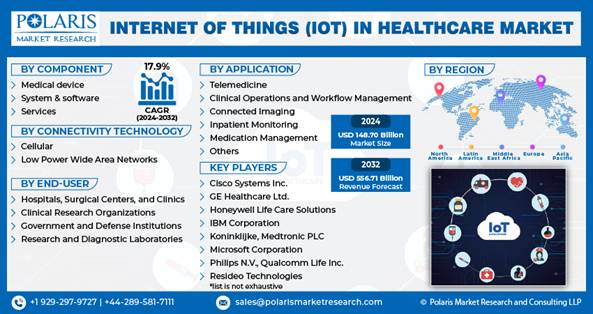
IoT in Healthcare Market Overview:
The global healthcare ecosystem is undergoing a transformative shift as connected technologies redefine patient care delivery. According to a recent analysis by Polaris Market Research, the Internet of Things (IoT) in Healthcare Market is projected to reach USD 556.71 billion by 2032, growing at a robust CAGR of 17.9% during the forecast period.
The Internet of Medical Things (IoMT) connects medical devices, software platforms, and healthcare infrastructure through smart sensors and wireless technologies. These connected solutions enable real-time data exchange between patients, physicians, and healthcare systems, enabling faster decision-making and improved patient outcomes.
Key Market Growth Drivers
1. Rising Demand for Remote Patient Monitoring
Healthcare providers are increasingly leveraging IoT-enabled monitoring devices to improve patient engagement and reduce hospital readmissions. Remote patient monitoring systems allow clinicians to track health conditions outside clinical settings, ensuring proactive medical intervention.
The rising incidence of chronic diseases and aging populations has significantly increased the need for continuous monitoring solutions that enhance patient safety and treatment efficiency.
2. Integration of Artificial Intelligence and Predictive Analytics
AI-powered IoT solutions are transforming healthcare diagnostics and decision-making capabilities. Connected medical devices collect large volumes of patient data, which can be analyzed using predictive algorithms to identify disease risks and treatment patterns.
AI-integrated IoT solutions help healthcare providers optimize workflows, reduce operational costs, and improve clinical accuracy.
3. Increasing Adoption of Smart Hospitals
Hospitals worldwide are adopting IoT-enabled infrastructure to streamline patient flow, manage medical equipment, and improve resource utilization. Smart hospital ecosystems integrate connected imaging systems, medication tracking solutions, and automated clinical workflows.
IoT applications such as connected imaging and workflow optimization are expected to drive significant revenue growth across healthcare institutions.
Market Segmentation Insights
By Component
Based on component, the medical devices segment dominates the market due to the growing adoption of connected diagnostic and monitoring tools. Software platforms and cloud-based healthcare systems are also witnessing rapid growth as healthcare organizations embrace digital transformation initiatives.
By Connectivity Technology
Cellular connectivity technologies account for a major share of the market, enabling seamless transmission of healthcare data across long distances. Advanced connectivity frameworks support real-time communication between devices and healthcare professionals.
By Application
Key applications driving market expansion include:
- Telemedicine
- Clinical workflow management
- Connected imaging
- Medication management
- Inpatient monitoring
Telemedicine remains a dominant segment due to increased adoption of virtual healthcare services worldwide.
By End User
Hospitals, clinics, and surgical centers represent the fastest-growing end-user segment due to increased demand for operational efficiency and improved patient outcomes. Research laboratories and clinical research organizations are also adopting IoT technologies to enhance data accuracy and research productivity.
Regional Analysis
North America accounted for the largest market share due to rapid adoption of telehealth platforms, advanced digital infrastructure, and increased investments in connected healthcare technologies. The presence of leading technology companies and strong regulatory frameworks further supports regional market growth.
Meanwhile, Asia-Pacific is anticipated to witness the fastest growth during the forecast period, driven by expanding healthcare infrastructure, increasing digitalization initiatives, and rising healthcare expenditure.
Competitive Landscape
The IoT healthcare ecosystem is highly competitive, with major technology providers focusing on strategic collaborations, product innovation, and mergers to strengthen market presence. Leading companies are investing heavily in AI-enabled platforms, cybersecurity solutions, and cloud-based healthcare technologies to enhance patient care delivery.
Continuous advancements in robotics, edge computing, and predictive analytics are expected to reshape the competitive landscape and unlock new revenue opportunities.
Challenges and Opportunities
Despite promising growth prospects, the market faces challenges related to cybersecurity risks, data privacy concerns, and interoperability issues. The increasing volume of sensitive patient data stored on connected platforms raises the need for robust security frameworks.
However, increasing government investments in digital healthcare infrastructure and supportive regulatory policies are expected to create significant growth opportunities for industry participants.
Future Outlook
The future of healthcare is increasingly connected, data-driven, and patient-centric. IoT technology is expected to play a crucial role in transforming healthcare delivery by enabling predictive diagnostics, personalized treatments, and real-time patient engagement.
As healthcare systems continue to embrace digital innovation, IoT solutions will remain at the forefront of improving clinical efficiency and patient outcomes globally.
For more information, visit https://www.polarismarketresearch.com/press-releases/internet-of-things-iot-in-healthcare-market