


Fujitsu Self-Evolving Multi-AI Agent Technology – Fujitsu Limited today announced the development of a self-evolving multi-AI agent technology(1) that enables multiple AI agents to perform tasks as a team, continuously and safely learning from daily execution results, human feedback, policy revisions, and specification changes.
In corporate operations, legal revisions, system changes, specification updates, and on-site rule modifications occur continuously. In business operations involving vast amounts of documents and design specifications, determining which information to reference, which judgment criteria to prioritize, and the extent of impact to confirm when responding to business needs has traditionally relied on the experience and tacit knowledge of skilled professionals. In addition, from a system perspective, continuous adjustments by experts were necessary to reflect changes in prompts, search methods, evaluation criteria, and operational rules.
While conventional AI agents demonstrate high processing capabilities for given instructions, they have found it difficult to independently analyze reasons for failure and safely incorporate them into subsequent operations. Consequently, adapting AI agents to the latest business environments required experts to continuously adjust prompts, search methods, evaluation criteria, and operational rules.
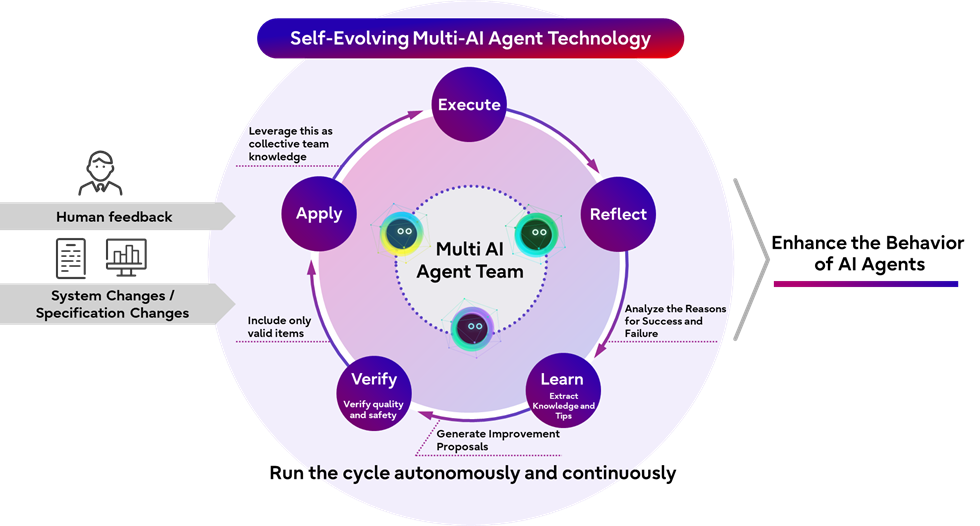
To address this challenge, Fujitsu has developed a technology that allows AI agents to safely learn by autonomously verifying their operational experience.
This technology is a multi-AI agent technology that continuously and safely evolves by adapting to changes in business environments and incorporating business execution results, human feedback, institutional revisions, and specification changes. Its most significant feature is that while performing tasks, AI agents identify reasons for success and failure, extract actionable knowledge and operational insights, and do not simply store generated improvement proposals. This allows AI agents to take over tasks such as prompt adjustments and evaluation criteria updates, which were previously performed continuously by experts. Furthermore, by deploying AI within the customer’s environment, it continuously adapts to individual rules and judgment criteria that arise during business operations, realizing a business foundation that evolves with people and the environment.
Fujitsu applied this newly developed technology to the following two areas and evaluated its accuracy:
1. Automated enhancement and continuous evolution of business-specific LLMs
This technology can be applied to the entire process of building business-specific LLMs. Multi-AI agents autonomously execute and optimize a series of steps such as data selection, adjustment of learning conditions, evaluation, and improvement, which were previously handled by experts. Each AI agent generates improvement proposals based on business execution results and evaluation results, and by verifying and reflecting only the effective ones, it continuously improves model performance. This significantly reduces the need for tasks previously performed by experts, realizing a mechanism where AI autonomously continues to evolve within business operations.
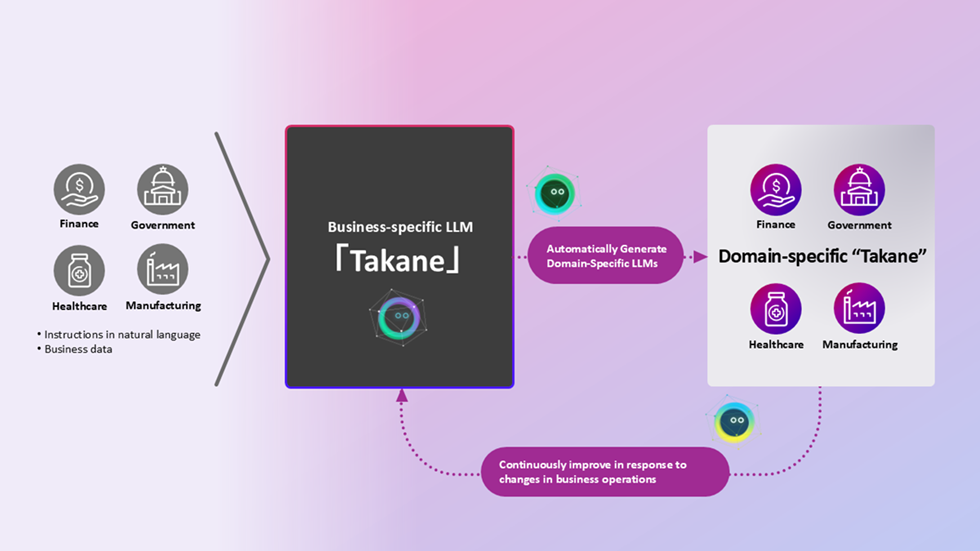
Fujitsu automatically enhanced “Takane” for multiple domains such as manufacturing, healthcare, finance, and public administration, and continuously improved it through operations. Through operational use, continuous improvements were implemented, resulting in a significant average accuracy improvement of 28 points compared to pre-specialization performance. In the medical field, for example, the application of this technology enables structured extraction of information tailored to specific business operations, such as extracting diagnostic names, progression stages, and treatment policies from unstructured data such as medical records and test results, in a consistent format. This not only improves the accuracy of responses but also demonstrates that multi-AI agents can automate the process of building and improving business-specific LLMs, which previously required design and adjustment based on specialized knowledge, and continuously optimize them through operations. This enables companies to build AI tailored to their own operations in a short period and continuously improve it in response to changes in operations, without heavily relying on AI specialists.

Furthermore, under the OneFujitsu initiative(2), Fujitsu has been promoting the global standardization of internal IT, data, and business processes. By globally applying this technology and the multi-AI agent platform equipped with “Takane,” Fujitsu is achieving autonomous business execution and accelerating management speed, thereby accelerating the transition to Data & AI-driven management.
2. Application to Design Specification Search in Large-Scale Business Systems
This technology was applied to AI agent-based document search for design specifications of Fujitsu’s electronic health record system for medium-to-large hospitals and business solutions for local governments. Traditionally, identifying the scope of impact for software modifications due to legal revisions or policy changes required skilled experts with deep knowledge of regulations, business processes, and system architecture. With this technology, AI agents now learn from past search results, failure cases, and human corrections. As a result, they autonomously improve search range expansion and document extraction strategies. This reduces the effort required for designing and improving search logic and also improves accuracy. This indicates that AI agents did not merely repeat searches, but learned and applied the exploration techniques used by skilled experts, such as checking related peripheral documents during operations and not excluding seemingly irrelevant documents if they belong to the same business domain. Going forward, Fujitsu will apply these insights and technologies to its AI-Driven Software Development Platform to further enhance and streamline the overall design and development process.
Future plans
Fujitsu plans to integrate this technology into its proprietary AI platform and offer it as a core technology to support the in-house development and autonomous operation of business-specific AI. Furthermore, as one of the advanced AI technologies within the Fujitsu Kozuchi AI platform, Fujitsu will promote its application to a wide range of areas requiring specialized knowledge and continuous improvement.
Additionally, by combining insights from joint research with Associate Professor Graham Neubig and Assistant Professor Tim Dettmers from Carnegie Mellon University and Fujitsu’s developed generative AI reconstruction technology, Fujitsu will advance the development of technology to operate self-evolving multi-AI agent systems with less memory and power. This aims to enable the use of AI teams that continuously learn from operations not only in cloud environments but also in highly confidential on-premises and edge environments.
Fujitsu aims to realize sovereign AI that can continuously learn not only in the cloud but also in on-premises and edge environments. Furthermore, by enabling AI to learn from on-site failures, human instructions, and environmental changes in real-time, and safely apply this knowledge to subsequent tasks, Fujitsu will evolve AI into an intelligent foundation that grows with the workplace. This will solve societal challenges such as the shortage of specialized personnel, adaptation to regulatory changes, succession of tribal knowledge, and advancement of on-site operations, thereby creating a future where people and AI learn from each other to evolve entire industries.
For more information visit: https://global.fujitsu/en-global