

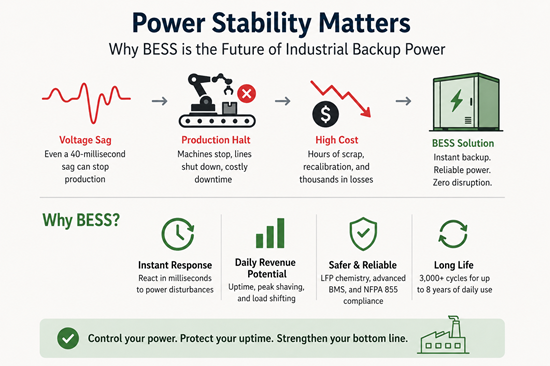
Grid instability can take you by surprise. You don’t realize it’s happening until a 40-millisecond voltage sag causes a programmable logic controller to crash, shuts down an automated assembly line, and renders three hours of product scrap. By the time a technician has the system back up and the line recalibrated, you’re out $10,000 – and it won’t even appear as a line on your power bill.
But this is the operational reality that much of the energy debate skips over. The grid is not stable enough for lean manufacturing, and the margin of error is getting smaller.
The disruption hiding in your power supply
While you notice long-lasting blackouts the most, they are not the most frequent type of power disruption. Short, momentary voltage sags or dips are behind a large portion of disruptions. Those are the events that cause robots, conveyors, and EOAT to stop on the factory floor. Where a momentary voltage sag or dip may occasionally just slow a motor or robot down, for a tightly synchronized, high-speed process it’s equivalent to a power outage.
Turning backup power into a daily revenue asset
Here’s a scenario where Return On Investment (ROI) suddenly makes a diesel generator feel like an outdated device from a past era, and battery energy storage (BESS) much more like the infrastructure project of the future that it is: if a generator needs to run for a few hours or a few days once or twice a year to get a facility back online, that’s probably a fair annual run for any assumed level of maintenance in the lifespan-calculation. Most large lithium-ion manufacturers are now offering warranties for 3,000 cycles or more – which means a well-managed BESS could do a partial charge and discharge every single day for eight years before crossing the cycle warranty threshold. Voila: ROI.
Engineers scoping a project at this scale need to compare hardware specs across manufacturers early in the planning process. Resources like https://bessbase.com allow procurement teams to evaluate commercial-scale systems side by side – comparing cell chemistry, usable capacity, cycle warranties, and thermal management configurations before the specification stage. For every industrial application in which BESS is configured for ‘four-quadrant operation’ – meaning that can charge/discharge and provide or absorb reactive power – there are three other potential revenue streams: uptime provisioning, peak shaving, and load shifting.
Why diesel generators don’t solve this
For decades, the standard backup response has been the diesel generator. It’s perfect if you need to power a facility through a sustained outage, keeping critical systems running for days or weeks on end. The thing is, that’s not the disruption profile most industrial facilities actually face.
Factories and storage facilities are well-constructed to keep the outside environment outside. Your process room is built to keep oxygen, or humidity, or dust, or particulate matter, or whatever else might be lurking in the ambient air, from disrupting whatever delicate alchemy you have going on in there. When there is a power failure and your air exchange goes down, it’s supposed to be the case that the power failure is the real disruption, and everything else in the external environment is more or less a known quantity. Except for the power flickering back on.
For that disruption – the voltage sag, switch, or spike – there simply is no time to bring a generator online. Not even a small home backup generator; they all take at least ten seconds to fire up and accept load, and it can easily be fifteen or more. That’s a full hardware iteration, up and down, for most industrial kit. A tenth of a second of disruption can equate to a great deal of downtime.
Selecting the right chemistry for an industrial environment
There are different levels of risk associated with battery systems but thermal runaway, a chain reaction that could result in a fire within a battery cell, is a risk in any stationary energy storage battery. The choice of battery chemistry matters.
For LFP, the dominant battery chemistry in industrial BESS, it is not about energy density but rather the thermal stability of the cells. LFP cells have a much higher thermal runaway threshold compared to nickel manganese cobalt (NMC) chemistry which makes a real difference when you are installing a multi-MWh system inside your plant or right next to it.
If you are an industrial customer, NFPA 855 compliance is non-negotiable for your battery installation. You can’t compromise on the battery management system providing active monitoring and cell-level protection with integrated fire suppression – that’s the baseline.
The levelized cost of storage metric – which is the total lifetime cost divided by the total energy throughout of the system – will help your procurement team objectively compare system economics across different battery chemistries and configurations without relying on the often misleading $/kWh numbers that vendors publish without considering cycle degradation.
The grid is only going to continue to get more unstable. The industrial plants that consider their power supply to be an asset they can control rather than an expendable utility bill are already exposed to less risk and have smaller operating budgets than those expecting the lights to go out.