

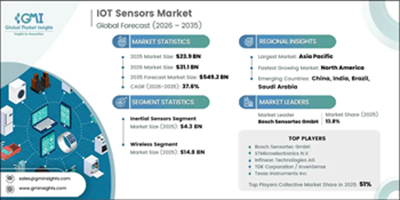
IoT Sensors Market – The global IoT sensors market was valued at USD 23.9 billion and is estimated to grow at a CAGR of 37.6% to reach USD 549.2 billion by 2035, according to the recent report by Global Market Insights Inc.
The IoT sensors market is witnessing exponential growth driven by the rapid acceleration of digital transformation across industries and the widespread integration of connected technologies. Increasing adoption of Industry 4.0 frameworks is transforming manufacturing environments into highly automated and data-driven ecosystems. Expanding smart city infrastructure projects are further boosting sensor deployment across transportation, utilities, and public safety systems. The growing use of predictive maintenance solutions is enabling enterprises to reduce operational downtime and improve asset efficiency.
Rising demand for connected healthcare applications is also strengthening market expansion by enabling real-time patient monitoring and remote diagnostics. The continuous increase in connected devices globally is reinforcing the importance of IoT sensors as a core enabling technology for real-time data collection, automation, and intelligent decision-making across industrial, commercial, and public sectors. Advancements in cloud computing, edge analytics, and artificial intelligence are further enhancing the functionality and scalability of IoT sensor networks, supporting their integration into complex digital ecosystems.
| Market Scope | |
| Start Year | 2025 |
| Forecast Year | 2026-2035 |
| Start Value | $23.9 Billion |
| Forecast Value | $549.2 Billion |
| CAGR | 37.6% |
The inertial sensors segment accounted for USD 4.3 billion in 2025, maintaining a strong position within the IoT sensors market. This segment includes accelerometers, gyroscopes, and magnetometers that are widely used across consumer electronics, industrial systems, automotive platforms, wearables, and drones. These sensors enable critical functions such as motion tracking, navigation, orientation detection, and asset monitoring. Growing adoption of MEMS-based inertial technologies in industrial automation and automotive systems continues to strengthen the segment’s market presence.
The wireless segment captured USD 14.8 billion in 2025. This dominance is supported by the rapid expansion of smart homes, industrial IoT ecosystems, connected healthcare devices, smart infrastructure projects, and wearable technologies. Wireless sensor systems offer cost efficiency, installation flexibility, and seamless integration with cloud and edge computing platforms. Increasing deployment of connectivity technologies such as Wi-Fi, Bluetooth Low Energy, Zigbee, LoRaWAN, NB-IoT, and 5G is further accelerating adoption across multiple application areas.
North America IoT sensors market held 25.5% share in 2025, driven by early adoption of industrial automation technologies and strong implementation of IoT-enabled solutions across key industries. The region benefits from significant investments in smart infrastructure and digital transformation initiatives across manufacturing, healthcare, transportation, and utilities. A strong ecosystem of semiconductor manufacturers, technology providers, and cloud service companies is further supporting regional growth and accelerating the adoption of advanced sensing technologies.
Major companies operating in the IoT sensors market include STMicroelectronics N.V., Bosch Sensortec GmbH, Texas Instruments Inc., Infineon Technologies AG, Analog Devices, Inc. (ADI), Murata Manufacturing Co., Ltd., TDK Corporation / InvenSense, ROHM Co., Ltd., Sensirion AG, Melexis NV, Vishay Intertechnology Inc., Panasonic Corporation, PixArt Imaging Inc., Seiko Epson Corporation, and MEMSIC Semiconductor Co., Ltd.
Companies operating in the IoT sensors market are strengthening their market position through continuous innovation in sensor miniaturization, energy efficiency, and multi-functional integration. Market participants are increasingly investing in MEMS technology advancements and next-generation sensing platforms to enhance accuracy, durability, and performance across diverse applications. Strategic partnerships with semiconductor firms, cloud service providers, and industrial automation companies are enabling faster integration of sensor data into advanced analytics ecosystems. Companies are also expanding production capacities to support rising demand from automotive, industrial, and consumer electronics sectors.
Source – https://www.gminsights.com/industry-analysis/iot-sensors-market