

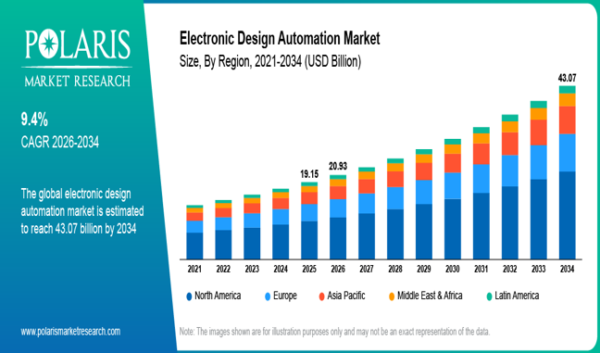
Electronic Design Automation Market – The global Electronic Design Automation (EDA) market is undergoing a structural transformation, with chip design complexity, AI integration, and surging semiconductor demand converging into one of the most compelling growth stories in the electronics sector. According to a comprehensive market study published by Polaris Market Research, the Electronic Design Automation market was valued at USD 20.93 Billion in 2026 and is projected to reach USD 43.07 billion by 2034, expanding at a robust CAGR of 9.4% over the forecast period of 2026–2034.
This landmark growth trajectory signals a fundamental shift in how the semiconductor and electronics industry approaches chip design, validation, and manufacturing — and positions EDA as a critical enabler of the next technology revolution.
What Is Electronic Design Automation — And Why Does It Matter Now?
Electronic Design Automation refers to a category of software tools used to design, simulate, verify, and manufacture complex electronic and semiconductor devices — from integrated circuits (ICs) and printed circuit boards (PCBs) to system-on-chip (SoC) architectures. As node sizes in semiconductor fabrication shrink to 5nm, 3nm, and beyond, the complexity of chip design has grown exponentially. Manual processes are no longer viable, making EDA tools mission-critical across every tier of the electronics ecosystem.
The acceleration of AI accelerator chips, ADAS automotive systems, 5G infrastructure buildouts, and high-performance computing platforms has dramatically expanded the scope of what chip designers must accomplish — and EDA tools are the foundational layer that makes it all possible.
Key Market Drivers Fueling EDA Growth Through 2034
Escalating Chip Complexity: As integrated circuits pack more transistors at smaller process nodes, the design challenge scales in every dimension — timing, power, signal integrity, and physical layout. EDA platforms offering simulation, synthesis, physical design, and sign-off capabilities are no longer a luxury — they are indispensable for achieving design closure and manufacturing yield.
AI-Powered Design Acceleration: Artificial intelligence is rapidly reshaping the EDA landscape itself. AI-driven EDA tools are being deployed to reduce manual design cycles, detect errors earlier in the development pipeline, and explore wider design-space possibilities with greater efficiency. The outcome: faster time-to-market and superior silicon quality. Leading vendors such as Keysight Technologies have already launched AI- and machine learning-enabled EDA suites to help engineers simplify complex RF device design.
Explosive Automotive Electronics Demand: The automotive sector is one of the fastest-growing end-use segments in the EDA market, fueled by the proliferation of electric vehicles (EVs), Advanced Driver Assistance Systems (ADAS), in-vehicle networking, and autonomous driving platforms. EDA tools play a pivotal role in designing and validating automotive-grade electronic control units (ECUs), power electronics, battery management systems, and motor controllers — all of which require extreme reliability and performance optimization.
Cloud-Based EDA Democratizing Access: The cloud-based EDA segment commanded a dominant 67.1% revenue share in 2025. Cloud-native EDA platforms eliminate the need for massive on-premises compute infrastructure, enabling geographically distributed design teams to collaborate seamlessly while scaling resources on demand. The pay-as-you-go model is particularly attractive for fabless startups and small-to-mid-sized semiconductor companies with capital constraints.
5G, IoT, and HPC as Structural Tailwinds: The global rollout of 5G networks, rapid IoT proliferation, and the insatiable compute demands of AI workloads and data centers are collectively driving unprecedented semiconductor R&D investment. Each new chip generation requires EDA tools to handle ever-greater design complexity, further anchoring EDA spend within semiconductor capital allocation.
For more information, visit @ https://www.polarismarketresearch.com/industry-analysis/electronic-design-automation-market
Segment Spotlight: Where the Opportunities Are Concentrated
Semiconductor IP — The Fastest-Growing Product Category: The Semiconductor Intellectual Property (IP) segment is projected to grow at a 9.8% CAGR through 2034. Pre-designed and pre-verified IP blocks — encompassing processor IPs, memory IPs, interface IPs, and application-specific cores — allow design teams to bypass the costly and time-intensive recreation of foundational components. This accelerates development timelines and reduces engineering risk, making semiconductor IP a cornerstone of modern chip development strategies.
Chiplet Architecture and 3D IC Integration: An emerging architectural paradigm is reshaping EDA requirements. The industry’s shift toward chiplet-based designs and 2.5D/3D IC integration introduces a new tier of complexity, requiring EDA tools capable of managing multi-die systems, thermal management, and inter-chiplet interconnect reliability. In June 2025, Siemens Digital Industries Software introduced purpose-built EDA tools — Innovator 3D IC and Calibre 3D Stress — specifically engineered for this emerging design paradigm.
Microprocessors & Microcontrollers: This application segment retains the largest revenue share, driven by voracious demand from consumer electronics, automotive, telecom, and industrial automation. As processors at 5nm and 3nm nodes become mainstream across smartphones, edge AI devices, and automotive SoCs, the EDA tools required to design and verify them become more sophisticated and indispensable.
Regional Landscape: North America Leads, Asia Pacific Accelerates
North America maintained its position as the dominant regional market in 2025, capturing over 49.80% of global revenue. The region benefits from a dense concentration of fabless semiconductor companies, EDA vendors, and government-backed initiatives including the U.S. CHIPS and Science Act, which is catalyzing fresh investment in domestic semiconductor manufacturing and, by extension, demand for EDA solutions.
Asia Pacific is the region to watch, projected to register the highest CAGR of 10.2% through 2034. The region’s semiconductor powerhouses — Taiwan, South Korea, Japan, and China — are investing heavily in advanced chip R&D. As these nations design more sophisticated chips for global markets, the demand for best-in-class EDA tools scales proportionally.
Competitive Landscape: Innovation at the Core
The EDA market is dominated by established technology leaders including Cadence Design Systems, Synopsys, Siemens EDA, Keysight Technologies, Ansys, and Altium, alongside a robust ecosystem of specialized vendors. Competition is intensifying around AI-driven capabilities, cloud-native platforms, and deep integration with leading semiconductor foundry processes. Vendors are increasingly forging strategic partnerships with foundries — as demonstrated by the Siemens-Intel Foundry collaboration announced in June 2024 to develop EDA certifications for embedded multi-die interconnect bridge technology.
The Bottom Line: EDA Is the Infrastructure Behind the Semiconductor Revolution
Every chip in your smartphone, every processor in a data center, every sensor in an autonomous vehicle begins its life in an EDA environment. As semiconductor design complexity continues to scale with Moore’s Law and beyond, the EDA market’s role as the backbone of electronic innovation becomes ever more entrenched.
Read More @ https://www.polarismarketresearch.com