

Industrial automation systems depend on thousands of interconnected components working together under demanding operating conditions. While programmable controllers and industrial networks often receive the most attention, the long-term reliability of a control system frequently depends on smaller devices such as relays and power supplies. Selecting these components carefully can significantly reduce unplanned downtime, maintenance costs, and operational risk throughout the equipment lifecycle.
Why Component Selection Matters More Than Ever
Even relatively inexpensive control components can determine whether an automated production line continues operating or experiences an unexpected shutdown. Relay failures may interrupt critical control signals, while unstable power supplies can affect PLCs, HMIs, sensors, communication modules, and other automation devices simultaneously.
Reliable operation is rarely achieved by selecting the highest-rated component available. Instead, long service life depends on matching electrical characteristics, environmental conditions, installation practices, and maintenance strategies to the actual application.
As manufacturers increasingly pursue continuous production and higher equipment availability, lifecycle-focused component selection has become an essential engineering practice rather than simply a procurement decision.
Understanding the Role of Relays and Power Supplies in Industrial Automation
Industrial relays: more than simple switches
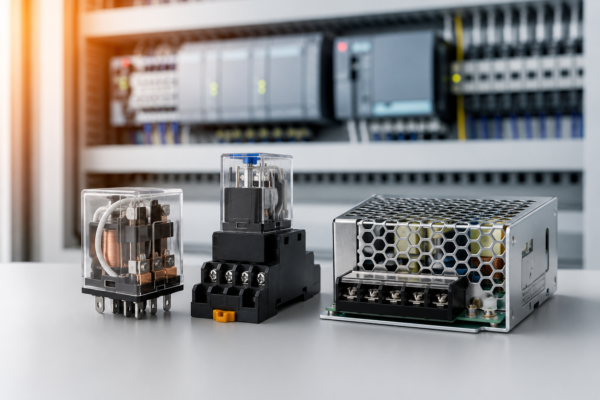
Industrial relays perform much more than basic switching functions. They provide electrical isolation between control circuits and field devices, enable signal switching, control electrical loads, support machine automation, and contribute to safety interlocking systems.
Depending on application requirements, engineers commonly select from several relay technologies, including electromechanical relays (EMR), solid-state relays (SSR), safety relays, interface relays, and time-delay relays.
Each relay type offers distinct advantages. Electromechanical relays provide excellent isolation and versatility, while solid-state relays offer silent operation, high switching speeds, and long electrical life because they contain no moving contacts.
Industrial power supplies: the foundation of stable control systems
Industrial power supplies convert incoming AC power into stable DC voltage required by modern automation equipment. They supply PLCs, sensors, HMIs, industrial communication devices, and numerous field components with consistent electrical power.
Beyond voltage conversion, quality power supplies help absorb input voltage fluctuations, maintain stable output during changing load conditions, and protect connected equipment through integrated overload and short-circuit protection. Stable power distribution contributes directly to overall system reliability.
Key Factors That Influence Long-Term Reliability
Component specifications provide only part of the reliability picture. Actual service life is largely determined by operating conditions throughout the equipment lifecycle.
Environmental conditions
Industrial environments expose components to varying levels of temperature, humidity, dust, vibration, and chemical contaminants. Elevated enclosure temperatures accelerate capacitor aging inside power supplies, while corrosive atmospheres may affect electrical contacts and terminal connections. Dust accumulation can also reduce cooling efficiency and increase operating temperatures.
Electrical loading
Electrical stress significantly influences component longevity. Engineers should carefully evaluate continuous versus intermittent loads, inrush currents during startup, switching frequencies, and potential overcurrent events. Additionally, understanding load characteristics—whether resistive, inductive, or capacitive—and accounting for voltage fluctuations are critical steps in mitigating premature wear.
Electromechanical relays gradually experience contact erosion, coil insulation aging, and mechanical fatigue as switching cycles accumulate. Solid-state relays eliminate mechanical wear but require effective thermal management because semiconductor devices generate heat during operation.
Installation quality
Even properly selected components may fail prematurely if installation practices are inadequate. Proper DIN rail mounting, sufficient enclosure ventilation, organized cable routing, secure terminal connections, and effective heat dissipation all contribute to long-term reliability.
How to Choose the Right Industrial Relay
Relay selection should be based on application requirements rather than catalog ratings alone. The following checklist provides a practical framework for evaluation.
- Verify the required control voltage.
- Select the appropriate contact configuration (SPST, SPDT, DPDT, etc.).
- Confirm the rated switching current.
- Match relay ratings to resistive, inductive, or capacitive loads.
- Evaluate expected switching frequency.
- Review electrical endurance specifications.
- Consider mechanical life expectancy.
- Verify required regional or industry certifications.
| Application | Recommended Relay Characteristics |
| Motor control | High switching capacity with inductive load rating |
| PLC output interface | Compact interface relay with low coil power consumption |
| Safety circuits | Certified safety relay |
| High-speed switching | Solid-state relay |
| HVAC control | General-purpose industrial relay |
When comparing relay specifications, engineers often review detailed industrial relays categories to compare contact ratings, coil voltages, mounting options, and environmental specifications before finalizing a design.
Selecting a Reliable Industrial Power Supply
Power supplies influence every device connected to the control cabinet. Proper selection requires evaluating electrical performance as well as future operational requirements.
Output capacity should include a safety margin
Operating continuously at or near 100% of rated output reduces thermal margin and may shorten component life. Many engineers reserve additional capacity to accommodate startup surges, temporary overloads, and future system expansion without replacing the power supply.
Look beyond wattage
Several performance specifications deserve equal attention during selection. Output voltage accuracy, conversion efficiency, and ripple/noise characteristics directly impact power quality.
Furthermore, robust protection mechanisms—such as overload, short-circuit, and overvoltage protection—combined with a wide input voltage range and sufficient hold-up time during input interruptions, provide a much more complete picture of operational reliability than output power alone.
Consider redundancy for critical applications
Systems with high availability requirements often incorporate redundant power architectures. Parallel redundancy modules, dual power supplies, UPS integration, and fault monitoring improve operational resilience by allowing production to continue despite a single component failure.
Common Mistakes That Reduce Component Lifespan
Oversizing or undersizing components
Components that are significantly oversized may operate inefficiently, while undersized devices experience excessive electrical stress. Proper sizing improves both performance and service life.
Ignoring ambient temperature ratings
High enclosure temperatures accelerate insulation aging, reduce capacitor life, and shorten the operating life of both relays and power supplies.
Selecting by price alone
Initial purchase cost represents only a portion of total ownership cost. Downtime, maintenance, replacement frequency, and operational reliability often have greater long-term financial impact.
Neglecting preventive maintenance
Routine visual inspections, terminal tightening, thermal imaging, and scheduled replacement of heavily cycled relays help identify developing problems before failures interrupt production.
Mixing incompatible components
Compatibility between PLC outputs, relay coil voltages, power supply output voltage, and connected field devices should always be verified before installation or replacement.
Reliability Standards and Certifications Worth Understanding
Compliance with recognized standards provides additional confidence regarding product performance and safety, although proper engineering design remains the primary determinant of system reliability.
| Standard | Why It Matters |
| IEC 60947 | Defines requirements for low-voltage switchgear and controlgear |
| IEC 61010 | Specifies safety requirements for electrical equipment |
| UL Listed | Demonstrates compliance with North American safety requirements |
| CE Marking | Indicates conformity with applicable European regulations |
| RoHS | Restricts hazardous substances used in electrical equipment |
The International Electrotechnical Commission (IEC) publishes globally recognized standards such as IEC 60947 and IEC 61010, while organizations including the National Electrical Manufacturers Association (NEMA) provide additional guidance for selecting and applying industrial electrical equipment. Engineers should always verify which standards apply to their specific region, industry, and application.
Lifecycle Planning Improves Long-Term Reliability
Selecting reliable components is only the beginning of an effective reliability strategy. Long-term performance also depends on structured lifecycle management.
Good engineering practice includes maintaining inventories of critical spare components, monitoring manufacturer lifecycle announcements, documenting installation dates, periodically evaluating equipment performance, and planning replacement before unexpected failures occur.
As part of preventive maintenance planning, many facilities periodically review compatible industrial power supplies to ensure suitable replacements remain available throughout the service life of the equipment. Industry resources such as Iainventory can also help maintenance teams monitor component availability as product lifecycles evolve.
Best Practices for Engineers and Maintenance Teams
- Select components based on actual operating conditions rather than nominal ratings alone.
- Design systems with appropriate electrical and thermal safety margins.
- Follow manufacturer installation recommendations carefully.
- Maintain accurate engineering documentation and maintenance records.
- Keep inventories of business-critical spare components.
- Verify compatibility before replacing relays or power supplies.
- Inspect relay contacts and monitor power supply performance periodically.
- Consider product lifecycle availability during the initial system design phase.
Conclusion
Reliable industrial automation begins with informed component selection. Relays and power supplies should be evaluated according to electrical requirements, environmental conditions, expected service life, maintenance strategy, and lifecycle availability rather than purchase price alone.
Applying sound engineering principles during specification, installation, and ongoing maintenance helps reduce unplanned downtime, extend equipment life, and lower the total cost of ownership. By viewing these foundational components as long-term assets instead of commodity items, engineers can build control systems that remain dependable throughout many years of industrial operation.