

Legacy PLCs Are Everywhere—And They’re Not Going Away Anytime Soon
Walk through almost any established manufacturing facility, and there is a good chance that programmable logic controllers (PLCs) installed 15 to 30 years ago are still running critical production equipment. While automation technology continues to advance, many production lines rely on hardware that has demonstrated stable operation over decades of continuous service.
For many manufacturers, replacing a functioning PLC is not simply a technology decision—it is an operational and financial one. Production systems are typically designed for long service lives, and automation hardware often outlasts several generations of business planning. As long as equipment continues to meet production requirements safely and reliably, modernization may offer limited practical benefits compared with the risks and costs involved.
This explains why legacy PLC hardware remains common across industries. Rather than replacing equipment solely because it is old, manufacturers increasingly focus on managing the lifecycle of existing assets while planning upgrades strategically.
What Makes a PLC “Legacy”?
Defining legacy automation equipment
In industrial automation, the term legacy does not automatically mean obsolete, unreliable, or unsuitable for production. Instead, it generally refers to equipment that remains operational but has reached a later stage in its product lifecycle.
Legacy PLC systems commonly exhibit one or more of the following characteristics:
- Discontinued product families
- End-of-life (EOL) announcements from the original manufacturer
- Limited or discontinued technical support
- Dependence on older industrial communication protocols
- Increasing difficulty obtaining genuine replacement parts
- Reduced availability of engineering expertise familiar with the platform
Organizations such as the International Society of Automation (ISA) emphasize that lifecycle management extends beyond equipment age and includes maintainability, supportability, and operational risk throughout an asset’s service life.
Common examples of legacy hardware still found in production
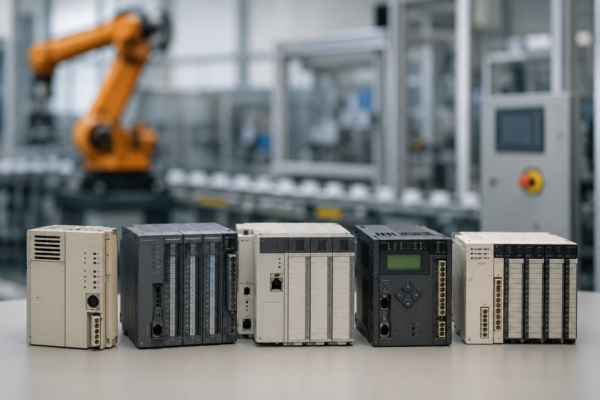
Many automation systems continue operating reliably despite their age. Frequently encountered legacy components include PLC CPUs, digital and analog I/O modules, communication processors, power supplies, HMIs, expansion racks, and specialty interface cards.
In many facilities, these components remain fully functional because they have operated within their intended environmental conditions and have been maintained consistently.
Why Manufacturers Continue Using Legacy PLC Systems
Although newer automation platforms offer increased processing power, networking capabilities, and cybersecurity features, replacing a mature control system is rarely a straightforward decision.
Proven reliability
Legacy PLCs often control production processes that have been validated over many years. Maintenance teams understand normal operating behavior, troubleshooting procedures are well established, and equipment performance is predictable. This accumulated operational knowledge represents significant value.
High cost of full system replacement
A complete PLC migration extends well beyond purchasing new hardware. Engineering redesign, software conversion, production downtime, operator training, validation activities, and regulatory compliance testing frequently account for a much larger share of project costs than the controllers themselves.
Process continuity
Industries such as food processing, pharmaceuticals, water treatment, oil and gas, and automotive manufacturing often cannot tolerate prolonged shutdowns. Planned production interruptions may require months of preparation, making incremental lifecycle management more practical than immediate replacement.
Existing infrastructure still meets operational requirements
Many facilities maintain stable production volumes using equipment that continues to satisfy quality, throughput, and safety requirements. If additional functionality offers little operational benefit, reliability may remain the higher priority.
The Real Challenge Isn’t Age—It’s Lifecycle Management
Hardware age alone rarely causes unexpected failures. Instead, operational risk increases because the surrounding support ecosystem gradually changes.
Common lifecycle challenges include:
- Component obsolescence
- Limited availability of spare parts
- Vendor discontinuation of product lines
- Loss of experienced engineering personnel
- Longer repair turnaround times
- Reduced access to compatible programming software
For this reason, many manufacturers now approach lifecycle planning as an ongoing engineering discipline rather than a reactive maintenance activity. The objective is not merely keeping equipment operational today, but reducing operational uncertainty over the coming years.
Strategies for Extending the Service Life of Legacy PLC Hardware
Maintain an accurate spare parts inventory
Effective spare parts management begins with identifying which automation components are business critical. Historical failure rates, production impact, equipment redundancy, and supplier lead times should all influence stocking decisions.
Proper environmental storage—including temperature control, humidity management, and electrostatic discharge protection—also helps preserve spare module reliability.
When planning long-term maintenance, many engineering teams establish qualified inventories of replacement PLC modules before critical components become difficult to source.
Monitor component health
Preventive inspection frequently identifies degradation long before complete failure occurs. Engineering teams should proactively monitor electrolytic capacitor aging, inspect power supplies for voltage stability, track enclosure temperatures, and routinely check cooling fans and wiring terminations.
These relatively simple maintenance activities often provide substantial improvements in long-term system reliability.
Standardize maintenance documentation
Comprehensive documentation reduces troubleshooting time and minimizes dependence on individual engineers.
Essential documentation should include:
- PLC backup programs
- Network architecture diagrams
- I/O allocation tables
- Firmware version records
- Configuration files
- Maintenance history
Source compatible replacement modules before emergencies occur
Waiting until a critical controller fails significantly limits procurement options. By qualifying compatible replacement modules in advance, maintenance teams can reduce downtime and avoid emergency purchasing decisions made under production pressure.
Repair, Refurbish, or Replace? Choosing the Right Strategy
| Option | Advantages | Limitations | Best Used When |
| Repair | Lowest immediate cost | Not always technically feasible | Minor failures with repairable components |
| Refurbished replacement | Often available quickly | Quality depends on refurbishment process | Obsolete equipment with limited new inventory |
| New replacement | Latest hardware and manufacturer support | Higher migration costs | Major upgrade projects |
| Full migration | Long-term platform support | Highest capital investment and engineering effort | Complete system redesign or expansion |
No single strategy fits every situation. Maintenance planners should evaluate downtime costs, spare part availability, remaining equipment life, regulatory requirements, and future production expansion before determining the most appropriate approach.
Supply Chain Challenges for End-of-Life Automation Components
Recent global supply chain disruptions have highlighted how procurement decisions increasingly influence equipment reliability. Semiconductor shortages, extended manufacturer lead times, discontinued product lines, counterfeit electronic components, and logistics uncertainty have all affected industrial maintenance planning.
Guidance from the U.S. National Institute of Standards and Technology (NIST) also recognizes supply chain risk management as an important element of operational resilience, particularly for industrial control systems where component authenticity and availability directly affect system reliability.
Industry observers tracking discontinued industrial automation parts frequently note that sourcing becomes significantly more difficult after manufacturers announce end-of-life status. Resources such as ChipsGate monitor component availability trends that maintenance teams may consider during long-term lifecycle planning rather than emergency procurement.
Best Practices for Building a Long-Term Legacy Hardware Strategy
- Classify automation assets according to business criticality.
- Monitor manufacturer lifecycle and end-of-life announcements.
- Review spare parts inventory annually.
- Verify compatibility before purchasing replacement components.
- Maintain accurate firmware and software version records.
- Develop phased modernization plans instead of emergency migrations.
- Evaluate refurbishment providers using documented quality processes.
- Train maintenance personnel on both legacy and modern automation platforms.
Organizations that plan proactively generally experience lower lifecycle costs than those responding only after unexpected equipment failures.
Conclusion
Legacy PLC hardware continues to power modern manufacturing because dependable performance, validated production processes, and long equipment lifecycles often outweigh the immediate benefits of modernization. In many facilities, the greater challenge is not the age of the controller but the management of its remaining service life.
Effective lifecycle management combines preventive maintenance, disciplined documentation, strategic spare parts planning, and informed sourcing practices to reduce operational risk. Rather than viewing legacy automation equipment as outdated technology, manufacturers can maximize its value by applying structured engineering practices that support reliable production while preparing thoughtfully for future modernization.