

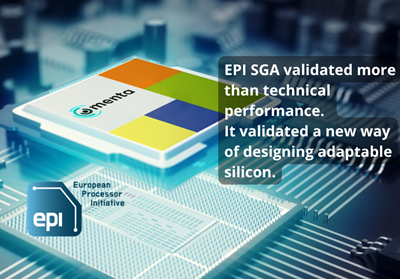
European Processor Initiative – Menta announces its contribution to the successful completion of the European Processor Initiative (EPI) SGA2, whose final review, held on July 1–2, 2026, in Luxembourg before the European Commission and the EuroHPC Joint Undertaking, concluded successfully.
As part of the Work Package dedicated to eFPGA technologies, Menta led several major developments aimed at advancing embedded programmability capabilities for future highperformance computing (HPC) architectures.
The project delivered several significant technical achievements.
Menta’s Origami Programmer design environment underwent a major optimization of its placement engine through a multi-threaded implementation. During the final review demonstration, this enhancement achieved a measured acceleration of more than 9× using an eight-thread configuration. Performance scales with both the design complexity and the selected threading configuration, reaching up to 18× acceleration on certain workloads.
In parallel, working alongside project partners specializing in post-quantum cryptography, Menta defined an eFPGA architecture targeting Post-Quantum Resistant Cryptography (PQRC) applications for HPC and completed its physical implementation on GlobalFoundries 22FDX+ technology. These developments extend the capabilities of Menta’s embedded FPGA platform toward new application domains, including high-performance computing and post-quantum security.
Presented before representatives of the European Commission, EuroHPC JU and leading industrial experts, Menta’s demonstrations generated extensive technical discussions and 2 received highly positive feedback, confirming both the relevance of the architectural choices and the maturity of the developments achieved throughout the project.
“The successful completion of EPI confirms that adaptability is becoming a fundamental capability of future computing architectures. Large collaborative programs play a key role in transforming ambitious concepts into practical technologies. At Menta, we contribute to this evolution by embedding programmability directly into silicon architectures, enabling systems to evolve throughout their operational lifetime,” said Vincent Markus, President & CEO of Menta.
Beyond the results achieved within EPI, these developments build upon Menta’s embedded FPGA technology already deployed across industrial applications, extending its capabilities toward HPC architectures and post-quantum cryptography.
The project also reinforces Menta’s long-term commitment to strategic semiconductor initiatives, including CHASSIS, MFC, MOSAICS, as well as programs supported by Horizon Europe and France 2030.
Through these collaborations, Menta continues to contribute to the next generation of adaptable silicon platforms serving industrial systems, mobility, aerospace & defense, edge computing, security and next-generation computing infrastructures.