

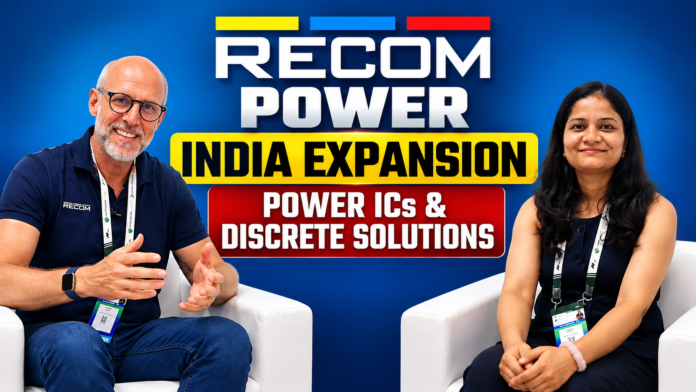
Electronics Media editor Pratibha Rawat, had an insightful conversation with Karsten Bier CEO of the RECOM Group of Power Supplies, during electronica India 2026, exploring RECOM’s growing focus on the Indian electronics and power-management market.
The discussion covered RECOM’s expansion into power ICs, transformers and discrete solutions, its strategy to strengthen supply-chain resilience, and plans to begin manufacturing products in India in 2027. Karsten also shared his views on India’s growing engineering capabilities, the transition from design to manufacturing, energy efficiency, and the evolving demands of industrial power applications.
In this conversation, he outlines how RECOM aims to support Indian engineers with flexible power solutions while strengthening its local technology and manufacturing presence.
RECOM has traditionally been known for its AC/DC and DC/DC power converters. What is driving RECOM to expand into power ICs, transformers and discrete solutions, and how do these complement its existing power conversion products?
We have been developing power supplies for more than 30 years, primarily offering modular solutions. Essentially, a modular solution combines a transformer and an IC package into a single solution.
Today, we have more than 120,000 customers globally using our power supplies. For customers working with smaller volumes, a modular solution makes sense. However, for customers with high-volume requirements where pricing is a key consideration, a discrete solution can offer greater flexibility. We can provide the power IC and transformer, allowing the engineer to develop their own design.
This engineering capability already exists in India, and that is one of the key reasons we want to offer both modular and discrete solutions. Customers can select the approach that best fits their application.
We are initially starting with isolated DC/DC discrete solutions from 1 W to 10 W, but we plan to scale the portfolio up to 60 W on the DC/DC side. Next year, we also plan to expand into AC/DC, including AC/DC ICs along with transformers.
This is particularly valuable because many semiconductor manufacturers provide only the IC. We offer the IC together with the transformer, along with schematics, BOMs and other design support. This makes the solution much easier for engineers to implement, and we believe the Indian engineering community will find this approach valuable.
Q2. For customers, when should they choose RECOM power converters, and when would an IC, transformer or discrete solution make more sense? How should they make that choice?
It depends primarily on the volume you are talking about. You also need to consider whether you have the necessary engineering capabilities within your team.
Power supply design requires power supply or analog engineers, particularly because there are several critical aspects involved. Thermal performance and EMI performance are two important considerations, so you need the right experience within your team to develop your own power supply.
The good news is that we also have a strong team in India supporting customers and helping them make the right decisions regarding their power supply designs.
However, a discrete solution makes sense primarily when you have a certain level of volume. Otherwise, it is more practical to use a finished module and integrate it directly into the product.
Our goal is to provide fast solutions to Indian customers. With the discrete solution, you have the transformer and the IC, allowing engineers to move quickly with their designs.
Q3. Supply-chain resilience has become a major concern for electronics manufacturers. How is RECOM changing its manufacturing footprint and supply-chain strategy to give customers greater flexibility and scalability?
This is a very important point because we are seeing a significant change in India. It is not only R&D that is increasingly being based in India; we are also seeing procurement teams coming into the country.
This means Indian customers are taking greater responsibility for decision-making, which we believe is a sensible approach. If you have full responsibility for your product, you can make better design decisions.
It also means that geopolitical risk management becomes increasingly important. Where can you manufacture? Which suppliers should you select? These are always important considerations in the RECOM world.
As a global supplier, we serve customers around the world, including Tier 1, Tier 2 and Tier 3 customers. Therefore, we need to maintain flexibility.
We have manufacturing operations in Europe and Asia across different countries. The good news is that in 2027, we plan to manufacture our first products in India.
We will initially start on a smaller scale, but the plan is to have our first product manufactured in India next year.
We believe this is particularly important for sectors such as railways and infrastructure projects, where having a local manufacturing footprint can provide significant benefits to customers in India.
Risk management, global availability and local availability are therefore all important parts of our strategy.
Q4. India is becoming an important electronics and manufacturing hub. What opportunities do you see for RECOM in the Indian market, and which sectors or application areas are particularly important?
Every year you come to India, you can see how the country is improving. I think infrastructure is particularly important. Power management, railway systems and public transportation are all areas with significant potential.
I believe India will become an increasingly important player globally because the country needs infrastructure, technology and the ability to scale that technology.
Everything in these areas will require advanced technology to support these applications. AI will also play an important role across many of these areas, including server infrastructure supporting AI.
However, I think one of the most important aspects is efficiency. We need to improve efficiency and reduce energy consumption across system solutions. This is an area where we can offer customers quick and effective solutions.
Q5. Looking ahead three to five years, what do you see as the biggest technology trend that will shape power-management design, and where does RECOM want to position itself in that evolution?
For power-supply design, efficiency is the most important topic.
Whether you are converting AC/DC, DC/DC or DC to DC, energy efficiency and consumption are critical considerations. We need to look at how we can improve efficiency across every part of the system.
One of the reasons we are developing our own power ICs is that large semiconductor companies often design their products primarily for consumer and automotive applications.
We develop our power ICs specifically for the industrial market. This enables us to focus on requirements such as higher performance, higher isolation, higher efficiency and wider input ranges.
We are trying to address the market based on the actual requirements of industrial customers. We use technologies such as GaN, SiC and IGBT, along with other available technologies. However, the important aspect is understanding how to manage firmware performance and EMI performance within the product.
We see a strong demand not only for developing technology but also for bringing that technology to the customer as a complete solution. It is not just about the IC; it is about the IC, magnetics and the combination of both.
We believe the engineering community in India will learn very quickly and develop a strong understanding of how to create power products for their end applications. We will support them in that process.
Q6. India is moving from designing to manufacturing, and this is an important shift for the country. What is your view on this transition, and how is RECOM contributing to it?
Exactly. That is what needs to happen.
From our point of view, as I mentioned earlier, we will bring technology to India for the design of new products. In addition, our plan is to manufacture our first products in India in 2027 so that we can secure the supply chain for Indian customers.
From the Indian government’s perspective, I think it is important to bring technology into the country and manufacture products locally.
On the semiconductor side, when you walk through the exhibition, you can see Indian semiconductor companies emerging. I think this is the right direction because every major economy needs this kind of technology. We will play our part by making sure that Indian engineers and companies have access to the technology they need, which they can then develop and manufacture locally.
Q7. If we specifically talk about your Indian customers, do you face challenges related to skilled engineers or the cost-sensitive nature of the market? What challenges are you seeing in India?
From an engineering capability perspective, I don’t see major challenges. It is great to see so many engineers and capable engineering professionals in India.
What India needs to overcome—and this is already changing as Indian companies become export companies—is the traditional focus on pricing.
Pricing is always important, but it is no longer the only crucial factor.
When you export to global markets, other factors become important, including risk management and quality.
I think the biggest challenge for the engineering community in India is to raise the level further and become a design and manufacturing hub for products that can be exported to other markets.
Understanding this process, as well as the requirements of different international markets, is very important. Today, we still often see companies and customers focusing heavily on price. That is beginning to change.
Price is one factor, but sustainability, quality and risk management are becoming increasingly important. That is the new world. There are many different factors involved, and Indian customers need to be able to navigate this changing environment.
Q8. As RECOM has started expanding into transformers and these new portfolio areas, are you also planning to introduce other products in the future? Are you looking to broaden the portfolio further?
We will always remain on the power side. We are power specialists.
If you look at our portfolio, we are actually like five companies in one. We work across low power, high power, automation and railway applications. We are very active in these areas and release a lot of products every year.
Our goal is to provide the complete power architecture to the customer rather than just one individual product. For example, if an engineer is working on a factory automation application, we want to be able to address every part of the power architecture within that application. So we are expanding both horizontally and vertically. This is also why we are developing our own ICs.
It allows us to secure the supply chain as well. We don’t want to depend entirely on external companies to provide key components to us. To a certain degree, we want to build the vertical side ourselves.