

India’s networking landscape is undergoing a significant transformation—from traditional connectivity infrastructure to high-performance, software-defined and increasingly intelligent networks. As AI, cloud, data centres and edge computing reshape connectivity requirements, the focus is shifting toward higher bandwidth, lower latency, resilience, automation and cybersecurity.
With more than four decades of experience in India’s networking ecosystem, Group Captain C.S. Krishnadas (Retd), Chief Executive Officer, MRO-TEK Networks Ltd, offers insights with our Editor, Pratibha Rawat, into how the country’s networking infrastructure has evolved, the technologies expected to shape the next five years, and the growing importance of indigenous R&D and end-to-end communications capabilities. He also discusses the specific demands of mission-critical sectors such as railways, telecom, government and utilities, and how network automation, SD-WAN, Zero Trust and SASE are redefining enterprise networking.
MRO-TEK has been part of India’s networking journey for more than four decades. How has the country’s networking infrastructure evolved since the company’s early years, and what do you see as the next phase of growth?
C.S. Krishnadas : India’s networking landscape has evolved from building basic connectivity infrastructure to creating highly interconnected, high-performance networks that now form the backbone of digital services. Over the past four decades, we have seen a transition from traditional networking technologies to Ethernet, IP, wireless and software-defined environments, alongside a significant increase in bandwidth requirements.
At MRO-TEK, we have witnessed and contributed to this evolution across telecom, enterprise, government and mission-critical sectors. Our journey has progressed from technologies such as media converters and modems to high speed routers and switches.
One of the more significant shifts over the last decade has been the growing focus on strengthening electronics and networking manufacturing within India. The introduction of Production Linked Incentive (PLI) schemes has given a significant impetus to electronics manufacturing in the country, encouraging large players to expand their manufacturing footprint and capabilities. This has been an important change in the overall electronics manufacturing ecosystem, alongside the availability of better technology and faster product development.
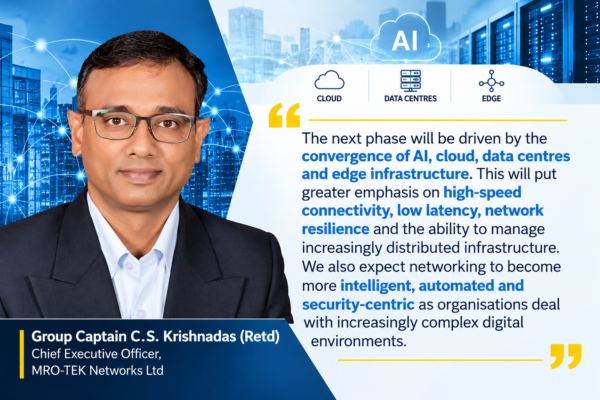
The next phase will be driven by the convergence of AI, cloud, data centres and edge infrastructure. This will put greater emphasis on high-speed connectivity, low latency, network resilience and the ability to manage increasingly distributed infrastructure. We also expect networking to become more intelligent, automated and security-centric as organisations deal with increasingly complex digital environments.
For India, this presents a significant opportunity to build networking infrastructure that is not only scalable, but also resilient and aligned with the country’s long-term digital ambitions. For MRO-TEK, our focus remains on building on our indigenous technology and R&D capabilities to support this evolving ecosystem.
2. Looking ahead, what technologies will define India’s networking landscape over the next five years?
C.S. Krishnadas : Over the next five years, we expect the networking landscape to be shaped by high-performance Ethernet, AI-driven network operations, software-defined networking, edge connectivity, automation and integrated cybersecurity.
The rapid adoption of AI and cloud is fundamentally changing network requirements. Applications are becoming more data-intensive, while workloads are increasingly distributed across data centres, cloud platforms, enterprise locations and edge environments. This will drive demand for higher bandwidth, lower latency and greater network scalability.
At the same time, AI will increasingly be applied to network operations to enable predictive monitoring, anomaly detection, traffic optimisation and faster response to network issues.
An area that we believe could have a significant influence is the development of an indigenous, end-to-end communications technology stack. Rather than looking at individual components in isolation, having the complete suite of networking products integrated with indigenous software, dashboards and an indigenous operating system can provide greater control over the technology stack. Building such an ecosystem could become increasingly important as India looks to strengthen its domestic networking and communications capabilities.
We therefore see the future network as one that is faster, more intelligent, automated and security-aware, rather than simply a connectivity layer.
3. How can Indian networking companies accelerate innovation while maintaining international quality and performance standards?
C.S. Krishnadas : Indian networking companies need to approach innovation with a combination of strong indigenous R&D, rigorous quality processes and a clear understanding of customer requirements.
The objective should not simply be to develop products locally, but to create technologies that can compete on performance, reliability, security and scalability with global offerings. This requires sustained investment in R&D, testing, engineering capabilities and adherence to relevant international standards.
MRO-TEK has followed this approach through more than four decades of networking R&D and indigenous product development. The company has an in-house R&D and a manufacturing facility. Our networking portfolio is built around regulatory compliance built around the government mandated Make in India Policy. Our quality requirements are stringent and relevant to demanding enterprise and mission-critical environments.
However, technology development also needs to remain closely connected to real-world deployment. Indian companies have the advantage of understanding the country’s diverse operating environments and can use that insight to develop solutions that are both globally competitive and locally relevant.
The larger opportunity is for Indian networking companies to move beyond the role of technology adopters and emerge as technology creators capable of developing and exporting globally relevant networking solutions.
4. MRO-TEK serves sectors such as railways, telecom, government, and utilities. What unique networking requirements do these mission-critical sectors have?
C.S. Krishnadas: In mission-critical sectors, networking is not simply about maintaining connectivity, it is about ensuring continuity of operations. Reliability, resilience, security and predictable performance therefore become fundamental requirements.
Railways, utilities and other infrastructure environments often involve geographically distributed locations, challenging operating conditions and applications where network downtime can have significant operational consequences. Networks in these environments therefore require features such as redundancy, ring protection, remote monitoring, traffic prioritisation and robust hardware.
Telecom and government networks bring another layer of complexity, with requirements around scalability, security, interoperability and long-term serviceability. These networks also need to accommodate growing traffic volumes without compromising availability.
MRO-TEK’s experience across such environments has reinforced the importance of designing networking solutions around the application, operating environment and business criticality, rather than taking a one-size-fits-all approach.
5. Zero Trust, SASE, SD-WAN, and network automation are becoming mainstream. Which of these technologies do you believe will have the greatest impact on enterprise networking in India?
C.S. Krishnadas: We believe network automation is likely to have one of the most significant impacts on enterprise networking, particularly as infrastructure becomes more distributed and complex. However, its impact will be closely connected with technologies such as SD-WAN, Zero Trust and SASE.
Enterprise networks today span offices, branches, data centres, cloud environments and remote users. Managing this infrastructure manually can become increasingly difficult at scale. Automation can help organisations provision networks faster, monitor performance continuously, identify anomalies and respond to issues with greater speed and consistency.
SD-WAN will continue to play an important role in managing distributed enterprise connectivity, while Zero Trust and SASE will drive the integration of security more deeply into network architecture.
From our customer interactions, the biggest barrier to enterprise adoption of network automation is not a single factor but a combination of challenges. Legacy infrastructure, the investment required, availability of the right skills and the complexity of integrating automation with existing environments can all slow adoption. As enterprises work through these challenges, the ability to integrate automation with their existing network infrastructure will be critical to achieving its full potential.
The larger shift, therefore, is towards networks that are software-defined, automated and security-centric. These technologies should not be viewed as competing approaches; together, they are helping redefine how enterprise networks are designed, managed and secured.