

As telecom networks become increasingly intelligent, distributed and autonomous, AI-driven networking is moving from experimentation toward real-world deployment. But according to VIAVI, simply adding AI to network operations is not enough. Reliable data, end-to-end visibility, rigorous testing and continuous assurance will be critical to building networks that can make increasingly autonomous decisions.
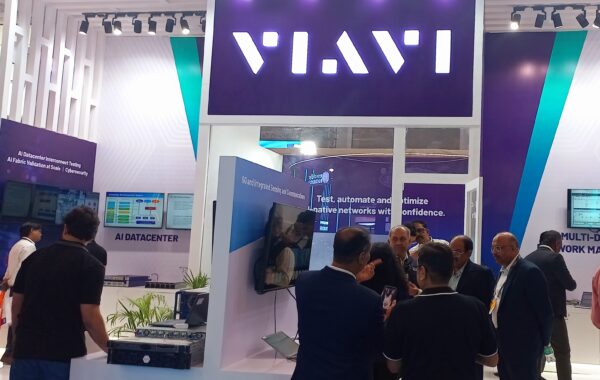
At India Mobile Congress (IMC) 2026, Electronics Media spoke with Stephen Hire, Vice President, Solutions and Partnerships at VIAVI, about the changing role of AI in telecom networks and the technologies needed to make intelligent networks trustworthy. In this interview, Hire discusses the biggest misconceptions around AI-driven networks, how operators can test and validate AI decision-making, and whether networks could eventually diagnose, optimise and remediate problems with minimal human intervention.
Electronics Media:What is the biggest misconception the industry has about AI-driven networks today?
Stephen Hire : The biggest misconception is that AI-driven networks are primarily about adding AI to network operations. In reality, AI is only as effective as the quality of the data, visibility, and assurance that underpin it.

As networks become increasingly complex and distributed, AI requires accurate, real-time data and end-to-end visibility to deliver meaningful outcomes. Without this foundation, even the most sophisticated AI models can produce limited or unreliable results.
The industry therefore needs to shift its focus from simply deploying AI to building networks that can continuously measure, understand, validate, and optimize themselves. AI should not be viewed as an overlay, but as part of a broader approach to creating intelligent, observable, and continuously assured networks.
Electronics Media : If AI is going to be the brain for future networks, who tests the AI? And how is VIAVI ensuring that AI-driven networks can be trusted?
Stephen Hire : If AI is going to be the brain of future networks, the industry needs to test not only the network itself, but also the intelligence making decisions about it. That means validating the quality of the data AI relies on, the accuracy and consistency of its outputs, and how the network behaves when those decisions are applied under real-world conditions.
VIAVI brings an independent, end-to-end approach to testing and assurance, providing the visibility, measurement, and validation needed to verify that AI-driven networks perform as intended. This is particularly important as networks become more autonomous and decisions increasingly move from human operators to AI-driven systems.
Network operators need objective, measurable evidence that the intelligence they rely on is accurate, predictable, secure, and delivering the expected network performance. By continuously testing and validating both the network and the intelligence operating within it, VIAVI helps build the trust needed for greater network autonomy.
Electronics Media : Could we reach a point where the network diagnoses, optimises, and fixes itself without a human engineer touching it?
Stephen Hire : Yes, we are moving toward networks that can increasingly diagnose, optimise, and even remediate issues autonomously—but we do not see this as eliminating the human engineer. The bigger shift is from manual intervention to intelligent automation and human oversight.
AI can identify anomalies, correlate data across complex network environments, recommend or initiate corrective actions, and continuously validate whether those actions have delivered the intended outcome. As this level of automation increases, independent measurement and assurance become even more important.
VIAVI’s role is to provide the visibility, testing, and assurance needed to make network autonomy trustworthy. The goal is a network that can increasingly self-optimise and self-heal, while engineers remain in control of the policies, thresholds, guardrails, and decisions that matter.
Electronics Media : Everyone is talking about AI-RAN, but what is the biggest hype versus reality gap you see in AI-powered networks today? What role does VIAVI see the TeraVM AI RAN Scenario Generator (AI RSG) playing for it?
Stephen Hire : While AI-RAN holds significant promise, translating that potential into tangible network performance requires more than AI models and compute power. Operators must validate that AI-driven RAN solutions deliver measurable improvements in capacity, energy efficiency, reliability, and quality of experience under real-world network conditions. Rigorous testing, end-to-end validation, and continuous assurance are essential to bridge this gap—ensuring AI-RAN delivers measurable, repeatable, and reliable performance gains.
VIAVI’s TeraVM AI RAN Scenario Generator (AI RSG) addresses this challenge through a RAN simulation digital twin for network validation. It enables operators, RAN vendors, application developers and ecosystem partners to create realistic and synthetic network scenarios to evaluate, benchmark, and optimize AI-driven network functions.
AI RSG supports RAN simulation, training, testing, and validation across 4G, 5G, emerging 6G, Open RAN, and NTN environments. It enables the development and validation of AI-driven RAN applications and intelligent network functions, including Massive MIMO optimization, Self-Organizing Networks (SON), rApps, xApps, and RAN Intelligent Controllers (RIC). It provides scalable scenario generation ranging from thousands of cells and UEs to city-scale environments, with configurable network topologies, UE types and mobility patterns, traffic profiles, radio/frequency conditions, real or synthetic GIS-based maps, and controlled anomaly injection.
By providing a controlled, scalable, and repeatable environment for AI-driven RAN validation, AI RSG helps improve interoperability, accelerate innovation, and build confidence in the performance and reliability of intelligent network functions before large-scale deployment.
Through digital twins, automation, and data-driven validation, VIAVI is helping operators and ecosystem partners establish more consistent approaches to testing and assuring the next generation of AI-powered networks.
Electronics Media :How will AI-native threats reshape the future of cybersecurity and accelerate the adoption of quantum-safe communications?
Stephen Hire : Organizations are preparing for an environment where cybersecurity increasingly becomes an AI-driven challenge requiring faster detection, stronger resilience, and continuous validation.
At the same time, the emergence of quantum computing is accelerating the need for quantum-safe security strategies. Technologies such as Post-Quantum Cryptography (PQC), Quantum Key Distribution (QKD), and hybrid security architectures are becoming increasingly important.
However, cryptographic strength alone is not enough. Organizations must validate how these technologies perform under real-world conditions, including large-scale traffic, complex network environments, and evolving threats.
VIAVI helps address this challenge by enabling security validation across multiple dimensions, including performance testing, interoperability validation, traffic emulation, and resilience assessment.
As hybrid security environments become the industry norm, continuous validation will be essential to ensure quantum-safe technologies integrate effectively with existing infrastructure while maintaining performance and reliability.
Electronics Media : As AI, automation, and cloud-native architectures reshape the Test & Measurement industry, how is VIAVI evolving its portfolio to enable smarter, more predictive network testing?
Stephen Hire : Testing must extend beyond individual components to assess end-to-end performance, interoperability, resilience, and operational efficiency under real-world conditions.
VIAVI is advancing its NITRO AI portfolio by integrating advanced instrumentation, automation, AI-driven analytics, and software-based validation to help operators and technology providers verify performance, accelerate innovation, and ensure reliable operation across increasingly complex network environments.
For AI infrastructure and next-generation data centers, solutions such as ONE LabPro ONE-1600 and TestCenter enable validation of high-speed optical and Ethernet networks, helping customers verify performance, interoperability, and scalability as they transition to 800G and 1.6T architectures.
VIAVI’s wireless, security, and applications portfolio, powered by TM500 and TeraVM, delivers a full suite of solutions for AI training, testing, and optimization from 5G to 6G. It covers specification testing and the testing of AI RAN and AI-driven RAN applications, backed by RAN and UE datasets, real field measurement data, and advanced ray tracing. The portfolio also tests AI-native components to enable neuromorphic architectures and AI-driven PHY-layer innovation.
Realistic conditions still need the right AI workload running through them. CyberFlood drives that workload, real traffic patterns at scale, end to end. AI Inference Test measures whether the responses that come back stay accurate, consistent and timely, under live RAN load.
The VIAVI NITRO platform adds intelligent assurance through automation, analytics, and real-time visibility, helping operators move toward more proactive network operations.
CyberFlood and TeraVM Security enables application and security validation to ensure resilience in increasingly connected environments.
VALOR pairs independent, AI-RAN Alliance-endorsed validation with AI-Driven Lab Intelligence: intelligent diagnostics, real-time health monitoring, predictive analytics, automated topology mapping, smart test orchestration and AI Experts.
Finally, AI Experts with Agents automate the engineer workflows, such as configuration, analysis, and diagnostics across field and lab.
Together, these capabilities enable smarter, more predictive testing across the network lifecycle—from research and development and manufacturing to deployment and live operations. By helping customers validate changes before deployment, identify potential issues earlier, and optimize performance continuously, VIAVI is enabling the industry to build more intelligent, resilient, and future-ready networks.