

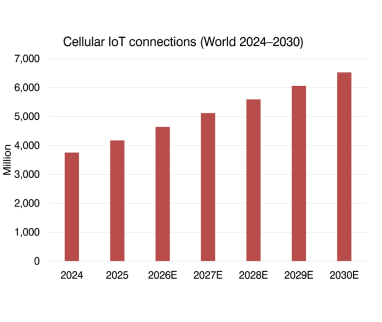
Berg Insight estimates that the global number of cellular IoT connections increased by 11 percent during 2025 to reach 4.2 billion at the end of the year – corresponding to around 32 percent of all mobile subscriptions. Until 2030, the number of cellular IoT connections is forecasted to grow at a compound annual growth rate (CAGR) of 9.3 percent to reach 6.5 billion at the end of the period. During the same period, cellular IoT connectivity revenues are forecasted to grow at a CAGR of 8.1 percent from € 14.5 billion in 2025 to approximately € 21.5 billion in 2030. Meanwhile the monthly ARPU is expected to drop from € 0.31 to € 0.28.
China is the world’s largest market for cellular IoT connectivity services by volume. According to data from the national telecom regulator, the installed base in the country grew by 5 percent year-on-year to reach 2.9 billion IoT connections at the end of 2025. This corresponded to about 70 percent of the global installed base. Berg Insight believes that the role of the Chinese government is the main explanation for why China is ahead of the rest of the world in the adoption of IoT. Authorities actively endorse large-scale IoT deployments as a method for addressing problems affecting the society, whether it is crime, fire safety, energy conservation or traffic management. The private sector is directed and encouraged to do the same.
North America and Western Europe ranks as the second and third largest markets for IoT connectivity with 321 million and 313 million IoT connections respectively at the end of 2025. In contrast to China, developments in these regions are largely driven by commercial interests. The connected car is currently one of the strongest trends with more than 90 percent of new cars sold featuring embedded cellular connectivity in the regions. Other key application areas are fleet management of commercial vehicles, smart utility metering and monitored alarm systems. South Asia, Latin America and Central & Eastern Europe had in the range of 93–142 million IoT connections, while Middle East, Africa and Southeast Asia had between 41–53 million. Australia & Oceania was the smallest region with approximately 22 million IoT connections.
China Mobile is the world’s largest provider of cellular IoT connectivity services. At the end of 2025, the operator reported 1.48 billion cellular IoT connections and a yearon-year growth rate of 5 percent. China Telecom and China Unicom ranked second and third with 746 million and 723 million connections respectively. Vodafone ranked first among the Western operators and fourth overall with 234 million connections, followed by AT&T with 160 million in fifth place. Airtel in India recorded the highest yearly growth rate, with IoT connections increasing to 69 million. Verizon and Deutsche Telekom had in the range of 62–69 million cellular IoT connections each. Telefónica and KDDI Orange were the last players in the top ten with about 59 million and 58 million connections respectively. The installed bases of the largest IoT connectivity providers grew at a rate of 5–115 percent annually.
IoT managed service providers play a key role in the ecosystem with a combined installed base of more than 250 million cellular IoT connections. While the distinction between mobile operators’ IoT businesses and IoT managed service providers is becoming less clear, the latter benefit their network-agnostic positioning and ability to aggregate multiple mobile networks through roaming agreements, sponsored IMSIs and eSIM profiles. Due to the nature of their business, the players are becoming increasingly international, supporting customers in many parts of the world. Important players in this category include 1GLOBAL, 1NCE, 1oT, Aeris, Airnity, BICS, CSL Group, Cubic3, emnify, Eseye, floLIVE, Giesecke+Devrient, Hologram, Kajeet, KORE, Lenovo Connect, Monogoto, Onomondo, Pelion, Semtech, Soracom, Tata Communications, Teal, Telit Cinterion, Velos IoT and Wireless Logic.
IoT connectivity revenues are growing at a slower rate than the number of connections. Berg Insight estimates that global IoT connectivity revenues increased by 5 percent during 2025, while the monthly ARPU dropped by 7 percent. IoT connectivity revenues accounted for 1–4 percent of service revenues for the largest mobile operator groups. As the value in IoT lies in value-added services rather than connectivity, IoT connectivity service providers increasingly focus on boosting their IoT portfolios by adding cloud services, security capabilities and devices on top of their connectivity offering to capture a larger share of the market.
This article is adopted from berginsight.com.