

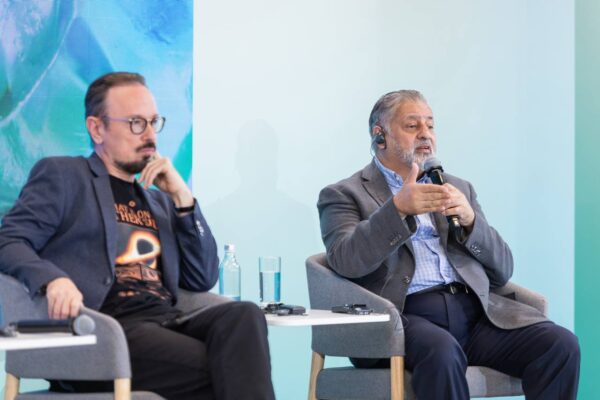
On the first day of the Moscow Startup Summit, a foresight session was held titled “Code 2035: Visionaries on Five Technology Sectors of the Future.” One of the speakers was strategic adviser and CEO of Fast Future Rohit Talwar, known for his research on the impact of artificial intelligence on business and society.
Here is what global futurist Rohit Talwar said about the future of AI in different areas of human life.
AI and Business: The New Role of Humans
According to Talwar, AI’s impact on business models and productivity will divide into three parts: personal productivity, where people will move faster and faster; small companies and creative industries, where transformation will proceed especially rapidly; and large corporations, where the human factor, concern for security, and fear of risk will slow adoption.
“Business leaders are not opposed to employees using AI for reports and data analysis,” the speaker noted. “But when it comes to automating entire workflows and decision-making by agents, two concerns arise: who is responsible if something goes wrong, and why are you needed if AI makes the decision?”
Robots for Real Tasks
In robotics, Talwar identified three trends: robots with fine control for manufacturing, warehouses, and logistics; the use of robots for construction and maintenance; and smart drones for inspecting buildings, fields, and working in burning buildings.
“Of course, robots for entertainment, gymnastics, or running are also developing. But the real shift will happen precisely where robots take on real work and become truly intelligent,” he emphasized.
The speaker separately focused on China, where AI and robotics are being combined so that people do not become redundant. “China is obsessed with ensuring that people do not remain without work. Hence the support for creating one-person companies,” Talwar explained. According to him, China will be able to offer humanoid robots very cheaply — for $1,000 or less.
Agri-foodtech: Autonomous Farms and Bioengineering
On a two-to-three-year horizon in agri-foodtech, the speaker sees the following trends: smart technologies on farms with drones and sensors, AI analysis of data and weather forecasts for optimal planting times, and the development of bioengineered products.
In the long-term future, according to the futurist, fully autonomous farms will operate, vertical farming will be used, and crops will be genetically enhanced.
Medtech: Personalized Medicine
In medtech, AI is already accelerating drug creation. Ahead lies the development of robotics and vision tools in surgery. The next step is autonomous surgery and personalized medicine, adapting drugs to each person’s individual physiology.
Education: An AI Teacher for Every Student
In education, over a three-to-eight-year horizon, Talwar sees personalization — a personal AI for every student, capable of being patient even on the fiftieth attempt to explain a differential equation. In a regular classroom, where there are 30 students and one teacher, each child receives a maximum of two minutes of the teacher’s attention per hour of lesson. AI can give 100% attention.
Another direction for using AI is supporting the teacher: lesson planning, finding different ways of teaching, and monitoring based on school data.
“Most schools, universities, and colleges use their facilities less than a third of the time. Why can’t we use these opportunities for continuous adult learning?” the speaker asked. He proposed a model in which everyone learns for free and then pays a percentage of income over the course of their life. “We are effectively securitizing education. Imagine each class: if one person becomes a millionaire, that is a huge return, and a large part of the money goes to educating the next generation,” Talwar explained.
From Printing Houses to New Business Models
Speaking about the future of cities, Talwar noted the growth of modular and prefabricated construction: in China, three-bedroom houses are already being printed for about 100,000 rubles. The next stage is converting waste into energy, motion sensors in floors that convert movement into power, and fully self-managing homes that reduce the need for energy, water, and waste disposal.
The futurist sees the future of urban infrastructure as follows: integrated management of roads and public buildings, automatic traffic rerouting during accidents and floods, solar roads, and self-healing concrete. Plus maintenance robots and drones that remove cars from accident sites faster than a helicopter.
Space: Space Elevators and Mirrors to Reflect Sunlight
Space, according to Talwar, is an area where something extraordinary can be expected. Among the radical ideas are space elevators, giant mirrors to reflect solar radiation and reduce the heating of the Earth, and a project for a new country in space on a floating station, created in part for experiments with growing food.
“It is interesting what new materials, food products, and treatments humans could create in weightlessness that cannot be made or even simulated on Earth?” Talwar asked.
What Will Change by 2035
The futurist described several stages in the development of AI: today’s AI, which writes text and creates images excellently but cannot drive a car; the next stage — AI that performs all human tasks in parallel and continuously improves; and the third — artificial superintelligence, which will be smarter than us.
“Superintelligence may create new areas of the economy and, I hope, solve some of our biggest problems,” he said, recalling that half the planet earns less than $7 a day, and about 50% of all food in the world is wasted.
Evgeny Kuznetsov, a representative of Singularity University in Russia and one of the founders of the Russian venture industry, also voiced his view of the future at the foresight session. The meeting was moderated by NTV project manager Tatyana Naumova.
The Moscow Startup Summit, dedicated to technological entrepreneurship and open innovation, is being held on September 29–30 in the smart city SberCity, in the space of the largest campus of “School 21.” The organizers of the summit are the Government of Moscow and Sber. The key idea of the 2026 event is the transformation of five key industries: medicine and biotechnology, education and creative fields, agriculture and food production, construction and urbanism, and smart devices and robotics with the help of startup technology solutions. The main goal of the summit is to facilitate deals between investors, corporations, and startups from these industries and to shorten the path from technology to working solutions. The program includes speeches by top speakers in innovation, unicorn startups, pitches, an exhibition of more than 100 Russian and foreign technology startups at stages from seed to pre-IPO, and the awarding of a technology prize to corporations, investors, universities, and media that have contributed to the development of the country’s innovation ecosystem.