


IOWN Technology in Tunnel Construction – HAZAMA ANDO CORPORATION (“HAZAMA ANDO”), NTT, Inc. (“NTT”), and 1FINITY Inc. (“1Finity”), a Fujitsu company and leading provider of global network solutions, today announced the successful completion of a Proof-of-Concept (PoC) using IOWN® technologies(1) to establish high-capacity, high-speed data communications for remote construction work control at a mountain tunnel construction site operated by HAZAMA ANDO. The three companies are conducting studies of the “Use Cases for Transforming Construction Sites”(2) to advance digital transformation at construction sites (Figure 1). The PoC established an optical communication network suited to tunnel conditions, despite blasting, spring water, dust, and other conditions unlike those in offices or telecommunications facilities. It also clarified communication performance and operational issues. The network enables timely transmission of large volumes of data, including 8K video and point clouds, from inside the tunnel to remote offices and data centers. In an environment simulating communications over 1,000 km, the PoC confirmed the feasibility of use cases required for remote construction work control across an IOWN® APN(3) (All-Photonics Network), the in-tunnel optical communication network, and wireless communications. It also demonstrated that remote inspection could identify cracks 0.2 mm wide(4), one of the construction control criteria for tunnel walls. The companies plan to proceed with operational trials connecting multiple tunnel sites, remote offices, and data centers to further verify construction automation and advanced construction work control. Beginning in fiscal 2027, the companies plan to proceed with verification for phased application to actual tunnels and validate effectiveness under real-world conditions based on knowledge gained through the operational trials.
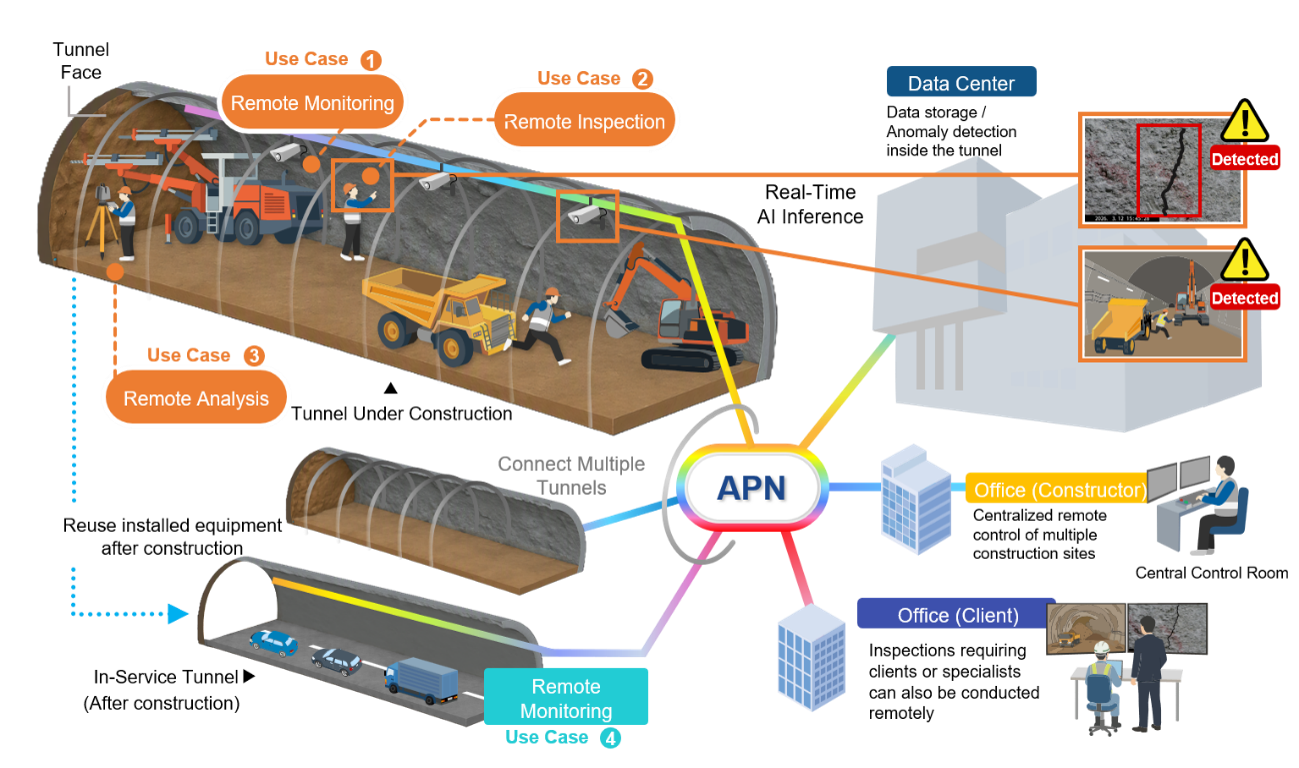
Figure 1. Use Cases for Transforming Construction Sites
Background and Objectives
Remote control of mountain tunnel construction is increasingly needed because of labor shortages, an aging skilled workforce, and the high risks associated with working near the tunnel face. Conventional site networks, however, have difficulty transmitting in real time – and with consistent stability – the high-definition video and large volumes of three-dimensional measurement data obtained using laser scanners that site engineers need to make construction decisions remotely.
This PoC aimed to create a high-capacity network by establishing an APN from inside the tunnel to a remote site. It also sought to build the technical foundation for remote monitoring, remote inspection, remote analysis, and other functions envisioned in the IOWN Global Forum(5)’s “Use Cases for Transforming Construction Sites.”
High-capacity transmission of data from any location inside the tunnel, including the tunnel face, is essential not only for these use cases but also for AI applications, digital twins, and remote robot control that will support future construction automation and optimization. Real-time transmission of high-definition images and video, sensor data, three-dimensional measurement data used in decisions to continue construction, and video and point-cloud data needed to monitor heavy machinery and robotic transport can enable more advanced remote construction work control, AI-based analysis, automated construction, and the use of robots.
Through this initiative, the companies will verify the applicability of IOWN technologies to the construction industry and work toward the future standardization of next-generation communications infrastructure for the industry.
Overview and Results of the Joint PoC
■ Network Configuration
The PoC was conducted at the Tsubakihara Tunnel construction project for the four-lane expansion of the Tokai-Hokuriku Expressway. A 1,100 m optical fiber cable was installed inside the tunnel, together with six optical transport nodes positioned at 100 m intervals from the tunnel face. A simulated IOWN® APN environment reproduced communications with a remote site for the PoC (Figure 2) in March 2026.
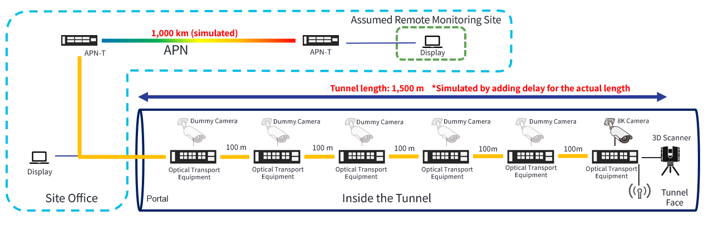
Figure 2. PoC Network Configuration
■ Key Results
The PoC confirmed the following results. See “Supplementary Information” for evaluation details and full results.
- No packet loss in the optical communication network section; jitter maintained at 100 nanoseconds or less; and continuous operation for more than 24 hours
- Stable operation of communications equipment installed in IP65-rated enclosures inside the tunnel despite dust, vibration, and spring water
- Using WiGig(6), sufficient communication bandwidth for visual confirmation of cracks 0.2 mm wide, even with a 100 m equipment spacing and with an obstruction
- Transmission of approximately 20 GB of three-dimensional measurement data from inside the tunnel to the site office in approximately one minute while continuously carrying video monitoring data equivalent to 15 cameras
- Transmission of 4K video and audio for remote inspection simulating a location 1,000 km away, visual confirmation of cracks 0.2 mm wide inside the tunnel, and successful crack detection using AI image analysis.
Roles of the Participating Companies
HAZAMA ANDO
Preparation of the PoC environment and overall promotion of the PoC
NTT
Construction of wireless communications and systems for use case verification, including remote inspection and AI-based crack detection
1Finity
Construction of an environment simulating the IOWN® APN and provision of optical networking equipment and technical expertise.
Future Development
To realize use cases for mountain tunnel construction work control, the companies plan to conduct operational trials using a live IOWN® APN environment. The trials will verify remote monitoring and remote inspection at multiple tunnel sites, AI-based remote analysis with real-time feedback to construction sites, and remote monitoring using fiber infrastructure.
These trials will seek to improve the efficiency of construction work control through centralized management of multiple sites and optimize on-site staffing through remote technical support from specialists. The companies also aim to contribute to the standardization of next-generation communications infrastructure by sharing knowledge from the operational trials with the IOWN Global Forum, other industry organizations, and the construction industry. The three companies will advance the use of optical communication networks, including IOWN® technologies, and AI to enhance construction management, while continuing to study the “Use Cases for Transforming Construction Sites,” thereby accelerating digital transformation at construction sites.
Supplementary Information
The following sections describe the key network configuration features and detailed PoC results.
■ Network Configuration Features
Scalable configuration supporting tunnel extension and multiple use cases
The configuration supports expansion as tunnel construction progresses and the simultaneous use of multiple use cases. It also assumes wireless connectivity inside the tunnel so that high-capacity communications can be used at any location, including construction sites where power sources may be spaced approximately 100 m apart.
Installation for demanding environmental conditions
Mountain tunnels present conditions substantially different from ordinary offices or telecommunications facilities, including momentary vibration and dust from daily blasting, a humid environment caused by spring water, and safety restrictions that preclude floor-mounted racks. The communications equipment was therefore housed in enclosures capable of withstanding dust, vibration, and water droplets from spring water, and mounted on messenger wires along the tunnel wall.
■ Detailed PoC Results
Communication Quality and Long-Term Stability
The PoC used the 1Finity Ultra Optical System(7) to establish a high-capacity, stable optical communication network from inside the mountain tunnel to a remote site (Figure 3). No packet loss was detected in the optical communication network section, and jitter was generally maintained at 100 nanoseconds or less. Continuous operation for more than 24 hours also confirmed long-term stability. These results are expected to reduce the risk of work interruptions caused by communication outages or delays and support stable remote construction work control.

Figure 3. 1Finity Ultra Optical System
Environmental Durability of the Equipment
The PoC confirmed that communications equipment installed in IP65-rated enclosures operated stably throughout the test period under the demanding geological conditions inside the tunnel and at the applicable dust concentration level (Figure 4).
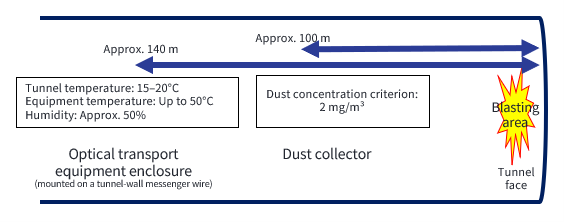
Tunnel Environmental Conditions
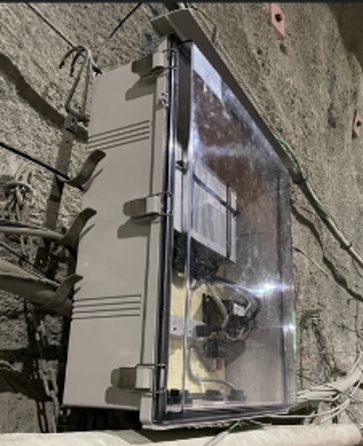
Optical Transport Equipment Enclosure
(Dustproof)
Figure 4. Environmental Durability Test Conditions for Communications Equipment
Effectiveness of Wireless Communications at Any Location
Using WiGig, the PoC evaluated distance dependency, angle dependency, and methods for maintaining wireless communications when an obstruction was present, taking advantage of the characteristics of the tunnel construction site (Photo 1). The required communication bandwidth for visually confirming cracks 0.2 mm wide from a distance of 1 m was secured even at a 100m spacing between communications devices with an obstruction. Combining the optical communication network with wireless equipment on mobile devices therefore enables flexible network configuration in the changing environment inside the tunnel.
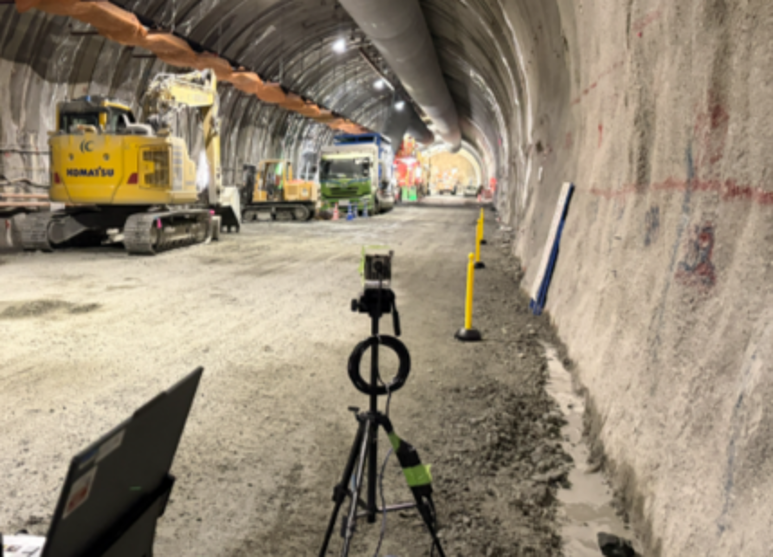
Photo 1. Wireless Communications Test
Simultaneous Video Monitoring and High-Capacity Data Transmission
While continuously transmitting video monitoring data equivalent to 15 cameras, the PoC transmitted approximately 20 GB of three-dimensional measurement data captured by a laser scanner from inside the tunnel to the site office in approximately one minute (Photo 2). This enables remote construction work control and quality inspection to be performed in parallel by supporting real-time monitoring at multiple locations while transmitting large volumes of data for detailed spot inspections. It can also shorten the time required to decide whether construction can continue during an emergency.
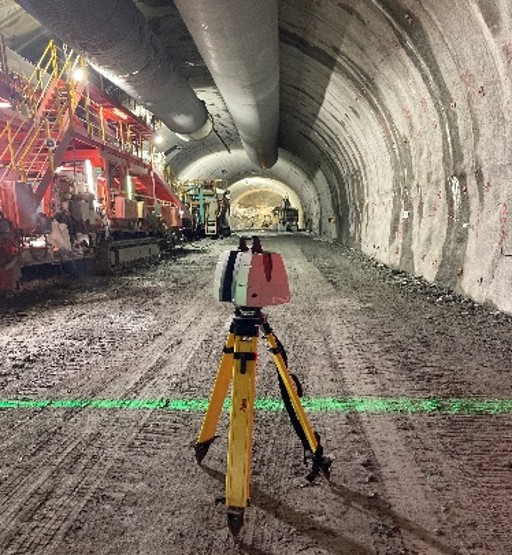
Photo 2. Point-Cloud Measurement Using a Laser Scanner
Remote Inspection Trial
The PoC established a remote inspection environment for video and audio data across the APN, the in-tunnel network, and the wireless network, and conducted a remote inspection simulating a location 1,000 km away. Transmission of 4K video and audio enabled personnel at the remote location to communicate with the site and identify cracks 0.2 mm wide inside the tunnel (Photo 3). AI image analysis also successfully detected cracks in images captured under tunnel lighting after learning from images of uneven wall surfaces. This technology supports inspectors, reduces the risk of human oversight, and enables earlier detection of abnormalities.
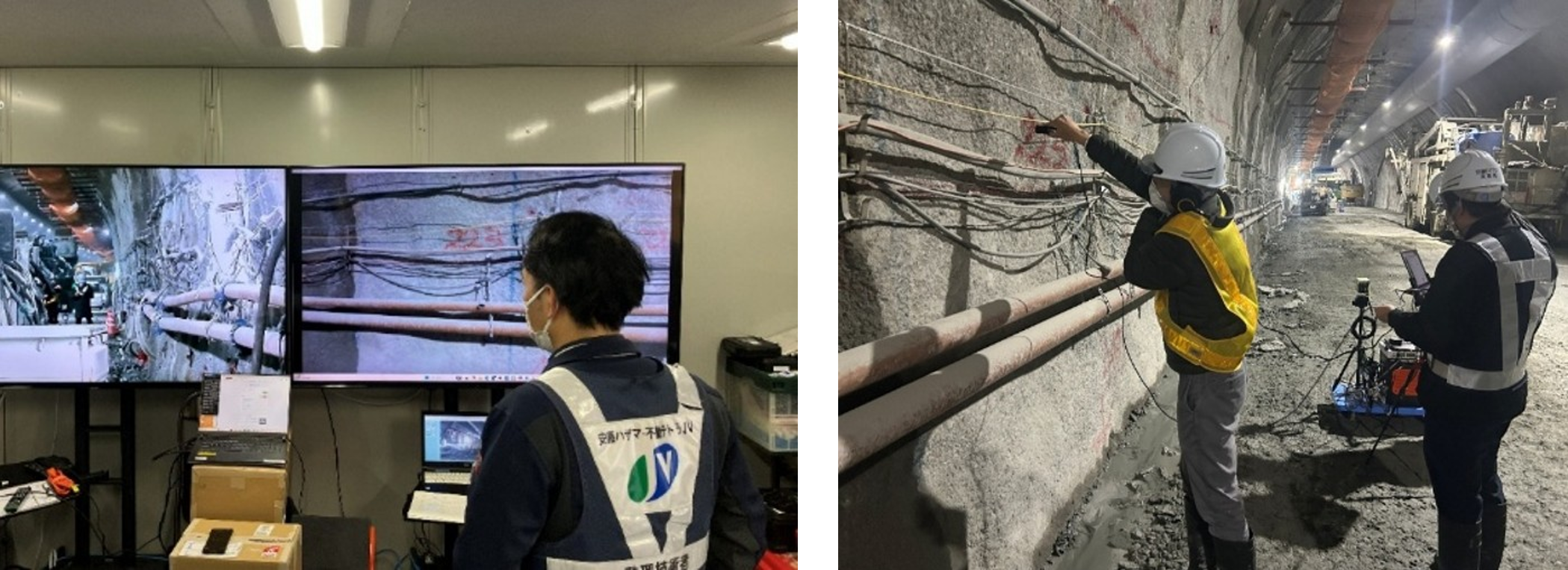
Photo 3. Remote Inspection Trial
Purpose of Participation for Each Company
HAZAMA ANDO
Since becoming the first company in the construction industry to join the IOWN Global Forum in July 2022, HAZAMA ANDO has led the development of use cases and related documentation as a leading construction company under its 2030 DX Vision. In future studies, HAZAMA ANDO will use IOWN as the communications foundation for its integrated mountain tunneling management system, i-NATM®, which is being developed to improve the productivity and safety of mountain tunnel construction.
NTT
NTT has extensive experience providing customers with high-speed, low-latency networks and is advancing the IOWN concept, including the IOWN APN. In future studies, NTT will examine and verify the architecture and specifications required for construction-site use cases, including integration between IOWN component technologies and computing and AI platforms. NTT will also consider the future use and implementation of technologies developed by NTT for efficient infrastructure maintenance, including AI-based image, video, and optical fiber analysis.
1Finity
As a network company supporting next-generation industrial infrastructure, 1Finity is accelerating the application and deployment of its mission-critical network technologies through IOWN. In future studies, 1Finity will further advance the network technologies required for a Reference Implementation Model that addresses challenges at construction sites, including integration with computing and AI platforms.
For more information visit: https://www.1finity.com/.