

Critical Manufacturing Version 12.0 – Critical Manufacturing today announced new capabilities for its MES-powered Industrial Operations Platform, introducing a catalog of purpose-built AI agents that answer questions and build dashboards on the same governed data model that runs manufacturing execution. Because the agents work on the platform’s Canonical Data Model, their answers reflect real production context, and what they build is governed configuration rather than generated code. Customers can also add their own agents to the same catalog. Version 12.0 also introduces the Global Data Orchestrator, an add-on module that keeps master data consistent across every site.
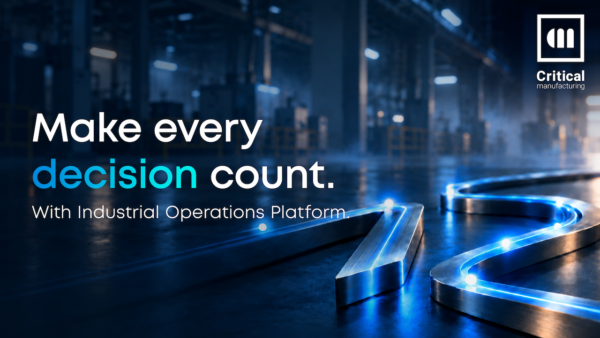
Under the theme “Make every decision count,” the latest developments bring execution, connectivity, analytics and AI together within one connected environment.
With MES at its core, the platform connects manufacturing execution with contextualized production data, analytics and AI. This means manufacturers can move beyond simply collecting and visualizing data to making it easier for teams to understand what’s happening in production, identify where attention is needed and take informed action within their operational environment.
AI that works because the data is ready for it
Most manufacturers have more AI tools available than they can use. The obstacle is data: it often sits across systems with no shared structure, so AI has little reliable context to work from. Critical Manufacturing’s platform is built on a Canonical Data Model, a single structure for products, resources, production flows and operational data. Version 12.0 builds on that foundation with a catalog of purpose-built AI agents.
The new AI agents were designed to help manufacturers get more value from their operational data without the complexity traditionally associated with creating manufacturing applications and visualizations.
For example, with Gen AI Build agents users can generate dashboards and user interface pages tailored to their specific needs, accelerating the creation of operational views without relying exclusively on specialized development resources. This makes it easier for teams to monitor production performance and access the information they need to do their jobs. It can be versioned and validated, it carries forward through upgrades, and users can refine it through conversation or edit it by hand at any time.
With Gen AI Ask agents, users can ask questions in natural language and receive answers grounded in actual manufacturing context, including product definitions, resources and production flows. Purpose-built for specific use cases, such as analyzing KPIs and trends or supporting shift handovers, these agents help users quickly find relevant information, understand production performance and make more informed decisions.
Unlike generic AI tools, these agents work within the same data environment that supports manufacturing execution, allowing them to apply production context to specific tasks. Manufacturers can also integrate their own agents into the same catalog, extending AI capabilities to address their specific processes, requirements and use cases.
Francisco Almada Lobo, CEO of Critical Manufacturing, said, “AI is becoming increasingly capable, but its value in manufacturing depends on having the right context behind it. Manufacturers don’t need more data, they need intelligence that understands their operations and can support the decisions being made within them. These new capabilities give manufacturers practical ways to apply AI to their operations while keeping people in control.”
Faster, more consistent rollouts across multiple factories
For manufacturers operating multiple factories, maintaining consistent master data across sites can be complex and time-consuming, leading to inefficiencies, errors and challenges in standardizing operations. The Global Data Orchestrator simplifies this process by enabling centralized coordination and synchronization of master data across production sites. Through controlled change packages and dry-run validation, manufacturers can verify updates before deployment, reducing manual effort, minimizing inconsistencies and accelerating changes while ensuring greater reliability and standardization across global manufacturing operations. It also strengthens Centre of Excellence (CoE) initiatives by enabling centralized governance while supporting local manufacturing requirements.
Less complexity for users, more focus on the task at hand
Manufacturing systems serve a wide range of users, from shop-floor operators to production supervisors and quality managers, each with different responsibilities and information needs.
User Workspaces provide role-based views tailored to the information and functions different users need, making it easier to focus on relevant tasks without navigating unnecessary information. Combined with interface improvements that introduce a clearer layout and improved accessibility, this more intuitive experience can help reduce training time and minimize user errors.
By combining manufacturing-aware AI, coordinated multisite operations and more intuitive user experiences, Critical Manufacturing continues to evolve its Industrial Operations Platform around the practical needs of manufacturers: faster access to relevant information, less effort managing complexity and greater consistency in how operations are executed and improved.
The new functionality is available within Version 12.0 of Critical Manufacturing’s Industrial Operations Platform and supports manufacturers across the semiconductor, electronics, medical devices and industrial equipment industries.
The Moment After Data podcast series
Critical Manufacturing will also launch a new podcast series, The Moment After Data – where industrial intelligence becomes action, beginning on November 12. The series opens with a 45-minute leadership conversation featuring Paul Straeten, VP Life Sciences; Leonor Marques, Architecture & Advocacy Director; and João Roque, Technology Advocate; moderated by Francisco Almada Lobo, examining how industrial intelligence can move beyond data and support operational action.
Three further 30-minute episodes will explore governed AI and AI-built dashboards, multisite data orchestration, and how approaches to customization can change the way manufacturers manage MES projects.
For more information visit: www.criticalmanufacturing.com.