

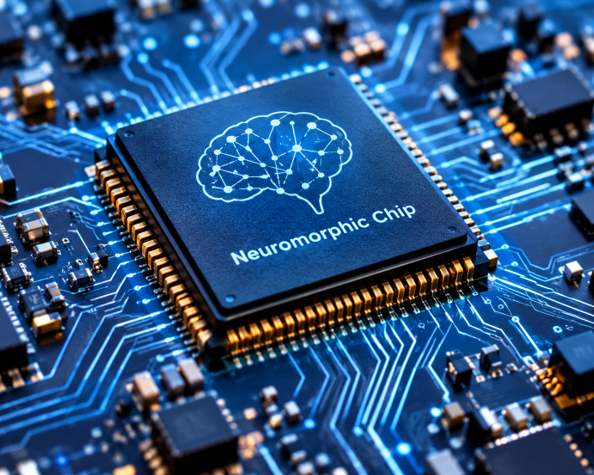
Neuromorphic Chip Market – According to latest research by Growth Market Reports, the global neuromorphic chip market size is valued at USD 931 million in 2025, with a robust compound annual growth rate (CAGR) of 46.7% projected from 2026 to 2034. By 2034, the neuromorphic chip market is expected to reach a value of approximately USD 21.4 billion. This remarkable growth trajectory is primarily driven by the escalating demand for advanced artificial intelligence (AI) and machine learning (ML) applications across multiple industries, as well as the increasing adoption of edge computing devices that require efficient, low-power processing solutions.
The neuromorphic chip market is gaining attention as industries explore computing technologies inspired by the structure and functioning of the human brain. Unlike conventional processors that typically execute instructions through sequential or parallel digital operations, neuromorphic chips are designed to emulate neural networks and process information through interconnected artificial neurons and synapses. This approach offers opportunities to improve energy efficiency, accelerate specific computational tasks, and support intelligent systems operating in real time.
Key Drivers of Market Growth
Rising Demand for Energy-Efficient Artificial Intelligence
The increasing computational requirements of artificial intelligence are encouraging technology developers to investigate alternatives to traditional processor architectures. Training and running sophisticated AI models can require substantial processing capacity and electricity, particularly in data-intensive environments. Neuromorphic chips offer a different approach by using event-driven computation, allowing certain systems to process information when relevant signals occur rather than continuously performing unnecessary calculations.
This capability can be valuable in applications where power consumption, response time, and compact hardware are important considerations. As organizations seek to deploy intelligence closer to data sources, neuromorphic computing is attracting interest as a potential complement to conventional AI accelerators.
Expansion of Edge Computing and Autonomous Systems
Edge devices increasingly need to interpret environmental information and respond without relying entirely on cloud infrastructure. Neuromorphic processors may support these requirements in robotics, autonomous navigation, industrial monitoring, and intelligent sensors. Their ability to process dynamic inputs with potentially low latency makes them relevant to systems that must react quickly to changing conditions.
Challenges Affecting Market Adoption
Technical Complexity and Ecosystem Limitations
Neuromorphic chip development involves specialized hardware architectures, software tools, programming methods, and system integration requirements. Developers may need to redesign algorithms to benefit from event-driven processing rather than directly transferring conventional AI workloads. Limited standardization and the relative immaturity of development ecosystems can increase implementation complexity for businesses evaluating the technology.
Compatibility with existing computing infrastructure is another consideration. Organizations must determine whether neuromorphic processors can deliver practical advantages within their specific workloads before committing to large-scale deployment.
Performance Evaluation and Commercial Readiness
Comparing neuromorphic systems with conventional processors can be challenging because performance depends on the application, algorithm, workload, and evaluation methodology. While certain tasks may benefit from neuromorphic architectures, other applications may remain better suited to established GPUs, CPUs, or specialized AI accelerators. Demonstrating consistent real-world advantages will be important for broader adoption.
Emerging Opportunities in the Market
Robotics, Healthcare, and Industrial Automation
Robotics represents a promising application area because machines increasingly need to recognize patterns, respond to sensory inputs, and operate within unpredictable environments. Neuromorphic processing could support efficient perception and adaptive responses in selected robotic systems.
Healthcare technologies may also benefit from specialized neural signal processing, wearable monitoring, and intelligent diagnostic research. In industrial environments, neuromorphic chips could help analyze sensor events, identify unusual operating patterns, and support predictive maintenance. These applications will depend on technical validation, reliability requirements, and integration costs.
Smart Sensors and Internet of Things
The growth of connected devices is creating demand for computing solutions that operate under strict energy and size constraints. Neuromorphic architectures may enable sensors to detect meaningful changes locally, reducing the need to transmit every observation to a central server. This could support applications in smart infrastructure, environmental monitoring, and distributed industrial networks.
Technological Advancements and Market Trends
Research into spiking neural networks, specialized memory architectures, and three-dimensional chip integration is influencing neuromorphic hardware development. These approaches aim to improve communication between artificial neurons, reduce data movement, and increase processing efficiency. Advances in sensor integration may also help create systems that combine perception and computation within compact devices.
Another emerging trend is the development of software platforms and hybrid computing architectures that connect neuromorphic processors with conventional digital systems. Such configurations could allow developers to assign different workloads to the most suitable hardware, supporting gradual adoption without requiring complete infrastructure replacement.
Competitive Landscape
Intel Corporation
IBM Corporation
Qualcomm Technologies Inc.
Samsung Electronics Co. Ltd.
BrainChip Holdings Ltd.
SynSense AG
Innatera Nanosystems B.V.
GrAI Matter Labs
Prophesee S.A.
SK hynix Inc.
Future Outlook
The neuromorphic chip market is positioned for continued development as demand grows for responsive, energy-conscious computing. Commercial progress will depend on measurable application benefits, accessible development tools, scalable manufacturing, and integration with existing AI ecosystems. Although technical and adoption challenges remain, advances in intelligent sensing, robotics, and edge processing could expand the technology’s practical relevance through 2034.
Source: https://growthmarketreports.com/report/neuromorphic-chip-market-global-industry-analysis