

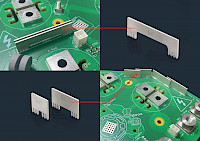
Würth Elektronik PowerBusbar PF – Würth Elektronik ICS presents the PowerBusbar PF, an innovative busbar that is press-fit vertically into the printed circuit boards to save space and increase current-carrying capacity exactly where this is needed. At the same time, it improves thermal management and can reduce the need for costly specialised PCBs, such as heavy-copper PCBs or PCBs with copper inlays.
The PowerBusbar PF (PF stands for press-fit) is available in four standard sizes, with lengths ranging from 19 to 59 mm, a height of 18.4 mm and a thickness of 1.2 mm. Combining the different lengths allows a wide variety of current paths to be implemented. In addition, the PowerBusbar PF can bypass specific areas of the PCB, thus acting as a high-current bridge.
When standard PCB traces are no longer sufficient
In applications such as AI data centres, electric mobility, energy storage and industrial automation, PCBs need to carry higher currents. At the same time, the focus on cost-effectiveness and resource efficiency is increasing. The PowerBusbar PF provides the required copper cross-sectional area exactly to those places on the PCB that are subject to high current loads. This eliminates the need for thick copper across the entire PCB when this is only needed in particular regions. As a result, a standard FR4 PCB can be used in many applications instead of a costly heavy-copper PCB. This saves on materials and costs, and adds flexibility when it comes to choosing suitable PCB suppliers.
Applications
Where space on the PCB is limited, vertically press-fit busbars reinforce existing trace paths in a highly space-efficient way by making use of the third dimension. Multiple PowerBusbar PFs can be combined in a modular configuration to create a continuous high-current path. This enables high currents to be transmitted reliably, even in compact PCB layouts.
If PCB traces need to cross over or direct current routing on the PCB is not possible, the PowerBusbar PF can be used as a high-current bridge. This provides greater freedom in layout design and enables complex current paths to be implemented in a space-saving manner.
Thermal management
In addition to acting as a high-current path, the PowerBusbar PF also improves the system’s thermal management. The high copper cross-sectional area of the PowerBusbar PF also helps dissipate heat and, thanks to its vertical arrangement, the busbar can also be used as a heat sink. The increased effective surface area helps to reduce hotspots and improve the reliability of the overall system. Measurements at an ambient temperature of 40°C and a current of 185 A showed a temperature reduction of up to 53.5 K.
The PowerBusbar PF is securely and permanently connected to the PCB using robust press-fit technology, eliminating the additional thermal stress on the assembly from soldering. Just as Würth Elektronik ICS Powerelements, the PowerBusbar PF enables the cost-effective implementation of high-current applications on PCBs. Visitors to electronica 2026 can experience the product family live in Munich from 10 to 13 November (Hall A3, Stand 334).
For more information visit: www.we-online.com/ics.