

The key takeaways from STMicroelectronics’ robotics briefing: the humanoid robot challenge is moving beyond AI to system-level engineering, power, sensing, motion control and cost.
Humanoid robots are often discussed through the lens of artificial intelligence. The conversation typically centres on how robots perceive their surroundings, understand instructions, make decisions and interact with humans. But after going through STMicroelectronics’ robotics briefing, my key takeaway was that AI is only one part of the humanoid robotics equation.
Underneath the intelligence is a highly complex electronic system that has to sense, compute, communicate, move, manage power and operate reliably as one integrated platform.
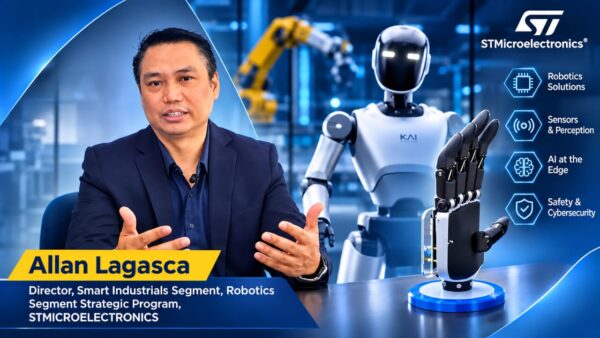
In a briefing titled “How ST is enabling the next generation of humanoid robots,” Allan Lagasca, Director, Smart Industrials Segment, Robotics Segment Strategic Program at STMicroelectronics, outlined the company’s approach to the robotics market and the engineering challenges facing humanoid robot developers.
What stood out to me was the shift from thinking about a robot as a collection of individual components to thinking about it as a complete system.
Here are five things engineers should take away from the briefing.
1. Humanoid robots are not just an AI challenge
The first thing from the briefing explores is the biggest challenge in humanoid robotics cannot be solved by making the AI model smarter alone.
ST identifies several technological challenges, including AI software maturity, insufficient training datasets and battery limitations. But these sit alongside cost, supply-chain, regulatory and implementation challenges.
This is important because the humanoid robot has to operate in the physical world.
It needs to understand its environment, but it also needs to move accurately, maintain balance, control motors, process sensor data, communicate between subsystems and manage energy.
In other words, there is a significant difference between an AI system that can make a decision and a physical robot that has to execute that decision through motors, joints and actuators.
For engineers, the humanoid robot should increasingly be viewed as an electromechanical computing platform, rather than simply an AI machine.
2. Semiconductors are distributed throughout the robot
The second major takeaway was how deeply semiconductors are embedded across the humanoid architecture.
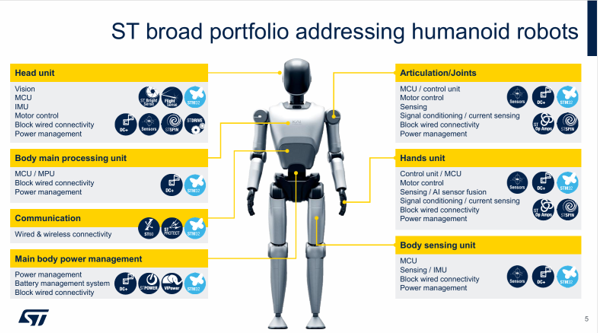
ST’s presentation divides the robot into multiple functional areas, including the head unit, body main processing unit, communication, main body power management, articulation/joints, hands and body sensing. These areas require combinations of MCUs, sensing, motor control, current sensing, connectivity and power-management technologies.
Consider the robot’s hand.
It may require a control unit or MCU, motor control, sensing, AI sensor fusion, signal conditioning/current sensing, connectivity and power management.
The same principle extends to the joints and body.
This tells us that the semiconductor opportunity in robotics is not concentrated in one processor. Instead, it is distributed across the robot’s nervous system and physical movement architecture.
Sensors provide information. MCUs and processors interpret and distribute information. Connectivity allows different parts of the robot to communicate. Motor-control electronics turn commands into movement. Power-management devices keep those systems operating.
3. Power could become as important as intelligence
One of the most interesting points from the briefing was the emphasis on battery limitations.
ST lists battery limitations including the need for longer operation and reduced downtime among the key technological challenges facing humanoid robots.
This makes perfect sense when we consider what a humanoid robot has to power.
There is compute. There are cameras and other sensors. There are numerous motors and actuators. There is communication between different modules. And there is continuous control of joints and movement.
Unlike a stationary computing system, a humanoid robot has to carry its energy source while physically moving that energy-consuming hardware.
That creates a difficult engineering balance: More capability implies more processing and sensing results in potentially more power consumption hence greater battery requirements.
The briefing also identifies power management and battery management as important elements of the robot’s architecture.
The future of humanoid robotics will not be determined only by how much AI processing can be put inside the robot. It will also depend on how efficiently that intelligence, sensing and movement can be powered. For semiconductor engineers, this makes power-management architecture a strategic part of robotics design rather than a supporting function.
4. Cost and supply-chain maturity will determine how quickly humanoids scale
Another lesson from the briefing is that technological capability alone will not make humanoid robots commercially successful.
ST highlights high unit costs, software customisation and an underdeveloped supply chain involving components such as precision motors, screws, reducers and sensors. The company also points to uncertain indirect costs associated with R&D, AI training and maintenance.
This is where the discussion becomes particularly relevant for the electronics manufacturing ecosystem.
A humanoid robot requires a large number of components working together. Even if individual semiconductor devices become more affordable, the overall system can remain expensive because of mechanical components, motors, sensing, integration, software and manufacturing complexity.
ST’s presentation estimates an overall $600 current BOM opportunity across the robot architecture. The diagram covers sensors, distributed processing, the main brain, actuators, power, communication, motors, encoders, reducers, bearings and other elements.
5. Semiconductor companies are moving from components toward system engineering
Perhaps the strongest message I took away from the briefing was ST’s emphasis on system engineering.
ST also briefed about the conventional product approach focused on product fit with a system-engineering mindset focused on achieving a system-level fit. It illustrates this using a robot-hand example, where the physical dimensions and functional requirements of the end application become part of the engineering equation.
ST’s module-to-system strategy illustrates this thinking across robot hands, joint motors, distributed control, sensing and connectivity. The presentation also highlights integrated robotics modules and a roadmap that includes compute-ready robotics and a full-robot pipeline.
The company’s ecosystem strategy also includes collaboration with NVIDIA, Leopard Imaging and other robotics companies, startups and solution providers.
This could be one of the biggest changes in semiconductor suppliers’ role in robotics. The opportunity is moving from: “Here is our component.” towards: “Here is how our technology fits into your robot.” That requires semiconductor companies to understand the customer’s complete system—including mechanical constraints, sensing requirements, compute architecture, communication, power and motion.