

Mobile Proxies vs VPN for 5G Testing: The Short Answer
Unlike ordinary proxies, mobile proxies send requests through a carrier connection on 4G, LTE or 5G, so destinations see carrier-network behavior. A VPN encrypts your own data and routes it through provider servers, usually with datacenter IPs. That protects and relocates the connection, but it does not create a cellular identity.
Mobile proxies cannot test the radio side of 5G: signal, handover or raw 5G throughput. Those checks need a 5G SIM in a device on site. Speed, latency and session control decide the fit. Choose mobile proxies when destinations must see traffic from a 5G carrier network. Pick a VPN when the task needs encrypted relocation.
What Mobile Proxies Do in 5G and 4G Tests
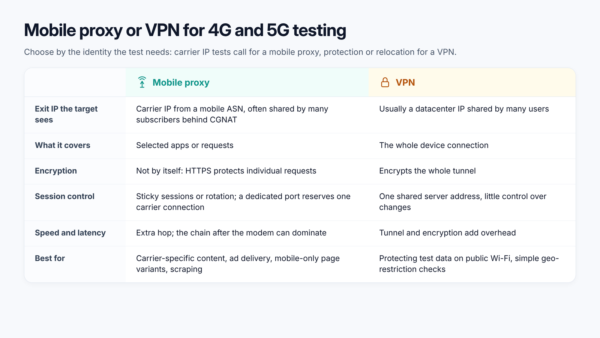
Mobile proxies route a request through a modem or SIM router on a real carrier network. The target sees a carrier IP address from a mobile ASN. Behind it can be LTE, 4G, or 5G access. CGNAT often puts many subscribers behind one public address. That is why platforms treat carrier IPs differently from datacenter ranges. These proxies usually expose HTTP, HTTPS, and SOCKS5.
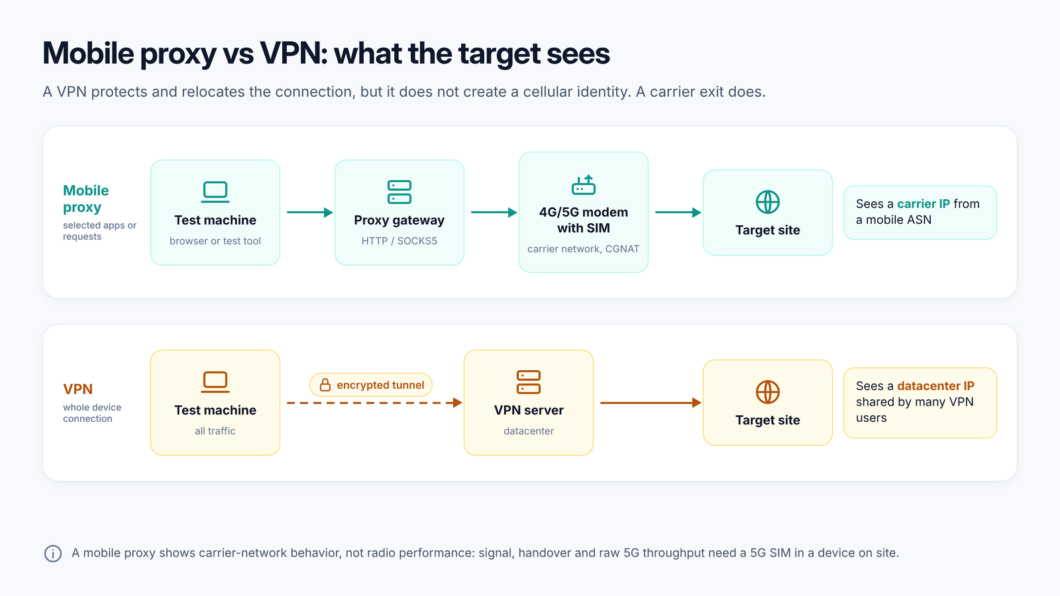
The main advantage is simple: you see 5G and 4G behavior on that network. You can check carrier-specific content, ad delivery, mobile-only page variants, and data rendering. A short test run does not need a large contract. A cheap mobile proxy rented per port for a day or a week can be enough. These proxies do not put your own device on 5G, because the radio side stays on the remote modem.
Where a VPN Fits — and Where It Falls Short
A VPN encrypts the whole device connection, while HTTPS protects individual requests. This helps testers on public Wi-Fi protect remote test data. It also moves your apparent location, so it suits simple 5G geo-restriction checks. A VPN works over 5G, but the exit address is usually a datacenter IP shared by many users. The target therefore sees a VPN network, not a carrier 5G or 4G connection. The added tunnel and encryption can slightly change 5G speed and latency during actual test runs. In the VPNalyzer study (2022), traffic leaks during tunnel failure appeared in 26 VPN providers, so choose a client with a reliable kill switch. A VPN’s advantage over proxies is system-wide setup: no per-app configuration, unlike mobile proxies.
Speed and Latency: 5G vs 4G Through a Proxy or VPN
Mobile proxies and a VPN both add a hop across another network before traffic reaches the target. That extra step changes speed and latency. The 2025 study “VPNs—Are They Really Good?” found VPN usage reduces throughput and raises latency. To gain carrier identity from these proxies, you accept a longer path. To gain encryption from a VPN, you accept overhead. The chain after the modem can dominate, so record test profiles separately.
Speed numbers from such proxies are not 5G radio benchmarks. In 2026, 5G SA can show latency under 15 ms, while 4G LTE often sits between 30 ms and 60 ms. For page loads, API calls, scraping, streaming, and login tasks, the target server often sets the pace. A stable 4G network with good coverage may then erase the 5G advantage.
5G helps most over 4G with large uploads, real-time apps, and tight response checks. 4G is often enough for short tasks where the server dominates. 5G alone does not guarantee a faster test, and the carrier network and 4G signal still shape every result. A 5G link may win on raw throughput, while a 4G link wins on predictability. Compare 4G and 5G results by the task, not by marketing speed claims.
IP Rotation, Sticky Sessions and Session Management
Fresh views and a stable address pull tests in opposite directions. IP rotation supplies new identities through rotating proxies, useful for independent checks or managing multiple accounts. Sticky sessions keep the same IP so a login, cart, or checkout does not break. Frequent changes can interrupt multi-step flows, while a page-availability check may tolerate a new address per request.
On a 4G or 5G mobile network, CGNAT and carrier pools shape rotation behavior. A VPN usually gives one shared server address with little control over changes. For stable session management, dedicated mobile proxies reserve one carrier connection for the rental period. The reserved connection keeps a 5G test isolated from another user’s traffic, and HTTP and SOCKS5 are supported. Session management makes the connection predictable. Use sticky sessions for stateful 5G paths and rotating proxies for fresh views.
Scraping, Ad Verification and Account Tasks
For web scraping, price data checks and content scraping, carrier IPs make requests look like ordinary phone traffic. That lowers false blocks that often hit datacenter addresses from a VPN. Ad verification uses the same idea: it shows how ads render and which creative an ad server serves to 4G and 5G audiences.
Social media automation, account tasks and scraping tasks on Instagram, Facebook or TikTok also depend on network origin. Mobile proxies can give accounts the network origin of a real phone on 5G, but such proxies do not change platform rules on multiple accounts. Compliant QA and account management still require checking each platform’s terms and robots rules before collecting data or managing owned or client accounts.
How to Choose Between Mobile Proxies and a VPN
Choose by the test identity: pick mobile proxies for carrier IP tests and a VPN for protection or relocation. Check 4G and 5G network coverage before trusting latency. For many tasks, 4G suffices. For scraping or account work, decide whether sticky sessions or rotation gives the advantage. Verify protocol support, because Chrome cannot send SOCKS5 username and password. HTTP works in that browser with login credentials, so use it or a local forwarder. Teams often assume one protocol fits all, and that mistake wastes debugging time, complicates session management, and forces paid reruns. For traffic-heavy runs, choose between per-port and per-GB plans and check support and replacement terms. Real 5G radio performance needs a physical 5G device. Residential proxies are another option. Sometimes a mobile proxy and a VPN both belong in one test.
Mobile Proxy Services Worth Considering
These well-known services offer mobile proxies for 4G and 5G testing. After you choose, compare their 5G network options, session control and support.
Bright Data — large-scale data collection teams
Proxyway reportedly marked Bright Data as discontinued in April 2026. Check its current status, mobile network options, session controls and billing model before planning a QA testing project around it.
OnlineProxy — dedicated mobile IPs for session-based 5G and 4G tests
OnlineProxy provides mobile proxies on 4G/5G carrier IPs through modems and SIM routers with real SIM cards. It suits tests needing stable carrier sessions, with a dedicated device, sticky sessions and HTTP/SOCKS5. Authentication is login/password only, and IP whitelisting is unavailable. Billing is per port for 1, 7, or 30 days, minimum 24 hours, not per GB.
Oxylabs — enterprise scraping and QA teams
Oxylabs suits teams that need broad mobile IP coverage. In Proxyway’s April 2026 mobile test, it recorded 1,192,449 distinct IPs, the highest count of any provider tested. That scale can aid rotation. However, the figure applies only to that test, so buyers should verify the current pool size before making procurement decisions.
SOAX — smaller teams starting with mobile IPs
SOAX offers mobile proxies for smaller teams starting with carrier-facing tests. The service has a reported pool of more than 33 million mobile IPs. Mobile proxies are reportedly priced at the same rate as residential proxies. Check session control, 5G coverage and device options before committing.
Services Compared at a Glance
Mobile proxy services compared
| Service | Best for |
| Bright Data | Large-scale data collection teams. Proxyway reported it discontinued in April 2026. |
| OnlineProxy | Session-based 5G and 4G tests. Dedicated device with sticky sessions. |
| Oxylabs | Enterprise scraping and QA teams. |
| SOAX | Smaller teams starting with mobile IPs. |
Match session control, billing and network coverage to the test before choosing a service.
FAQ: Mobile Proxies, VPNs and 5G
Does 5G work with a VPN? Yes, it still runs over the mobile network. However, encryption and the extra hop add latency and measurable overhead during normal checks. It can slightly change the results you record.
Are proxies the same as a VPN? No, proxies route selected app or request traffic, while a VPN tunnels the whole device and encrypts that path. Whole-device coverage makes setup simpler, but a VPN does not create a carrier identity.
What is the difference between a residential proxy and mobile proxies? Residential ones use home ISP addresses, while mobile ones use carrier 4G addresses behind CGNAT. Many subscribers share one public IP there. This affects how sites classify the visit.
Is 5G safer than LTE? It adds some security improvements, but neither generation replaces HTTPS or a VPN for protection. Radio security and traffic routing remain separate controls. A test plan should keep those layers distinct.
Can a mobile proxy measure real 5G speed? It does not show radio performance, but it shows end-to-end behavior through a remote modem. Signal strength, handover and local throughput belong to the handset, so those checks need a physical device.