


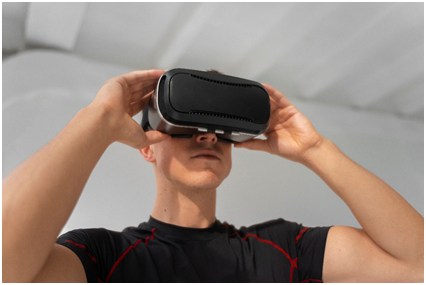
Augmented Reality Glasses: One of the most revolutionary developments in wearable computing is augmented reality (AR) glasses. In contrast to virtual reality (VR) that completely encloses users in a fabricated world, AR glasses attach digital data to the real world; thus, the user’s senses are amplified instead of being substituted. Initially, the tech was only there in the form of trials, but now it has become an increasingly sophisticated commercial device. Better optics, sensor systems, and display technologies have largely been responsible for their improved performances. Here, we follow the history of AR glasses, explain the latest innovations, discuss the changes in the market, and forecast the next generation of wearable tech.
Historical Evolution: From Concept to Commercial Platforms
In fact, the idea of AR glasses was conceived long before any wearable tech for consumers was available and has been mainly shaped by industrial requirements. These pioneering gadgets were equipped with some optics, a simple display, and camera features, but were not user-friendly or affordable enough for a great number of people. Though innovative, these first versions of the idea were lacking in features and therefore didn’t see widespread use. They have become the foundation for the next technological revolutions, which, among other things, pointed out the requirement for designs that are easier to use and more accessible.
The challenges a head-mounted display for everyday use had to face, such as form factor, battery life, and privacy issues, marked a turning point. These trials, though not successful in terms of sales, were very important for the development of future layouts, which would be more comfortable in an ergonomic sense and also more practical for application integration. With the improvement of the hardware, innovations in waveguide optics and micro-display technology have opened the way for high-resolution images through transparent lenses, thus helping to convert AR glasses from a mere concept to a commercially viable platform.
Contemporary Innovations and Applications
1. Integration of Artificial Intelligence
Contemporary AR glasses are progressively embedding AI features as part of their operating systems. They perceive the environment through images, analyze the context, and give the user the requested information right in their line of sight. Features like object recognition, real-time language translation, and smart navigation overlays are far from being basic notification functions.
With the help of AI, these AR glasses become one of the user’s cognitive instruments instead of just a visual showcase. Such a transformation gives the possibility of better decisions in situations requiring quickness and correctness, e.g. rescue operations, medical diagnostics, and complicated industrial processes.
2. Wearables Designed for Diverse Use Cases
AR glasses are now purpose-built to serve a wide range of professional and consumer needs:
- Professional and Industrial Applications:
Augmented reality glasses are used in areas like production and supply chain to get easy access to the procedure, monitoring the real-time data, and also for remote communication with people. The augmented reality glasses market is largely driven by the expansion of enterprise deployments of AR glasses.
- Healthcare Environments:
One of the most frequently used methods is when medical professionals use AR overlays during operations, whereby they can get patient data, anatomical references, and collaborative insights without interrupting the workflow or the visual concentration.
- Consumer and Social Use:
Consumer-focused AR glasses feature a lightweight design and intuitive functionality, providing navigation, multimedia interaction, and social connectivity as a natural extension of mobile devices and cloud platforms.
3. Operating Systems and Ecosystem Development
The availability of an ecosystem is probably one of the most important factors that will determine whether AR glasses will be adopted in the future or not. Consolidated operating systems specially made for extended reality setups are intended to maintain the uniformity of development procedures and reduce the division of different hardware and software platforms. Better compatibility makes it possible for devices, applications, and cloud-based AI services to be more compatible with each other, thus, the pace of AR glasses-based market innovation and adoption is getting faster.
4. Advancements in Form Factor and Wearability
One of the major effects of continuously miniaturizing the components of AR glasses is that the physical design of these devices has been radically improved. In particular, the industry has addressed issues of discomfort, battery inefficiency, and the device’s appearance with the introduction of ultra-thin displays, lightweight waveguides, and ergonomic construction, all of which greatly benefit the user. Also, academic research in this area is looking into the next generation of optical materials like diffractive waveguides which will pinpoint further enhancement that will make the visual experience with AR glasses more natural and comfortable for a long period of daily use.
Augmented Reality Glasses Market: Current Status and Key Drivers
The augmented reality glasses industry is moving beyond initial trials to a more stable commercial usage. Expansion is backed by several long-term changes:
- Increased enterprise utilization across manufacturing, healthcare, and logistics
- Broader consumer awareness driven by improved usability and accessibility
- Integration with an advanced network infrastructure and cloud-based AI systems that improve performance and responsiveness
A major signal of the technology’s expansion is the fact that the worldwide user base for mobile augmented reality applications has gone beyond 1 billion active users, which shows in a very convincing way that AR interfaces have been widely accepted even without the usage of a head-mounted form factor. This landmark demonstrates the increasing influence of AR technologies in people’s everyday lives and also works as a main indicator of the future development of AR glasses.
The sustained increase in the variety of applications as well as the profound integration of AR technology in the enterprise IT ecosystems, is a dependable source of long-term demand.
What’s Next: The Future of Wearable AR Technology
1. Convergence with Mixed Reality and Virtual Reality
AR glasses are becoming more popular as one of the elements of an extended reality (XR) ecosystem that also brings together VR and mixed reality technologies. The main objective of this convergence is to develop such digital experiences that users can switch in a very natural way from their physical to virtual environments and vice versa.
2. Expansion of AI Co-Processing Capabilities
It is predicted that next-generation AR glasses will have specially designed AI co-processors to manage complicated visual as well as contextual analyses by themselves. Such a local processing method results in lower delay, better data confidentiality, and more interactive real-time scenarios, even if the device is not connected to the external network all the time.
3. Emerging Interaction Models
There are new ways to interact with the system that are being developed very actively, such as gesture recognition, advanced voice control, and experimental neural interfaces. These changes are intended to offer people more instinctive and ‘human’ means of communication with digital overlays, which are something beyond the usual touch-based inputs.
4. Increasing Consumer Acceptance
As AR glasses become lighter, more compact and affordable, wider consumer acceptance is anticipated. The transition will unfold a plethora of possibilities for the use of the glasses to jump out of the professional productivity pool and into common daily activities, consequently setting AR glasses in the same line as other wearable technologies, which have become mainstream.
According to Pristine Market Insights, augmented reality glasses have moved beyond mere concepts to various potential and increasingly practical computing platforms. Fueled by continuous improvements in optics, AI, and wearable hardware, these gadgets are changing the way people access digital information in their real-world surroundings. The augmented reality glasses market is evolving further with the use of enterprises and the improvement of technology. By maintaining the momentum of innovation and the growth of the ecosystem, AR glasses are on the way to becoming the main interaction tool of the following computing wave, mixing the user’s physical presence with digital augmentation.