

New 5G Base Station Radio Unit:
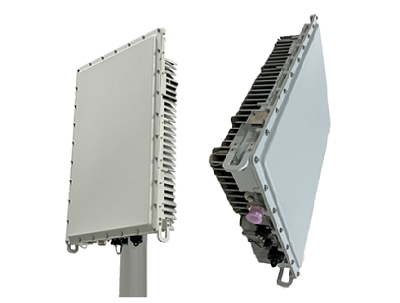
NEC Corporation announced the development of a new Radio Unit (RU) for 5G Sub-6GHz band base stations, featuring Massive MIMO technology. The new device is a successor to NEC’s current integrated antenna RU and is scheduled for release in the first half of fiscal year 2026, following performance evaluations and verification tests.
Since 2020, NEC has shipped over 50,000 Massive MIMO units in Japan and international markets, demonstrating its cutting-edge technological capabilities and extensive experience in this field. The new device was developed in response to growing demand for communications traffic and increasing societal need for energy efficiency. It significantly improves both uplink and downlink throughput, while also achieving a more compact, lightweight, and power-efficient design. Furthermore, by combining it with NEC’s virtualized RAN (vRAN), it offers greater flexibility in base station deployment locations, contributing to a reduction in operators’ total costs.
The new device leverages MU-MIMO (Multi-User MIMO) technology, which utilizes multiple antennas to communicate simultaneously with multiple terminals, and a technology that enables real-time formation of highly directional beams toward terminals. This ensures stable, high-speed communication even for fast-moving terminals and in congested environments.
Simulation results show that the average user throughput has improved by approximately 48% for uplink and 54% for downlink compared to NEC’s current model. With a future software upgrade, uplink performance is expected to further improve to approximately 55%.
In terms of power consumption, the new device achieves a significant reduction of approximately 42% to 315W during normal operation and 30% to 630W or less during peak operation compared to the current model, contributing to lower operating costs and environmental impact. A compact and lightweight design has also been achieved by reducing its volume by approximately 23% to 23.6L or less and its weight by approximately 33% to 16kg or less through the adoption of compact components and a fanless design. This allows it to be installed by a single person on-site, contributing to a significant reduction in installation labor.
Moreover, when integrated with NEC’s vRAN, the fronthaul distance between the RU and the Distributed Unit (DU), which is located in data centers and office buildings, will be extended from the current 30km to up to 40km by using software to smoothly control communications delays. This expansion of fronthaul distance increases flexibility in base station placement while minimizing the impact on throughput. It also enables dynamic allocation of RUs and optical transmission paths in response to fluctuations in communication demand, thereby optimizing both CAPEX and OPEX.
NEC plans to collaborate with telecommunication carriers to conduct performance evaluations and verification tests, aiming for a product launch in Japan in the first half of fiscal year 2026. Concurrently, NEC will continue development to meet the standards and requirements of various markets worldwide, with the goal of launching international versions in the second half of fiscal year 2026.
NEC will showcase the new device at “MWC Barcelona 2026 (MWC2026),” the world’s largest mobile-related exhibition, scheduled from March 2 to 5, 2026.
Some of the technologies used in the new device were obtained from a grant program (JPJ012368G50801) by the National Institute of Information and Communications Technology (NICT), Japan.
For more information, please visit www.nec.com.