

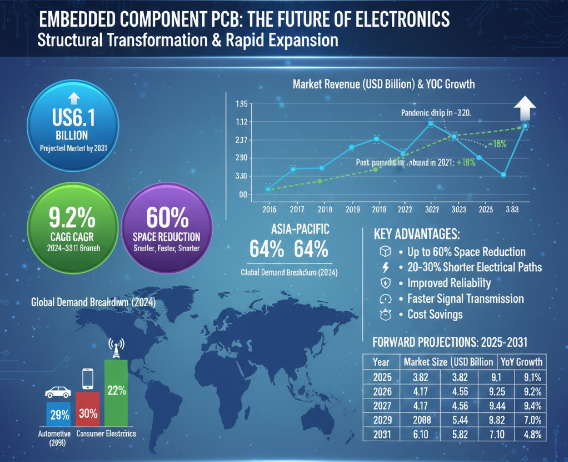
The global Embedded Component PCB market is shifting from incremental innovation to structural transformation. According to insights published by Marketintelo, the industry generated USD 3.2 billion in revenue in 2023, climbed to USD 3.5 billion in 2024, and is projected to reach USD 6.1 billion by 2031, expanding at a 9.2% CAGR (2024–2031).
Unlike conventional PCBs, Embedded Component PCB technology integrates resistors, capacitors, and even active chips within inner layers, cutting surface real estate by up to 60% and reducing electrical path length by 20–30%. The result: improved reliability, faster signal transmission, and measurable cost savings in high-density applications.
A Decade of Acceleration: 2016–2025 Market Evolution
Over the past nine years, the Embedded Component PCB industry has expanded from USD 1.95 billion in 2016 to an estimated USD 3.82 billion in 2025, representing a cumulative growth of 95.9%. What began as steady single-digit expansion has transitioned into structurally reinforced growth driven by automotive electrification, ADAS integration, high- density consumer electronics, and 5G infrastructure rollout.
Market Performance Snapshot (USD Billion)
| Year | Revenue | YoY Growth |
| 2016 | 1.95 | — |
| 2017 | 2.12 | 8.7% |
| 2018 | 2.29 | 8.0% |
| 2019 | 2.47 | 7.9% |
| 2020 | 2.39 | -3.2% |
| 2021 | 2.82 | 18.0% |
| 2022 | 3.05 | 8.2% |
| 2023 | 3.20 | 4.9% |
| 2024 | 3.50 | 9.4% |
| 2025* | 3.82 | 9.1% (Est.) |
Notable Shifts:
- Pandemic dip in 2020: –3.2%
- Post-pandemic rebound in 2021: +18%
- Production volume increased from 2.1 billion units (2016) to 3.6 billion units (2024).
- Multilayer embedded boards (>8 layers) rose from 41% of shipments (2017) to 55% (2024).
- 2025 acceleration milestone: Market revenue projected at USD 3.82 billion (+9.1% YoY), production near 3.9 billion units, with 58% multilayer board penetration.
Automotive Electronics: 32% of Global Demand by 2031
Automotive applications now represent 29% of Embedded Component PCB revenue (2024), up from 18% in 2016.
EV production data underscores this expansion:
- 2019: 2.2 million EVs
- 2021: 6.7 million EVs
- 2023: 14.1 million EVs
- 2024 (est.): 17.8 million EVs
That’s a 709% increase since 2019, driving integration of battery management systems and advanced driver-assistance modules.
Automotive segment forecast CAGR: 10.3% (2024–2031).
Telecom & 5G: Density Over Volume
Telecom contributes 22% of global Embedded Component PCB revenue (2024). 5G infrastructure installations grew from:
- 1.2 million base stations (2020)
- 3.4 million (2022)
- 4.8 million (2024)
Embedded Component PCB usage improved high-frequency signal stability by 18–25% in RF modules. The telecom segment is expected to surpass USD 1.5 billion by 2031.
Consumer Electronics: 30% Share, Shrinking Form Factors
Consumer electronics accounts for 30% of global demand, fueled by compact smart devices. Between 2018 and 2024:
- Average smartphone motherboard thickness reduced 19%
- PCB wiring density increased 37%
- Embedded passives penetration rose from 63% to 72%
Embedded Component PCB reduces assembly stages by 12–15%, directly lowering production cost per unit by 8–11% in high-volume manufacturing.
Regional Market Landscape (2024)
1. Asia-Pacific – The 64% Powerhouse
Market value: USD 2.24 billion (2024)
Projected 2031 value: USD 4.1 billion
Breakdown:
- China: USD 1.02 billion
- Japan: USD 450 million
- South Korea: USD 320 million
- Taiwan: USD 240 million
Regional CAGR: 9.8%
Semiconductor and PCB infrastructure investments across Asia-Pacific exceeded USD 52 billion (2022–2025 pipeline).
2. North America – Innovation-Driven Growth
Market size: USD 690 million (2024)
Forecast CAGR: 8.1%
- Aerospace electronics demand grew 12% YoY (2023–2024).
- Advanced defense electronics funding surpassed USD 850 billion federal allocation (2024).
Embedded Component PCB adoption in aerospace systems improved vibration resistance reliability by 23%.
3. Europe – Automotive Backbone
Market value: USD 460 million (2024)
Germany accounts for 36% of European demand.
Automotive electronics exports increased 9.2% in 2023, supporting steady embedded PCB integration.
Projected CAGR: 7.6%
4. Rest of World
Market size: USD 170 million (2024)
Growth rate: 6.5% CAGR
Technology & Manufacturing Metrics
- Embedded passives: 72% of total implementations
- Embedded active components: 28%, fastest-growing at 11.4% CAGR
- Manufacturing yield improvement: from 90% (2018) to 95.2% (2024)
- Average R&D spending among leading PCB firms: 5.1% of revenue
- Capital expenditure in PCB fabrication (2022–2024): USD 20+ billion
Power electronics applications alone are forecast to grow at 11.7% CAGR through 2031.
Forward Projections: 2025–2031 Revenue Outlook
| Year | Market Size (USD Billion) | YoY Growth |
| 2025 | 3.82 | 9.1% |
| 2026 | 4.17 | 9.2% |
| 2027 | 4.55 | 9.1% |
| 2028 | 4.98 | 9.4% |
| 2029 | 5.44 | 9.2% |
| 2030 | 5.82 | 7.0% |
| 2031 | 6.10 | 4.8% |
By 2031:
- Global production expected to reach 6.3 billion units annually
- Automotive share projected at 32%
- Telecom share projected at 24%
- Embedded Component PCB penetration in advanced PCB manufacturing expected to reach 19%
Key Numerical Highlights
| Indicator | Data Point |
| Market Value (2024) | USD 3.50 Billion |
| Forecast (2031) | USD 6.10 Billion |
| CAGR (2024–2031) | 9.2% |
| Asia-Pacific Share | 64% |
| Automotive Share | 29% |
| Consumer Electronics Share | 30% |
| Telecom Share | 22% |
| Manufacturing Yield (2024) | 95.2% |
| Embedded Passives Adoption | 72% |
| Global Production Forecast (2031) | 6.3 Billion Units |
| Industry Investment (2022–2024) | USD 20+ Billion |
| Space Reduction Capability | Up to 60% |
Data-Backed Conclusion: Integration Becomes the Competitive Edge
The Embedded Component PCB market has transitioned from incremental growth to structural expansion, with:
- Nearly 80% revenue growth in eight years
- Automotive demand rising over 700% in EV-driven applications
- Asia-Pacific controlling 64% of global production
- Manufacturing yields surpassing 95%
With projected revenues crossing USD 6.1 billion by 2031 and annual output exceeding 6 billion units, Embedded Component PCB technology is becoming indispensable in high- density electronics, electric mobility systems, 5G infrastructure, and power modules.
As component density increases and device form factors shrink, Embedded Component PCB integration is no longer optional—it is becoming a measurable competitive differentiator across global electronics manufacturing.
Read A Full Report: https://marketintelo.com/report/embedded-component-pcb-market