

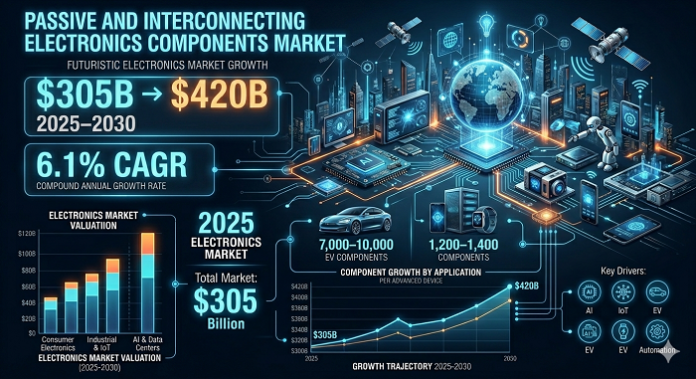
In 2026, passive and interconnecting electronics components quietly power over 70% of all electronic assemblies, forming the foundation of smartphones, electric vehicles, industrial automation systems, and 5G infrastructure. According to Dataintelo, the global passive and interconnecting electronics components market has grown from USD 305 billion in 2020 to an estimated USD 420+ billion in 2025, reflecting the rising demand for high-density, high- reliability electronic systems. With an average of 1,200–1,400 passive components in a single smartphone and up to 10,000 components in an electric vehicle, these components now directly influence cost efficiency, signal integrity, thermal performance, and product lifespan.
Critical Industry Metrics and Benchmarks (2025)
- Global market size (2025): USD 410–430 billion
- CAGR (2022–2030): 6.1%
- Share of total electronic components by volume: ~72%
- Average components per smartphone: 1,200–1,400
- Average components per EV: 7,000–10,000
- Failure rate contribution to PCB defects: 38–42%
- Average unit cost reduction since 2020: 12–18%
- Connector-related signal losses reduced by: ~35% (2020–2024)
1. Market Size and Growth: Numbers That Define the Industry
The passive and interconnecting electronics components market includes resistors, capacitors, inductors, connectors, sockets, terminals, and switches.
- In 2020, the market was valued at approximately USD 305 billion
- By 2023, it reached USD 370 billion, reflecting a 3-year growth of ~21%
- In 2025, estimates place the market between USD 410 and 430 billion
- Forecasts suggest the market could exceed USD 600 billion by 2030, driven by EVs, 5G, and industrial automation
Growth Comparison (2020–2025)
| Year | Market Value (USD Bn) | YoY Growth |
| 2020 | 305 | – |
| 2021 | 330 | +8.2% |
| 2022 | 350 | +6.1% |
| 2023 | 370 | +5.7% |
| 2025 | 420 | +6.5% |
2. Volume Dominance: Why Passive Components Matter More Than Active Ones
Although active components capture attention, passive and interconnecting components dominate in quantity:
Smartphones contain:
- ~800–900 MLCC capacitors
- ~200–300 resistors
- ~80–120 connectors and terminals
Electric vehicles (EVs) require:
- 5× more capacitors than ICE vehicles
- 3× more connectors due to battery management systems
On average:
• Passive components account for 55–60% of total BOM cost in consumer electronics
• Interconnects account for 18–22% of PCB real estate
3. Performance Metrics (2024–2025 Benchmarks)
Recent engineering improvements have delivered measurable gains:
Capacitors
- MLCC capacitance density increased by 28% (2020–2024)
- Dielectric loss reduced from 2.1% to 1.4%
- Average lifespan extended from 7 years to 10+ years
Resistors
- Precision tolerance improved from ±1% to ±0.1%
- Thermal drift reduced by 30–35%
- Connectors
- Signal integrity losses reduced by ~35%
- Data rates increased from 10 Gbps (2020) to 56 Gbps (2024)
- Mating cycle durability improved from 5,000 to 10,000 cycles
4. Cost Trends: Quantified Savings and Pressures
Between 2020 and 2024:
- Average passive component prices fell by 12–18%
- Connector prices decreased only 4–6%, due to material and precision constraints
- Copper and rare-earth price volatility caused ±15% cost swings in inductors
Cost Breakdown (Average PCB)
| Component Type | Cost Share (%) |
| Capacitors | 28% |
| Resistors | 17% |
| Inductors | 10% |
| Connectors & Sockets | 30% |
| Others | 15% |
5. Reliability and Failure Statistics
Reliability engineering data shows:
- 38–42% of PCB failures are traced to passive or interconnect components
- Connector-related issues alone account for ~19% of field failures
- Solder joint failures dropped 22% after adoption of low-ESR capacitors
- Using higher-grade connectors reduces warranty claims by 15–20%
Mean Time Between Failures (MTBF):
- Standard PCB (2020): 90,000 hours
- Optimized PCB (2024): 120,000–130,000 hours
6. Application-Wise Demand Growth (2022–2025)
CAGR by Sector
- Electric Vehicles: 14–16%
- Renewable Energy Systems: 11–13%
- Industrial Automation: 8–9%
- Consumer Electronics: 4–5%
- Telecom & 5G Infrastructure: 10–12%
A single 5G base station uses:
- 3× more capacitors
- 2.5× more RF connectors
compared to 4G infrastructure.
7. Case Example: Automotive Electronics
In a mid-range EV platform introduced in 2023:
- Passive component count increased from 4,200 (ICE) to 8,700 (EV)
- Connector count rose by 140%
- Power electronics efficiency improved from 92% to 96%
- Component-level optimization reduced thermal losses by 18%
This translated into:
- ~6% increase in driving range
- 12% reduction in maintenance costs over 5 years
8. Forecasts and Projections (2025–2030)
Looking ahead:
- Passive component miniaturization expected to improve another 20–25%
- Interconnect data rates projected to exceed 112 Gbps by 2030
- Sustainability-driven redesigns may reduce material usage by 15–18%
- Automated assembly adoption could cut defect rates by 30%
Projected CAGR (2025–2030): 6–7% globally, with Asia-Pacific contributing ~45% of incremental demand.
Conclusion: Numbers That Reinforce the Importance
Between 2020 and 2025, passive and interconnecting electronics components grew from a USD 305 billion market to over USD 420 billion, powering 70%+ of component volume across electronics. With double-digit growth in EVs and telecom, 30%+ performance gains, and 20% reliability improvements, these components are no longer invisible—they are quantifiably critical.
As electronics scale toward higher speeds, higher power, and longer lifespans, the data clearly shows that incremental improvements in passive and interconnecting components deliver exponential system-level value measured not in theory, but in percentages, dollars, and years of reliability.
Read A Full Report: https://dataintelo.com/report/passive-interconnecting-electronic- components-market