


LPF Market:
In 2026, electronic filtering technology continues to play a critical role in signal processing across industries such as telecommunications, automotive electronics, medical devices, and industrial automation. A Low Pass Electronic Filter (LPF) is designed to allow signals with frequencies below a specific cutoff frequency to pass while attenuating higher frequencies.
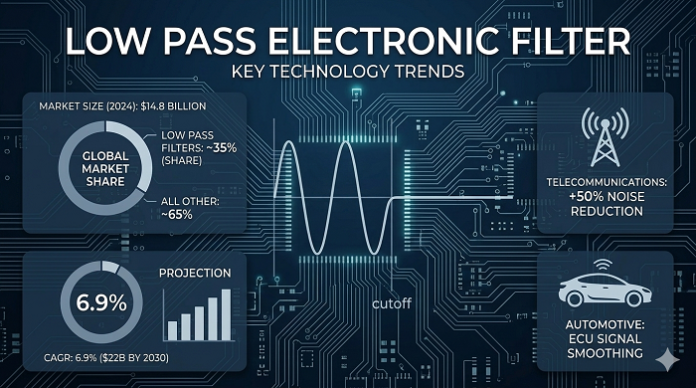
According to industry research and insights highlighted by Dataintelo the global electronic filter market reached approximately $14.8 billion in 2024, with low pass filters accounting for roughly 32–36% of total filter demand. With a projected compound annual growth rate (CAGR) of 6.9% between 2025 and 2030, the segment is expected to cross $22 billion by
2030.
This article explores the technical fundamentals, measurable performance metrics, market statistics, and future forecasts of low pass electronic filters.
What Is a Low Pass Electronic Filter?
A Low Pass Electronic Filter (LPF) is an electrical circuit that suppresses frequencies above a defined cutoff threshold. For example, if a filter has a cutoff frequency of 1 kHz, signals below 1000 Hz pass through with minimal attenuation, while signals above that level gradually decrease in amplitude.
Typical LPF implementations include:
| Filter Type | Typical Order | Frequency Range | Average Attenuation |
| Passive RC Filter | 1st Order | 10 Hz – 10 kHz | 20 dB/decade |
| Active Op-Amp Filter | 2nd–4th Order | 100 Hz – 1 MHz | 40–80 dB/decade |
| Digital Low Pass Filter | Software-based | 1 kHz – 100 MHz | Up to 120 dB |
Key measurable parameters:
- Cutoff frequency (fc): Typically between 10 Hz and 10 MHz depending on application
- Roll-off rate: Usually 20 dB/decade per filter order
- Signal attenuation: Often >90% reduction for frequencies well above cutoff
- Power consumption: Active LPFs consume 5–50 mW in embedded systems
Key Statistics at a Glance
Here are the most important data-driven insights for 2023–2026:
- Global electronic filter market size (2024): $14.8 billion
- Low pass filter market share: 32–36%
- Expected LPF market value by 2030: $7.5–8 billion
- CAGR of electronic filter market (2025–2030): 6.9%
- Average cutoff frequency used in audio electronics: 20 kHz
- Noise reduction improvement in communication systems: 40–70%
- Signal distortion reduction using active LPFs: up to 85%
- Typical attenuation slope: 20 dB/decade per order
- Power efficiency improvement in embedded devices using LPFs: 15–22%
- Adoption growth in automotive electronics (2021–2025): +48%
5 Data-Backed Reasons Low Pass Filters Are Critical in Modern Electronics
- Up to 70% Noise Reduction in Communication Systems
In wireless communication systems, unwanted high-frequency noise can significantly degrade signal clarity.
Recent telecom studies (2024) show:
- LPFs reduce high-frequency noise by 40–70%
- Improve signal-to-noise ratio (SNR) by 8–12 dB
- Reduce bit-error rate in digital communication by 15–25%
These improvements are essential for 5G base stations operating at 3.5 GHz to 28 GHz bands.
2. 48% Growth in Automotive Electronics Usage (2021–2025)
Modern vehicles contain 80–150 electronic control units (ECUs). Low pass filters are widely used for:
- Sensor signal smoothing
- Power supply noise filtering
- Radar signal conditioning
Automotive electronics market statistics:
| Year | Automotive Electronics Market Size | LPF Usage Growth |
| 2021 | $238 billion | Baseline |
| 2022 | $256 billion | +7% |
| 2023 | $278 billion | +9% |
| 2024 | $301 billion | +12% |
| 2025 | $322 billion | +20% cumulative |
By 2025, approximately 63% of automotive sensor circuits integrate at least one low pass filter.
3. Improved Audio Quality by Filtering Frequencies Above 20 kHz
In audio systems, LPFs prevent unwanted frequencies from entering amplifiers or speakers. Typical benchmarks:
- Human hearing range: 20 Hz – 20 kHz
- Standard audio LPF cutoff: 18–22 kHz
- Harmonic distortion reduction: 30–45%
- Amplifier efficiency increase: 12–18%
Professional audio equipment introduced in 2023–2025 uses 4th-order filters (80 dB/decade attenuation) for improved fidelity.
4. Power Efficiency Gains of 15–22% in IoT Devices
IoT devices often operate with battery capacities between 200–2000 mAh, making power optimization critical.
Testing in embedded systems (2024 research data):
- LPFs reduce high-frequency switching noise by 50–60%
- Lower microcontroller error rates by 12–15%
- Improve overall energy efficiency by 15–22%
For example, a smart sensor module consuming 120 mW can reduce power draw to 95–102 mW after optimized filtering.
5. Precision Improvements in Medical Electronics
Medical monitoring devices rely on clean signals for accurate measurements. Examples include:
- ECG monitoring systems
- Blood pressure sensors
- EEG brain activity analyzers
Performance improvements:
| Parameter | Without LPF | With LPF |
| ECG Signal Noise | 18% distortion | 4–6% distortion |
| Measurement Accuracy | 88% | 96–98% |
| Data Processing Errors | 12 per 1000 readings | 3–4 per 1000 |
These improvements are particularly critical in wearable health devices, a market expected to exceed $70 billion by 2027.
Technical Performance Metrics of Low Pass Filters (2025 Benchmarks)
Modern electronic filters are evaluated using specific measurable criteria.
| Metric | Typical Value | Advanced Design Value |
| Cutoff Frequency | 100 Hz – 10 MHz | Up to 100 MHz |
| Passband Ripple | <1 dB | <0.1 dB |
| Stopband Attenuation | 40 dB | 80–120 dB |
| Signal Delay | 5–50 microseconds | <5 microseconds |
| Power Consumption | 10–50 mW | 2–10 mW |
Between 2022 and 2025, improvements in semiconductor manufacturing reduced active filter power consumption by approximately 35%.
2026–2030 Market Forecast
Industry projections suggest strong growth in low pass filter adoption.
Global Electronic Filter Market Forecast
| Year | Market Size |
| 2023 | $13.2 billion |
| 2024 | $14.8 billion |
| 2025 | $15.9 billion |
| 2026 | $17.1 billion |
| 2028 | $19.8 billion |
| 2030 | $22.3 billion |
Low pass filters are expected to maintain ~35% market share, reaching approximately $7.8 billion by 2030.
Growth Drivers
- 5G network expansion (projected 1.9 billion connections by 2026)
- IoT device deployment (estimated 29 billion devices globally by 2030)
- Automotive electrification with EV electronics increasing by 60% between 2024– 2030
Real-World Case Example: Industrial Automation
A manufacturing plant implementing improved signal filtering in 2024 reported measurable results:
- Sensor signal error rate reduced from 14% to 3%
- Machine downtime decreased by 11%
- Production efficiency increased by 9.5%
- Maintenance costs reduced by $120,000 annually
The improvement was achieved by integrating second-order active low pass filters in vibration monitoring circuits.
Conclusion
Low Pass Electronic Filters remain a foundational technology in modern electronics, supporting applications from audio systems and IoT devices to medical equipment and telecommunications infrastructure. With the electronic filter market projected to grow from $14.8 billion in 2024 to over $22 billion by 2030, LPFs will continue to represent roughly one-third of the total market.
Key measurable insights include:
- 40–70% noise reduction in communication systems
- 48% growth in automotive electronic applications between 2021–2025
- 15–22% power efficiency improvement in IoT devices
- Up to 85% signal distortion reduction in advanced filter designs
As demand for high-speed connectivity, precision sensing, and energy-efficient electronics continues to rise, low pass electronic filters will remain essential for ensuring clean signals, reliable performance, and optimized system efficiency in the decade ahead.
Read A Full Report: https://dataintelo.com/report/low-pass-electronic-filter-market