

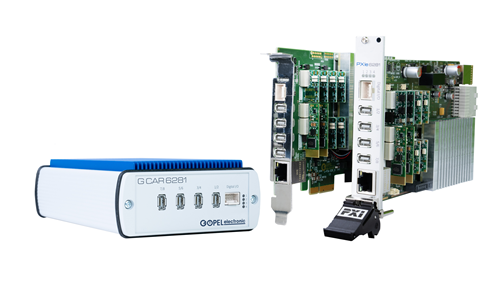
Automotive Ethernet Multibus Controller – The Multibus Controller 6281 is a field-proven test system from GÖPEL electronic offering a wide range of applications and high flexibility. This Series 62 test device is specifically tailored to the needs and transmission standards of the automotive sector and is widely used in that field. With the new expansion, the devices in the 62 Series become even more powerful: In addition to the already available support for 100BASE-T1 and 1000BASE-T1, users now have access to up to eight independent 10BASE-T1S interfaces. This allows the Multibus Controller 6281 to cover all communication technologies currently used in vehicles with just a single hardware unit. Numerous configuration and application options are available to ensure optimal adaptation to the device under test or the test task.
With the advent of Ethernet in automotive electronics, the demand for reliable and highperformance test solutions for these communication networks is growing. With a bandwidth of 10 Mbit/s and the use of a multidrop topology, which allows a large number of nodes to be connected to a single twisted-pair cable, 10BASE-T1S competes directly with established vehicle buses such as CAN, CAN FD, CAN XL, LIN, and FlexRay. The PLCA (Physical Layer Collision Avoidance) arbitration specified in the standard prevents collisions and thus enables full utilization of the available bandwidth with low latency. The new expansion for the 62 Series, featuring up to eight independent 10BASE-T1S interfaces for the first time, now allows for the simultaneous parallel testing of up to eight DUTs. This pays off above all in significant time savings during endurance tests. In addition to its eight communication interfaces, the highly flexible 6281 Multibus Controller offers eight digital I/O interfaces (4 digital inputs, 4 digital outputs). The communication interfaces can be configured in a wide variety of ways. In addition to Automotive Ethernet, CAN FD, LIN, K-Line, or FlexRay interfaces are also available. Each interface has an assigned transceiver slot, with the transceiver inserted into the slot determining the type of interface.
The Multibus Controller 6281 functions as a standalone embedded test system with its own real-time environment, in which the communication and simulation logic is executed entirely on the hardware, while the host connection via PCIe, PXIe, or Ethernet is used for parameterization, configuration, and result transmission. The G PCIe 6281 and G PXIe 6281 variants have been developed as plug-in cards for a PCIe or PXIe bus system, respectively; the G CAR 6281 is a standalone device with Gigabit Ethernet (1 GigE) as the host interface.
PCIe/PXIe offers a stable mechanical form factor and a standardized infrastructure for use in modular test systems.
Two connector variants are available to the user for connecting the DUT to the communication interfaces: RJ Point Five or, alternatively, HARTING ix Industrial®. The feature set of the Multibus Controller 6281 is identical for both variants, regardless of the connector type. The digital inputs and outputs of the Multibus Controller 6281 are located on a Molex connector. The Gigabit Ethernet host interface, which is also available on the PCIe and PXIe cards, supports PTP (Precision Time Protocol) and can therefore be used to synchronize multiple cards and devices.
In combination with the Net2Run software, complex communication and rest bus simulations can be configured based on data. Net2Run is fully based on the AUTOSAR standard and enables the import of common ECU description files such as *.arxml, *.dbc, *.ldf, and FIBEX. From these descriptions, an executable restbus configuration is generated, which is loaded onto the Multibus Controller 6281 and can be executed there completely autonomously.