


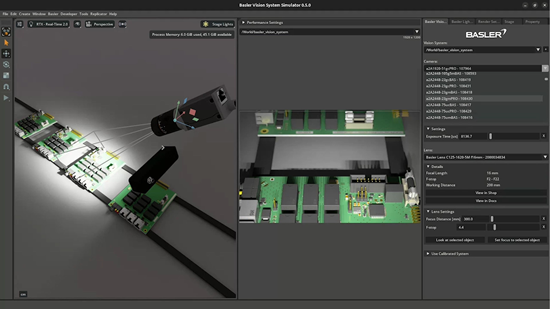
Basler Vision Simulation – Basler AG, a leading provider of machine vision products and solutions, is introducing a new tool for the digital development process of vision systems. “Basler Vision Simulation” is a software solution that allows users to develop and immediately test image processing systems and applications in a simulation environment. With the help of digital twins, vision systems can be configured digitally, evaluated realistically, compared with other configurations, and optimized—long before the hardware is built. At the same time, synthetic image data can be generated through targeted randomization to serve as training data for AI models.
The Early Access version is available for free download and offers an extensive selection of configuration options right from the start. More than 250 cameras can be combined with 30 fixed-focal-length lenses and 14 bar and ring lights.
Simulation-based development
Basler Vision Simulation brings together Basler’s decades of experience with image processing products. At the software’s core is the Basler cameras’ realistic digital modeling in terms of resolution, pixel size, field of view, and exposure time, combined with optics whose focal length, depth of field, and aperture are variable. The simulation software also takes into account lighting characteristics, such as light distribution, total light emission, and controllable lighting intensity.
The high accuracy between simulation and reality enables customers to make informed decisions about whether and how a specific application problem can be solved: Which field of view can be optimally achieved with which combination of camera and lens? Is the selected resolution sufficient? How does the scene change with different lighting products?
Synthetic data generation for AI training
AI architectures, in this case CNNs (Convolutional Neural Networks), are particularly accurate when trained with a balanced and diverse dataset of example images. In practice, real image data, especially for edge cases, is often difficult to obtain since complex test setups are typically required. In a virtual environment, both 3D objects and the parameters of vision systems can be varied (randomized) more easily. This allows image data of edge cases to be generated, such as particularly bright or dark scenes and reflections. Additionally, all synthetic images receive precise annotations—fully automatically and without the need for manual labeling.
Specific benefits for developers
Basler Vision Simulation offers development teams several advantages.
Faster decision-making: Instead of weeks for physical testing, virtual validation takes only a few hours. Multiple variants can be run through in parallel, and the best one is selected before ordering system components.
Reduced development costs: Fewer physical prototypes are needed, and fewer iterations are required, reducing development costs. Savings come not only from reduced hardware material costs, but also from the decrease in development labor time.
Higher quality and predictability: Since the systems are fully validated and optimized for the use case digitally, the performance increases in the final product.
Outlook
During the early access phase, the software will be further developed iteratively based on customer feedback. The focus is on two key aspects. Selena Schwarm, Head of Business Innovation at Basler, offers a glimpse into the future of the software: “The user-friendliness of Basler Vision Simulation will be further improved so that, for example, product selection and system configuration become more intuitive. In addition, we are working with the team on additional features that will represent real products even more comprehensively.” The goal is to release a fully updated version by early next year that can be used to increase productivity in day-to-day operations.
For more information visit: For more information on Basler Vision Simulation, visit baslerweb.com/vision-simulation