

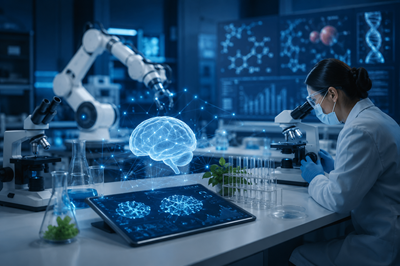
AI for Science – During the World Artificial Intelligence Conference (WAIC 2026), the “AI for Science: Beyond the Concept“ media roundtable was held in Shanghai. BAAI, CAS, SLAI, and Tsinghua University presented their latest AI-driven research outcomes across neuroscience, interdisciplinary research platforms, intelligent instrumentation, and life sciences — from sample preparation to data analysis, from literature review to experimental validation, R&D cycles are shortening from years to days.
Global R&D investment continues to rise, yet scientific discovery has not kept pace. Experimental cycles remain long, interdisciplinary collaboration faces persistent barriers, and research workflows remain fragmented. The central question — how to free scientists from repetitive tasks and embed AI across the full arc from hypothesis to validation — has become a shared priority across industry and academia. The four outcomes presented at this roundtable offer answers from multiple angles.
Unifying Neural Data Languages to Accelerate Cross-Individual Analysis
BAAI‘s ”Wujie·Brainμ1.0“ is the world’s first multimodal neuroscience foundation model, unifying EEG, calcium imaging, and neural probe signals into a single encoding framework — enabling previously incompatible neural signals to be aligned and understood within a shared architecture. In June 2026, a study it supported appeared in Science, demonstrating for the first time that memory reactivation bidirectionally regulates sleep — positive memory enhances sleep quality, while negative memory deepens fragmentation. The finding opens new avenues for intervention in sleep disorders associated with depression and anxiety. Trained on over 70,000 nights of sleep data, the model has sustained more than 12 months of automated analysis across partner labs.
Lei Bo, Researcher at BAAI, noted that while data standardization in neuroscience remains limited and the field‘s AI capabilities are still early-stage, scientist feedback has already been highly encouraging — ”This trajectory is healthier and more promising than earlier LLM development, because demand is leading capability, and real-world application is driving model iteration.“
Unified Modeling Across Eight Scientific Disciplines
CAS unveiled ScienceOne Omni, covering mathematics, physics, materials science, astronomy, and other disciplines. Built on a three‑layer architecture — Unified Scientific Data Encoding, Real‑World Knowledge Alignment, and Domain‑Specific Task Decoding — the model draws on 170 million scientific publications and integrates over 8,000 specialized research tools and skill libraries. A single model performs cross‑disciplinary data understanding, scientific reasoning, and content generation, overcoming the long‑standing trade‑off between specialist models that excel at single tasks and generalist models that lack domain depth.
Xu Nan, Researcher at the Institute of Automation, CAS, said ScienceOne Omni is more than a routine upgrade — it rethinks the very nature of scientific foundation models: ”enabling models to reason like scientists.“ ScienceOne Omni has compressed literature review from weeks to 20 minutes, boosted report generation efficiency by 5 to 10 times, and has been deployed across more than 100 research scenarios within CAS.
Full Instrument Automation, Scientists Return to Scientific Judgment
SLAI, in partnership with Suzhou National Laboratory, introduced Owl·AuraID, a multi-agent system that automates the entire experimental workflow — from sample preparation to data analysis. The system does not rely on instrument APIs. Instead, agents operate instrument interfaces the same way human experts do — observing screens, clicking buttons, and reading data — bridging the collaboration gap between software agents, embodied scientific agents, and instruments. The system now covers 6 types of precision instruments, reducing crystal structure analysis workload by 50.6%, cutting morphological analysis time from 9 minutes to 7.5 minutes, and increasing AI autonomous completion rates from 33% to 80%.
Ouyang Wanli, Vice Dean of SLAI, noted that scientific characterization demands substantial expertise and coordination across instruments — ”AI enables devices to interconnect, collaborate, and optimize, freeing scientists from operations and redirecting their focus toward scientific insight.“
AI is Evolving from a ”Supporting Tool“ to ”Research Infrastructure“
Professor Yu Li of Tsinghua University observed during the roundtable that AI is transitioning from a supporting tool to a core component of research infrastructure — its purpose is not to replace scientists, but to free them from repetitive work and refocus their efforts on scientific insight and creative thinking.
From point instruments to end-to-end automation, from single-discipline modeling to cross-disciplinary collaboration, from neuroscience to the life sciences — AI for Science is reshaping every stage of discovery at a tangible pace. When hypothesis generation, experimental validation, data analysis, and instrument operation can all be accelerated by AI, the boundaries of scientific discovery are being redrawn.
FAQs
Q1: What is the multimodal neuroscience foundation model Brainμ?
Brainμ is the world‘s first neuroscience foundation model capable of understanding multiple types of brain signals simultaneously. It unifies EEG, calcium imaging, and neural probe data into a single encoding framework, enabling scientists to analyze cross-individual, cross-scenario neuroscience data within a shared architecture. A study it supported was published in Science in June 2026.
Q2: Why is ScienceOne Omni important?
Previously, AI in research followed two paths: generalist models that lack domain depth, and specialist models that excel at single tasks but cannot generalize. ScienceOne Omni bridges this gap through its three-layer architecture — Unified Data Encoding, World Knowledge Alignment, and Task-Specific Decoding — enabling a single model to achieve both broad interdisciplinary understanding and domain-specific depth.
Q3: What are the application scenarios for Owl·AuraID?
Owl·AuraID has been deployed across 10 types of precision instruments in materials science, chemistry, biology, and other disciplines. Researchers can remotely issue instructions to complete the full workflow — from sample placement and parameter configuration to intelligent analysis — enabling 24/7 instrument operation. It has been validated in three task categories: crystal structure analysis, morphological analysis, and internal structure scanning.
This article is adopted from https://mediaconnect.com/.