

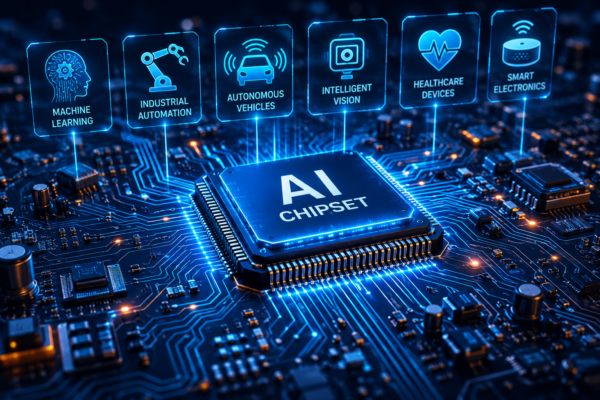
Artificial intelligence is no longer limited to cloud data centers. It has extended its application in smartphones, industrial robots, self-driving cars, medical devices, surveillance equipment, and consumer electronics. Central to this development have been AI chipsets, which are special processors developed to perform machine learning tasks faster and more efficiently than traditional computers.
Industry experts suggest that about 70% of smart electronic gadgets launched in 2026 will be equipped with dedicated AI capabilities. This transformation can be attributed to the wish for quick decision making, low timing, and more energy efficient operations. While regular average CPUs are still unable to give enough computing power to complex systems, specialized AI chipsets can combine optimized hardware architecture with advanced processing technologies.
The fast evolution of Artificial Intelligence technology in the market is evidenced by not just the improvement in its productivity, but also the widening of its commercial possibilities. As Market Intelo explains, the global market for AI chipsets amounted to USD 80.2 billion in 2020 and is predicted to reach USD 622.8 billion by 2034, with an average yearly growth of 29.5%.
Moving Towards AI-Specific Processors
Traditionally, CPUs have been the main CPU for devices. However, given that deep learning performs a lot of mathematical operations, the need for parallel processing becomes obvious. That is why special hardware optimized for AI is being developed, namely GPUs, NPUs, TPUs and AI accelerator chips.
Between 2020 and 2026, computation requirements of cutting-edge AI models increase nearly eight times, while edge AI applications grow at 25% a year.
This transition is essential for applications requiring a response time of milliseconds, such as robotics, industrial automation, and driverless transportation systems.
Why Edge AI is Driving Applications for AI Chipsets
One of the most important trends in electronics is the shift of AI processing from centralized cloud system to edge devices. Instead of sending everything to servers, modern devices are now doing processing and inference in their devices.
Recent research shows that around 60% of enterprise data is expected to be carried out on the edge by 2028 as opposed to only about 20% five years ago.
When talking about Edge AI, it has a variety of useful features:
- dramatically reduced latency when making decisions;
- increased security by performing analysis of sensitive data locally;
- lower use of bandwidth when transferring data and thus less dependence on remote servers;
- increased reliability in terms of operating in setups with low data transfer capabilities;
- decreased power usage during operations with AI technology;
These advantages have stimulated the demand for compact and energy-efficient AI chipsets.
AI Chipsets in Different Electronic Segments
The AI chips have invaded every sphere of electronics. Designs vary from application to application depending on factors like performance, power consumption, memory bandwidth, and cost.
| Industry Segments | Primary AI Function | Estimated Adoption Rate by 2026 |
| Smartphones | Image processing, voice recognition | 95% |
| Automotive Electronics | Driver assistance, perception | 68% |
| Industrial Automation | Predictive maintenance, vision inspection | 57% |
| Consumer Electronics | Personalization, speech AI | 72% |
| Healthcare Devices | Medical imaging, diagnostics | 46% |
| Smart Surveillance | Object detection, facial analytics | 74% |
The use of AI capabilities signals the incorporation of specialized chipsets in modern electronics systems.
Innovation in Semiconductors Impacts AI Hardware Developments
The rapid development of semiconductor installations has been affecting the performance of AI processors drastically. One component of this process is the shift to smaller technological processes and chip packaging techniques, which imply a heterogeneous architecture for chips manufactured.
Today’s AI CPUs often integrate CPUs, GPUs, NPUs, DSPs, and special memory modules as parts of a single SoC. Meanwhile, the data about the transistor counts in AI processors have shown an increase of more than 300% over the last six years allowing to achieve considerably greater computation density while not proportionally increasing the dimensions of chips.
Technologies related to memory also change at a fast pace. Innovations regarding high-bandwidth memory usage, improved cache architecture, and advanced interconnection technology lead to the reduction of data transfer bottlenecks that usually cause AI processing delays.
The Future of Intelligent Electronics Will Rely on AI Chipsets
Future electronic devices will be based on local intelligence rather than cloud computing. Analysts predict that more than 35 billion smart connected devices will exist globally by 2030, generating high demand for new semiconductor technologies.
Innovations in the fields of robotics technologies, collaboration systems, extended reality, smart healthcare, and intelligent transportation technology will generate demand for specialized AI-enabled computing.
The future AI chipsets cannot be perceived as dedicated processors but, rather, they will serve as intelligent systems which will be able to run multiple AI applications simultaneously and adapt to the changing conditions in real-time.
The growth of AI chipsets will happen on an ongoing basis making this technology one of the most significant ones among intelligent electronics of the future. The combination of efficient computing power and minimum energy consumption allows creating devices featuring unique performance qualities which will be used in consumer goods, industrial applications, motor vehicles, healthcare, and infrastructure.
In the future, the advancement of intelligent electronics will be determined not only by software development but by specialized hardware created for the needs of AI.