

cellular IoT supply – Astute Group has signed a franchise agreement with UTA Wireless covering markets worldwide, except China, Italy and Spain. The agreement adds a new source of cellular and positioning modules as memory shortages disrupt production across the electronics industry.
Counterpoint Research reported in April that tight LPDDR4 supply and rising memory costs were affecting high-end cellular IoT modules. TrendForce forecasted a 58–63% quarter-on-quarter rise in conventional DRAM contract prices for the second quarter of 2026.
Memory is built into many cellular modules alongside the modem and processor. If the required LPDDR or flash is unavailable, the complete module cannot ship. OEMs can then face longer lead times, higher prices or allocations that fall short of their production plan.
UTA Wireless has secured access to these critical memory products through its investors’ shareholdings in Dosilicon and Fidelix. This allows the company to source memory alongside the cellular module and support immediate demand while other supply routes remain constrained.
Headquartered in Milan, UTA Wireless supplies cellular, GNSS and short-range modules for automotive, industrial and IoT equipment. Its cellular portfolio covers LTE Cat 1 bis, LTE Cat 4, 5G RedCap and 5G NR.
Memory secured with the module
The memory portfolio available to UTA Wireless includes NAND and NOR flash, multi-chip packages combining flash and DDR, DDR3L and low-power LPDDR. The company can also combine module and memory requirements for higher-volume programmes.
UTA Wireless has no current supply issue affecting these components and can support orders now. For customers facing delayed or uncertain deliveries, that provides a practical second route while the wider memory market remains tight.
Bringing the two requirements together also simplifies planning. Engineers can select the cellular module and its memory supply as part of the same programme instead of qualifying a module only to find that one of its critical components cannot be secured.
The supply position is supported by an established engineering base. UTA Wireless was founded in Milan in 2025, while its technical centre, Tashang, was established with u-blox in 2018 and became independent through a management buyout in 2021.
The Tashang team developed the TOBY-L3 automotive cellular platform, with more than one million modules shipped to vehicle manufacturers and automotive suppliers. That experience now supports UTA Wireless products for automotive, industrial and general IoT markets.
A faster route to a second source
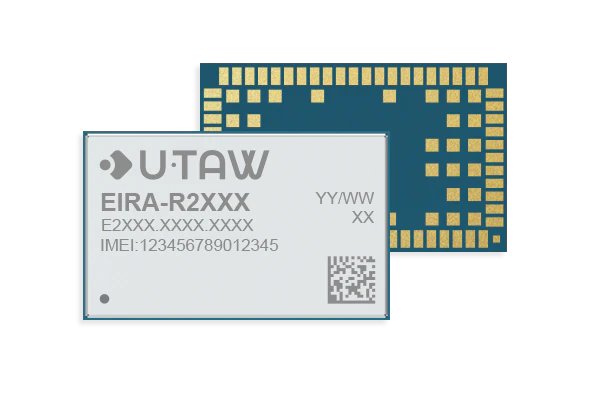
The range includes KING-R2, EIRA-R2 and ROSE-R2 LTE Cat 1 bis modules for metering, tracking and industrial IoT; NAYA-L4 for LTE Cat 4 gateways, routers and telematics; and GENE-N8 and THAD-N7 for 5G automotive and industrial systems. GNSS products cover standard and high-precision positioning, alongside Wi-Fi and Bluetooth modules.
Selected UTA Wireless products use pin arrangements aligned with established Quectel and former u-blox cellular platforms. NAYA-L4 addresses designs using Quectel EG25-G and EC2x devices, while EIRA-R2 and ROSE-R2 provide options for selected SARA and LEXI products now supported by Trasna.
A shared footprint can reduce hardware changes, but migration still requires checks covering firmware, frequency bands, interfaces, approvals and certification. Astute Group will support those comparisons for OEMs in industrial IoT, metering, telematics, transport, medical equipment, security and smart infrastructure.
“The memory shortage is now affecting complete cellular modules, not just individual components. UTA Wireless has secured the memory needed to support production and can help customers looking for supply now. It also gives us strong migration options across Cat 1 bis, 4G, 5G and GNSS.”
— Erik Gräfenschnell, Technical BDM, Astute Group