


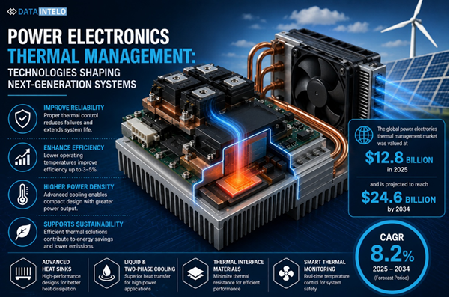
Power Electronics Thermal Management – The power electronics field is constantly evolving in terms of compactness, power, and heat generation. Examples of systems that typically operate with power outputs of several hundreds of watts to several megawatts include electric vehicles, renewable energy converters, industrial drives, data centers, and aerospace systems.
Increasing switching frequency and decreasing size of semiconductor devices create new problems in heat removal. Thermal management is necessary for better reliability, efficiency, and preventing high temperatures from limiting the performance of a given system.
The Significance of Thermal Management
Conduction in semiconductors creates heat. Energy conversion from AC to DC also makes heat. Even an efficient converter that is 98% does make a considerable amount of heat. To illustrate, a 500 kW power system operating at 98% efficiency makes 10 kW power loss. When this heat is not removed properly from the junction, it causes temperature rise.
According to Data Intelo, thermal management of power electronics market has a value of $12.8 billion by 2025 and is expected to become $24.6billion by 2034, while the compound annual growth rate (CAGR) during that period will amount to 8.2%. This illustrates that thermal control becomes increasingly important in the world of electronics.
Devices using silicon carbide (SiC) and gallium nitride (GaN) can withstand higher temperatures and frequencies of transition than silicon devices. Thus, SiC devices are designed to sustain junction temperatures of 175 and even 200 °C. Thus, higher junction temperature makes it possible to have smaller cooling systems but makes thermal design more complicated.
Heat Sink Technology Advancement
A heat sink is one of the most commonly employed methods for thermal dissipation. While traditional aluminum heat sinks tend to have thermal conductive properties of approximately 200 W/m·K, copper has a better heat conductivity rating nearing 400 W/m·K. Consequently, while copper displays superior heat dissipation performance, its higher weight and cost may limit its applicability in weight-sensitive applications.
Modern heat sink designs are also making greater use of pin-fin and microchannel designs in order to increase surface area. Microchannel heat sinks can be designed to have channels of less than 1 mm in width, allowing the coolant to interact with a larger thermal transfer area within a small space, thus significantly decreasing thermal resistance compared to classic air-cooled designs.
Liquid Cooling and Two-Phase Cooling Techniques
In the context of increasing power density, liquid cooling is receiving more attention. Water and water-glycol mixtures are capable of absorbing much more heat than air due to their higher thermal conductivity and heat capacity. In automotive power electronics, cold plates can be applied to cool inverter modules.
Two-phase systems use the latent heat of evaporation to increase the efficiency of this cooling system. Refrigerants are capable of absorbing a lot of thermal energy in the process of transitioning from a liquid to a gaseous state. Two-phase systems that can operate at heat fluxes greater than 100 W/cm² are currently under investigation for various high-end applications, including high-performance computing, and advanced semiconductor modules.
Thermal Interface Materials
The junction between a semiconductor package and a heat spreader can become a significant thermal bottleneck. Thermal interface materials (TIMs) fill microscopic surface voids that would otherwise trap air with a thermal conductance of around 0.026 W/m·K at room temperature.
Traditional thermal greases have thermal conductivity values in the order of 3–8 W/m·K. However, high-performance phase-change materials and specially designed composites can have conductivity values above 10 W/m·K. Moving from 100 micrometers down to 50 micrometers in terms of bond line thickness will help to further minimize thermal resistance when proper material attributes are also achieved and tight manufacturing tolerances maintained.
Key Technologies by Application
| Application | Typical Thermal Challenge | Common Technology | Important Parameter |
| Electric vehicles | High transient loads | Liquid cold plates | 150–200°C junction range |
| Solar inverters | Continuous operation | Forced-air cooling | 2–5% conversion losses |
| Data centers | High power density | Liquid cooling | 100+ W/cm² heat flux |
| Industrial drives | Variable loads | Heat pipes and fans | 10–100 kW power range |
| Aerospace systems | Weight constraints | Advanced heat spreaders | Low mass per kW |
Emerging Strategies in Thermal Management Techniques
There are many technologies that are garnering greater engineering interest:
- Diamonds and alternative carbon materials. Diamond has very high thermal conductivity that can exceed 1,000 W/m·K, making it possible to use it for efficient local heat spreading applications.
- Additive-manufactured cooling designs: With the help of modern technologies, it is easy to produce complex cooling channels with the size below 1 mm that allows one to optimize the cooling path.
- Embedded cooling: Cooling channels can be incorporated into substrate or semiconductor package making the heat flow between the areas much shorter.
- AI-driven thermal design: Through computation optimization hundreds or thousands of geometrical combinations can be tested before the construction of the prototype.
Reliability and Thermal Cycling
Thermal management processes are deeply connected to component lifecycle. Repeatedly applied temperature changes create mechanical stresses in materials (like silicon, copper, solder, and ceramic) in components that expand at different rates. Therefore, components in power modules can face temperature variations of 50°C and more.
By controlling the peak temperature within 10–20°C fluctuations, one can achieve a considerable reduction of thermal stress in numerous designs. As a result, engineers take into account not only the maximum junction operation temperature but also the temperature differentials, cycling frequency, cooling medium temperature, and interface resistance.
The Path Forward
The next generation of electronic power systems will create a requirement for thermal systems capable of transferring more energy across even smaller dimensions. Regardless of its efficiency of 99%, for example, a power converter is going to generate 10 kW of waste heat at a rating of 1 MW. With an increase in frequency of switching, density, and temperature of operation, passive cooling is going to be less efficient in coming applications with high power rating.
Thus, the future is going to be about integrated solutions that would allow for melding advanced semiconductor packaging, next-generation interface materials, liquid cooling, optimized heat dissipation, and real-time temperature recording methods. The best designs will use the systems for thermal management as a part of power electronics architecture instead of an additional way to cool the systems after their design.