

Astute Group, an authorised distribution partner for Sensory, is offering engineers access to SoundID, an embedded AI technology that detects, classifies and interprets environmental sounds directly on-device. The solution supports 16 pre-trained sound categories, user-enrolled sounds and deployment across platforms including Linux, Android, Windows, embedded ARM cores and low-powered chips.
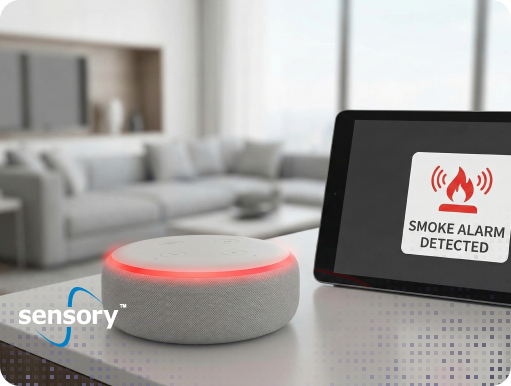
SoundID is designed for products that need to recognise events such as alarms, sirens, glass breaking, door knocks, baby cries, coughing and other environmental sounds without sending audio to the cloud. Sensory says the technology can operate locally even when connectivity is unavailable or poor, making the processing architecture independent of a continuous internet connection.
Low-power architecture targets embedded sound recognition
SoundID uses a multi-stage detection process intended to balance power consumption with recognition accuracy. A lightweight first-stage model identifies potential sound events, while an optional neural revalidation stage provides further confirmation before the system classifies the sound and triggers a response.
Sensory describes the approach as combining “fast low power first-stage detection” with an optional neural second stage. The company also uses a proprietary noise mitigation pipeline designed for environments including vehicles, homes, factories and public spaces.
The architecture is relevant to embedded designs where processor resources, memory and power budgets are constrained. Sensory’s SoundID technology is intended to run across both operating-system-based platforms and low-powered embedded hardware, with no cloud dependency.
Sensory also states that its SoundID platform can run from “88 KB per sound” and uses LiteRT and LiteRT Micro inference engines, extending deployment from low-power DSPs to application processors.
16 pre-trained sounds plus user-enrolled events
SoundID includes 16 ready-to-use sound categories covering applications such as alarms, sirens, knocking, glass break, baby cries, coughing, snoring and doorbells. Custom sound events can also be enrolled, with Sensory specifying around eight seconds of target audio, or four or more repetitions, for the enrolment process.
This allows the same technology to be configured around device-specific acoustic events rather than relying solely on a fixed library. Sensory identifies industrial sound detection as an application for identifying product issues or malfunctions, while its wider SoundID applications include automotive emergency-vehicle detection, smart home safety, accessibility and industrial IoT.
The processing flow starts with continuous local monitoring, followed by first-stage detection, optional neural revalidation and classification. Once an event has been identified, the device can trigger an alert, adjust its behaviour or communicate with another system. Sensory says audio is monitored locally rather than stored or transmitted for cloud processing.
SoundID supports automotive, industrial and medical applications
Sensory positions SoundID across automotive and transportation, consumer electronics and smart home products, mobile and personal devices, healthcare and medical devices, and retail systems. The company also identifies manufacturing floors, vehicles, homes and hospitals as environments in which its sound recognition technology is designed to operate.
For automotive systems, SoundID can be used for emergency-vehicle siren detection. In healthcare and accessibility applications, it can provide sound awareness while keeping audio processing on the device. Industrial applications can use enrolled sound events to identify particular operating conditions or product issues.
Sensory has more than 30 years of experience in embedded AI and says its technologies are deployed in more than three billion devices worldwide. Its portfolio covers voice, speech, sound identification and biometric recognition for consumer, automotive, healthcare and industrial markets.
Stay ahead on electronics news
Join the electronics industry Astute Engineer newsletter
As an authorised distribution partner for Sensory, Astute Group provides access to SoundID alongside the manufacturer’s wider embedded AI technology portfolio. Astute operates as a fully authorised franchise distributor for specialist electronic component manufacturers and supports customers through design, prototyping, sourcing, distribution and supply-chain services.
For designs where environmental sound recognition forms part of the system architecture, SoundID provides a route to local sound detection without making cloud connectivity a requirement. Its support for low-powered hardware, multiple operating environments, pre-trained sound categories and user-enrolled events also allows the implementation to be matched to the requirements of individual products.
Sensory’s SoundID is available through Astute Group as part of its authorised distribution portfolio, giving customers a direct route to the technology and the associated design-in support provided through Astute’s franchise distribution model.
Damian Semple, Franchise Marketing Manager at Astute Group, comments: “Sensory SoundID gives product developers a practical way to add environmental sound recognition without building the application around continuous cloud connectivity. The combination of low-power processing, embedded deployment and configurable sound detection also gives designers more flexibility when working within tight hardware and power constraints.”