

Glass Substrate Manufacturing – Some of the world’s biggest chip companies, including Nvidia and Intel, are turning to glass to replace the plastic-based materials AI chips sit on today, making room for larger and more complex chip assemblies. According to femtosecond laser company LITILIT, how fast this shift happens will depend not only on how well glass can be processed, but also on whether the lasers used to process it can become widely available, affordable and easy to integrate into industrial production.
A report from semiconductor industry association SEMI earlier this year projected the glass core substrate market to grow 67.2% a year from 2028 to 2040, and the biggest players are already pushing to move faster. Nvidia is reportedly asking substrate makers to finish developing glass substrates within two years, while Intel and Samsung Electro-Mechanics are developing their own.
Chipmakers favor glass because it stays flat under heat, expands at almost the same rate as silicon and carries signals with less loss. However, Nikolajus Gavrilinas, co-founder and CEO of LITILIT, notes that scaling glass substrates depends on a delicate manufacturing step, creating microscopic holes called through-glass vias (TGVs), and on making the lasers that do it ready for mass production.
“Each panel needs thousands of TGVs to carry signals and power from the chips down to the circuit board. Mechanical drills and conventional lasers can stress or overheat the glass, potentially resulting in cracks. For this kind of precision task, femtosecond lasers are emerging as a leading choice. Their pulses deliver energy faster than heat can spread, significantly reducing the risk of cracking the surrounding glass. They can drill holes directly or, in one of the main TGV manufacturing methods, modify the glass along the path of each via so it can then be opened by chemical etching,” he explains.
“But cracking is only part of the challenge. Making one good hole in glass is not the hard part. The question is whether the industry can make billions of them quickly, with the same quality every time and at a low enough cost per hole. That is why femtosecond lasers now have to move from specialized, low-volume systems into mass industrial production.”
According to Gavrilinas, how fast and reliably glass is processed will also influence the pace of the AI revolution, since femtosecond lasers are used to make components for the optical links that connect AI chips in data centers and the fiber connectors that carry their data.
Beyond AI hardware, these advanced lasers are also used to process glass for the aerospace, automotive and microelectronics industries, cut smartphone screens, manufacture medical stents and perform complex eye surgery.
Despite growing applications, femtosecond laser manufacturing capacity remains limited worldwide. In 2025, global production capacity for industrial-grade femtosecond lasers was estimated at about 9,600 units, while about 7,280 units were sold.
LITILIT is addressing this with a compact, patented laser architecture designed for simple integration into industrial equipment. This allows manufacturers to run many lasers in parallel within a single production system and process multiple vias at the same time, increasing throughput and lowering processing costs.
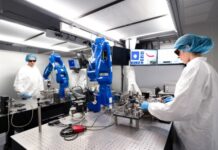
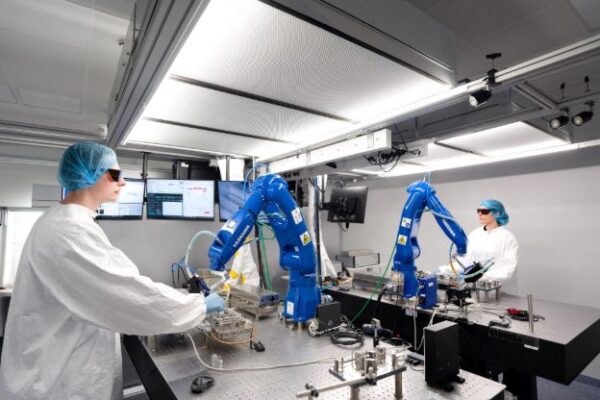
In October, the company opened a new factory in Vilnius designed to produce up to 3,000 femtosecond lasers a year at full capacity. According to the company, its modular design and automation remove much of the manual alignment and testing that typically requires hundreds of highly skilled specialists in femtosecond laser production.
“Typically, such a factory would require hundreds of highly skilled employees and a large share of production time spent on manual alignment and testing, because femtosecond lasers evolved from scientific systems and are complex to assemble. Our purpose-built patented architecture and modular design remove much of that work, while automation can handle steps that elsewhere still need a specialist’s hands,” Gavrilinas explains.
With the Vilnius factory now open, LITILIT is already planning its next expansion steps: replicating the factory in other parts of the world together with international partners. The company develops its lasers based on two patents, one of which was developed in collaboration with the Center for Physical Sciences and Technology (FTMC).
For more information visit: https://www.litilit.com/.