

Abstract
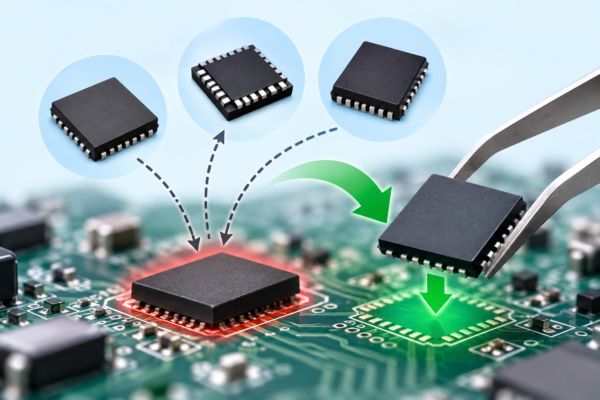
Component shortages can force embedded teams to evaluate replacements under production pressure. But matching package, voltage, and current ratings does not establish true interchangeability. A practical alternate-part workflow should combine parametric screening, circuit-level validation, supply-chain checks, and targeted retesting before a substitute enters the approved BOM.
A shortage often begins as a purchasing problem. Lead time stretches, allocation tightens, or a familiar part disappears from normal distribution. But once an alternate enters the discussion, the decision returns to engineering.
Consider an industrial edge gateway moving into a 3,000-unit production run. One buck regulator on the main board is no longer available within the required schedule. Procurement finds several candidates with similar headline specifications. On paper, the problem appears solved. In practice, this is where the real work starts.
Start With the Function the Part Performs
The first screening step should be based on the component’s role in the actual circuit, not simply on a part number or distributor description.
Assume the gateway’s existing regulator supports a 4.5–18 V input range, 3 A output current, 500 kHz switching frequency, and a QFN package. One candidate matches the input range, current rating, and package, but switches at 1 MHz.
A parametric search may still flag it as a close match. Yet the frequency change can affect inductor selection, switching losses, output ripple, EMI behavior, and PCB layout sensitivity. The candidate may be electrically viable without being a drop-in replacement.
The same principle applies to other device classes. A logic device with an identical truth table may have different input thresholds or propagation delay. A transceiver supporting the same interface may still differ in ESD tolerance, common-mode range, or startup behavior. Engineers need to define which parameters are critical before looking for substitutes.
Treat Cross-Reference Results as Candidates, Not Answers
Cross-reference tools are useful because they reduce the search space. Their best role is candidate discovery, not automatic approval.
A search for an electronic component equivalent can reveal devices with similar functions, packages, or electrical characteristics. The next step is to compare each candidate against the actual operating conditions of the circuit.
Component equivalence has several layers. A device may be functionally similar but not pin-compatible. It may be pin-compatible but require different passive components. It may satisfy both conditions yet behave differently during startup, transient loads, thermal stress, or fault events.
| Screening Area | Search Data Can Tell You | What Still Requires Engineering Review |
| Package | Package designation | Pinout, exposed pad, and layout constraints |
| Voltage | Rated operating range | Startup and transient conditions |
| Current | Nominal current rating | Thermal behavior and current limiting |
| Switching | Frequency specification | Inductor choice, ripple, losses, and EMI |
| Logic | Functional description | Thresholds, timing, and power-up behavior |
A parametric match identifies a candidate; it does not approve a replacement.
Recheck the Supply Chain at the Same Time
A technically acceptable alternate is not much help if it introduces the same availability problem a few months later.
Once candidates survive engineering screening, procurement and engineering should review sourcing conditions together. Current stock is only one factor. Manufacturer lifecycle status, authorized distribution, regional availability, lead-time behavior, date-code requirements, and traceability all influence the quality of the decision.
For the gateway project, imagine that the 1 MHz regulator is easy to buy today but comes from a vendor with limited regional distribution. A second candidate is a closer electrical match and has broader channel coverage, even though its current spot-market availability is lower. The second option may create less long-term risk.
When approved channels cannot meet the production schedule, procurement may also need to widen supplier research geographically—for example, by evaluating electronic component suppliers in China—without relaxing traceability, authenticity, or qualification requirements.
Component databases and sourcing platforms, including CNChipDepot, can shorten the discovery stage. They do not remove the engineering burden: every alternate still has to be validated against the real circuit and the broader sourcing plan.
Decide What Must Be Retested
Not every component change requires full product requalification, but every change should trigger an explicit test decision.
For the gateway regulator, sensible checks may include startup behavior, output ripple, load transients, thermal performance, and EMI. If the replacement changes switching frequency or edge rates, a board that previously passed emissions testing can behave differently even when functional tests still look normal.
The same logic applies to other parts. Replacing memory can affect boot timing or firmware compatibility. Changing a transceiver can alter signal integrity or ESD margin. The test plan should follow the failure modes that the changed component can realistically influence.
A short engineering change record can document why the alternate was selected, which specifications were compared, and which tests were repeated. That record becomes valuable when the same shortage returns later or when another engineer has to review the decision.
Build Alternate Parts Before the Emergency
The strongest alternate-part strategy starts before procurement sends the shortage email.
During design review, teams can flag components that are single-sourced, hard to replace, nearing maturity, or exposed to allocation risk. For selected devices, a second source can be investigated while the board is still in validation. Even if the alternate is not approved immediately, documenting package constraints, critical parameters, and likely substitutes can shorten the response later.
For embedded systems with long production or service lives, this is less about maintaining a giant list of backup parts than preserving design flexibility.
The key judgment is simple: alternate sourcing should accelerate engineering decisions, not bypass them. The best replacement is not the part that looks most similar in a search result. It is the part whose technical behavior, sourcing path, and validation burden are understood well enough that the team can make the change deliberately rather than under pressure.