

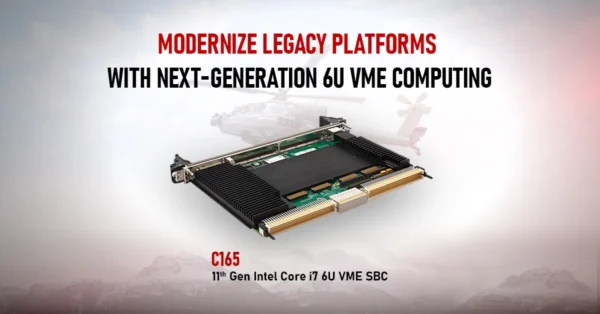
Aitech C165 – Aitech has introduced the C165 Rugged 6U VME Single Board Computer (SBC), giving defence and aerospace programmes a route to modernise fielded VME systems without moving to a new architecture. Announced earlier this month, the C165 combines an 11th Gen Intel Core i7 processor, integrated Intel Iris Xe graphics, secure NVMe storage and cybersecurity features in a rugged 6U VME form factor.
C165 provides a VME-compatible upgrade path
Aitech developed the C165 to address programmes that continue to use deployed VME architectures but require higher computing performance and updated security capabilities. The company says existing VME infrastructure can remain in place, avoiding the cost, schedule disruption and technical risk associated with a complete platform redesign.
The C165 is a pin-compatible successor to Aitech’s C164 and C163 SBCs. This gives existing deployments using those boards a defined upgrade path while retaining qualified hardware, software and platform infrastructure, according to Aitech.
“Defense customers need practical modernization solutions that improve mission capability while minimizing program risk,” said Alex Trigoub, product manager at Aitech.
The board uses an 11th Gen Intel Core i7-1185GRE Tiger Lake UP3 processor with integrated Intel Iris Xe graphics. Aitech specifies a two-times improvement in CPU performance per watt compared with previous-generation Aitech VME platforms, alongside more than 2.5-times higher graphics performance.
For systems handling mission computing, ISR processing, video analytics and sensor-driven workloads, the additional processing and graphics capability provides a way to increase performance while retaining the VME architecture already deployed.
Up to 32GB memory and 4TB secure storage
The C165 supports up to 32GB of LPDDR4X-4267 memory with in-band ECC and up to 4TB of self-encrypted NVMe SSD storage.
Security features are provided through Aitech’s AiSecure cybersecurity framework. Aitech specifies TPM 2.0, Secure Boot and Intel Boot Guard support, alongside encrypted storage, Quick Erase and Secure Erase capabilities.
“The C165 delivers modern, power-optimized Intel processing, powerful integrated GPU, advanced cybersecurity, versatile I/O and high-capacity secure storage,” Aitech said.
The board also supports PMC and XMC mezzanine sites for functional and I/O extensions. Air-cooled and conduction-cooled variants are available, with the rugged 6U VME form factor designed for defence and aerospace systems.
Stay ahead on electronics news
Join the electronics industry Astute Engineer newsletter
Availability through Astute Group
The C165 is now available for mission development and platform modernisation programmes, according to Aitech.
Astute Group is an authorised Aitech distributor and design-in partner across Europe, Australia and New Zealand. Its Aitech portfolio covers rugged embedded computing for aerospace, defence, space and maritime applications, including single-board computers based on Intel and PowerPC processors across VME, VPX and CompactPCI architectures.
Astute’s Aitech offering includes 3U and 6U SBCs in air-cooled and conduction-cooled formats, alongside rugged GPGPU products and enclosures. Astute also provides design-in assistance and support with product selection and integration.
The C165 therefore extends an existing Aitech VME portfolio with a current computing platform aimed specifically at programmes looking to address component obsolescence and increase processing capability without replacing the underlying VME infrastructure.
For programmes already using Aitech C163 or C164 boards, the pin-compatible C165 provides a direct route to a higher-performance processor, improved graphics capability, expanded memory and secure NVMe storage while retaining the established board architecture.
Aitech has confirmed that the C165 is available now for mission development and platform modernisation programmes.
Damian Semple, Franchise Marketing Manager, Astute Group, comments: “The C165 gives existing VME programmes another option when obsolescence starts to put pressure on established hardware. Retaining the VME architecture can also reduce the amount of wider system change required when a computing upgrade is needed.”