


Quantum-Safe Communication – NEC Corporation (“NEC”) and IBM Japan, Ltd. (“IBM Japan”) announced that they successfully completed Japan’s first demonstration of a hybrid quantum-safe communication technology combining quantum key distribution (QKD) and post-quantum cryptography (PQC).
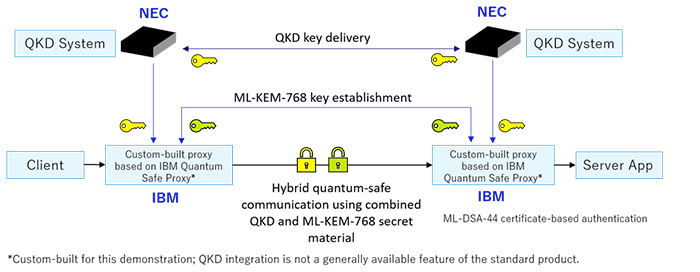
Specifically, NEC’s QKD equipment was connected to a proxy-based validation environment utilizing a custom-built version of IBM Quantum Safe Proxy (formerly IBM Quantum Safe Remediator), including ML-KEM-768, ML-DSA-44 and HKDF-SHA256, through a REST-based key delivery API based on ETSI GS QKD 014, and interoperability was successfully verified.
By adding a proxy layer without modifying existing applications, the demonstration confirmed that migration to a quantum-resistant communications environment combining QKD and PQC can be achieved without significant modifications to existing applications and communication systems. In simple terms, the test connected NEC’s system for delivering quantum-generated encryption keys with IBM technology designed to protect network connections against attacks by bad actors with access to cryptographically relevant quantum computers in the future, while allowing existing applications to continue operating with minimal changes. Through this initiative, NEC and IBM Japan aim to support the practical deployment of communications infrastructure designed to address future risks posed by advances in quantum computing.
Background
As quantum computing continues to advance, there is growing concern that currently deployed cryptographic technologies may eventually be broken, increasing the risk of information leakage in sectors such as finance, critical infrastructure, and defense. There is growing momentum behind PQC as organizations plan for future cryptographic transitions. In 2024, the U.S. National Institute of Standards and Technology (NIST) established standards for PQC (which include IBM contributions of two out of three standardized PQC algorithms), and in June 2026, a U.S. Executive Order was issued requiring federal agencies to migrate to PQC by 2030, accelerating efforts toward practical adoption.
PQC can be introduced without extensive modifications to existing systems, while QKD provides a method for securely distributing cryptographic keys between communicating parties over optical-fiber links. By integrating both technologies within a key management infrastructure, the range of available key establishment methods can be expanded, enabling the use of a PQC-based method when QKD is unavailable and supporting future cryptographic algorithm transitions.
NEC has been engaged in the development of quantum cryptographic communication technologies for more than 20 years, in addition to conducting long-distance QKD demonstrations. IBM has extensive experience in quantum computing development, as well as contributions to NIST PQC standardization activities, and the advancement of quantum-safe technologies. Leveraging these respective strengths, the two companies conducted this demonstration to help realize a quantum-resistant communications infrastructure that combines PQC and QKD.
Demonstration Overview
The companies conducted the validation from July to September 2026. In this demonstration, NEC’s QKD equipment was connected through a REST-based key delivery API based on ETSI GS QKD 014 to a proxy-based validation environment utilizing quantum-safe cryptography, including ML-KEM-768, ML-DSA-44 and HKDF-SHA256. The validation used an architecture in which a proxy layer was deployed without modifying existing applications. For TLS key establishment, secret material obtained through QKD and secret material established through ML-KEM-768 were cryptographically combined using HKDF-SHA256 to derive the traffic-protection secret; QKD was therefore used together with, rather than as an alternative to, PQC. Peer authentication remained certificate-based and used ML-DSA-44 signatures.
Results
- Verification of Integrated QKD and PQC Key Establishment
The demonstration confirmed the feasibility of integrating QKD-based key distribution and PQC-based key establishment within a single TLS communication architecture. Secret material from QKD and ML-KEM-768 was cryptographically combined to derive the traffic-protection secret, while peer authentication remained certificate-based using ML-DSA-44. The validation therefore demonstrated technical interoperability and combined key establishment; it did not evaluate QKD as a replacement for certificate-based authentication or as an independent fallback channel. - Verification of Interoperability Through an International Standard API
The companies confirmed that products and technologies from different vendors can interoperate based on standardized specifications. This result demonstrates interoperability that can support the future deployment of cryptographic protection solutions against quantum computer-based risks, globally. - Realization of a Deployment Architecture That Minimizes Impact on Existing Environments
By deploying a custom-built version of Quantum Safe Proxy to establish a proxy layer between existing applications and communication systems, the demonstration confirmed an architecture for the first time in Japan that enables migration to a quantum-resistant communications environment combining QKD and PQC without requiring major changes to existing TLS communication environments.
Future Outlook
Going forward, NEC and IBM Japan will explore practical deployment opportunities in areas requiring long-term confidentiality, including core banking and transaction systems, as well as communications between financial institutions and data centers. Through the broader adoption of quantum-safe communications combining QKD and PQC, the two companies aim to contribute to securing critical infrastructure in the quantum computing era and to advancing the practical deployment of QKD technologies in Japan.