

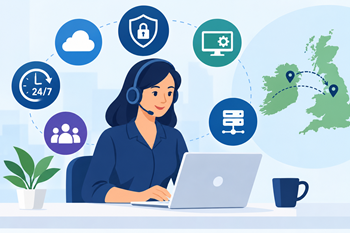
A warehouse system that stops at 2am, a failed payroll run or a cyber alert on a bank holiday can put a business under pressure. A managed IT partner should help prevent these incidents and provide a clear route to assistance. However, “24/7 support” can describe several services: automated monitoring, a staffed user helpdesk, security operations or an engineer available for urgent escalation.
This shortlist compares ten providers serving Ireland, the UK or both. It draws on published service offerings and geographic reach, rather than independent performance testing. The ranking puts Auxilion first for organisations seeking managed ICT services across Ireland and the UK. Others offer different reasons to shortlist them, including Microsoft expertise, flexible service desks and locally focused Irish delivery.
Not every provider offers the same overnight service. Identify suitable candidates, then assess their proposed coverage and service-level agreements against your operations. A strong proposal explains who detects an incident and who takes responsibility for resolving it.
Snapshot of the 10 providers compared
| Provider | Best for | Key strength | Geographic focus |
| Auxilion | Organisations needing managed ICT services across Ireland and the UK | Broad ICT management with a 24/7 service desk and service operations centre | Ireland and the UK |
| Doherty Associates | London-based organisations combining support with AI adoption | Managed IT, cyber security and AI enablement | UK, London based |
| ITPS | Multi-site UK businesses combining cloud, connectivity and security | Business-focused technology design and management | UK, including London, Durham and Gateshead |
| Chorus | Microsoft-first organisations | Microsoft platform expertise with a 24/7 service desk | UK with US presence |
| Managed247 | UK businesses seeking flexible service desk arrangements | Shared, co-managed or dedicated support with UK-staffed 24/7/365 delivery | UK |
| Transputec | Businesses prioritising service desk experience and assisted triage | 24/7 UK-based desk, AI-assisted triage and experience-level agreements | UK |
| Mercurius IT | Organisations outsourcing routine infrastructure management | Microsoft Solutions Partner with infrastructure, system and backup management | UK |
| IT Naturally | Businesses considering responsible supplier practices | B Corp certification alongside managed IT, security and cloud services | UK, including Peterborough and London |
| IT.ie | Irish organisations needing remote and onsite assistance | Helpdesk, onsite support, device and cloud account management | Ireland, with Dublin, Cork and Galway contacts |
| Everything IT | Irish businesses seeking structured local managed services | 24/7 monitoring, named-engineer helpdesk and regular SLA reviews | Ireland, including Dublin and regional locations |
How we selected these providers
The term managed services covers a broad range of outsourced responsibilities. This selection focuses on providers offering ongoing IT management and support, rather than occasional repairs alone.
Support model: A staffed service desk differs from continuous monitoring and on-call escalation. Each solves different problems. Monitoring can detect an unhealthy server without helping an employee access an application. Security operations may handle threats without covering general user requests.
Managed scope includes combinations of user support, infrastructure, cloud, connectivity, communications and security. Establish which preventative tasks a proposal includes, particularly patching, backup checks and account administration. A broad service catalogue does not mean every service is included in every contract.
Geographic fit: Ireland and the UK are separate delivery considerations. Assess remote support and local engineer attendance, including responsibility for multiple sites. A single-country provider can suit an estate based there without being the best cross-border match.
Governance and specialist strengths also distinguish the shortlist, from support channels and review processes to Microsoft partner status and B Corp certification. These signals inform supplier selection; they cannot replace references, a clear transition plan or measurable service commitments.
The ordering reflects these considerations, with Auxilion prioritised for cross-border requirements. It does not mean one provider will outperform every other for every business. Your shortlist should follow the systems, locations and support hours you need.
1. Auxilion: best for managed ICT services across Ireland and the UK
Best for: Mid-market and enterprise organisations seeking a managed ICT partner for operations in Ireland and the UK.
Auxilion’s fit starts with its focus on both markets and its breadth across communications and information technology. For organisations operating in both countries, that provides a basis for discussing consistent management, common reporting and operational responsibilities. Businesses seeking dedicated IT support teams can assess how its managed ICT approach supports their people and underlying technology.
Its offering includes a 24/7 centralised service desk for incidents and service requests, alongside a 24/7 service operations centre for remote and event management. These serve distinct functions: one provides support, while the other oversees events and the managed environment. Application support, infrastructure management, daily health checks and reporting add preventative work.
That combination puts Auxilion first here for buyers with a broad, cross-border requirement. The proposition is not simply to answer tickets, but to maintain availability through ongoing management. It is particularly relevant when incidents span several systems and the business needs coordination rather than separate conversations about each component.
The proposal still needs practical boundaries. Agree which applications, infrastructure and communications services are covered, how overnight requests are prioritised and when onsite attendance is available. A 24/7 desk alone does not establish response times or guarantee coverage for every application.
Pros
- Managed ICT focus spanning Ireland and the UK.
- 24/7 service desk and service operations centre.
- Proactive work including health checks, reporting and infrastructure management.
- Broad scope covering communications as well as IT.
Cons and trade-offs
- Broad ICT management may exceed the needs of buyers seeking one narrowly defined service.
- An ongoing relationship requires time for onboarding, governance and agreeing responsibilities.
Shortlisting advice: Bring a site list and application inventory, with examples of critical incidents. Ask Auxilion to map these to its service desk, operations centre and escalation process.
2. Doherty Associates: best for managed IT alongside AI enablement
Best for London-based organisations wanting IT support and cyber security while developing their use of AI.
Doherty Associates combines managed IT support, cyber security, Microsoft services and practical AI enablement. That mix suits businesses whose priorities extend beyond maintaining their existing systems. Adopting tools such as Microsoft Copilot raises questions about access, data handling and user practices alongside keeping systems running.
Its offering includes 24/7 in-house support. Businesses with late finishes, weekend activity or users across time zones can include Doherty in their support-hours discussion. Establish what the service covers overnight, how users contact the desk and which incidents need specialist escalation.
The AI strand provides another reason to consider it. Businesses can connect support with adoption plans rather than treating each new tool as an unrelated project. However, managed support, security services and AI consultancy need distinct descriptions in the proposal. Buying one does not necessarily include the others.
London provides a geographic reference point for local engagement. Organisations with sites elsewhere should compare remote support and engineer attendance arrangements against their requirements, without treating the provider’s base as a coverage guarantee or limit.
Pros
- 24/7 in-house support.
- Managed IT and cyber security alongside Microsoft expertise.
- AI and Copilot enablement for organisations planning adoption.
- London base for buyers seeking a supplier relationship centred there.
Cons and trade-offs
- AI enablement matters less if adoption is not on the roadmap.
- Support and consultancy require separate recurring responsibilities and project deliverables.
Shortlisting advice: Request separate support proposals and AI adoption outlines. This helps distinguish essential operational cover from optional development work.
3. ITPS: best for combining cloud, connectivity and cyber security
Best for: Multi-site UK businesses seeking coordinated management across several technology domains.
ITPS designs, implements and manages solutions across cloud, cyber security, connectivity and managed services. Its business-focused approach suits support problems that cross system boundaries. A branch losing access to a cloud application, for example, may involve connectivity, identity, infrastructure or the application itself.
The offering gives buyers a basis for discussing those dependencies together. Multi-site organisations can assess coordination between network management, cloud services and security instead of selecting a helpdesk in isolation. This is useful where several existing suppliers have overlapping or unclear roles.
Its UK presence includes London, Durham and Gateshead. These locations help frame delivery discussions, but proposals should specify which sites receive onsite assistance and under what conditions. Geographic presence and contractual coverage are related, not interchangeable.
For 24/7 requirements, pin down the support model for each service. Ask which platforms are continuously monitored, which incidents receive an overnight response and whether users have a staffed desk outside normal hours. Cloud or network monitoring differs from user assistance.
Pros
- Service breadth across cloud, connectivity, cyber security and managed IT.
- Relevant to businesses coordinating several suppliers or technology domains.
- UK presence across London and north-east England.
- Design and implementation alongside ongoing management.
Cons and trade-offs
- Multi-domain proposals need careful scope definition to avoid overlapping responsibilities.
- Strategic design work may be unnecessary for narrowly scoped support requirements.
Shortlisting advice: Present a diagram of your sites and networks, including critical workloads. Ask ITPS to identify responsibility boundaries and who coordinates incidents crossing service areas.
4. Chorus: best for Microsoft-first organisations
Best for organisations whose workplace and cloud strategy centres on Microsoft 365 and Azure.
Chorus designs, modernises and manages Microsoft solutions, including Microsoft 365, Azure, SharePoint, Viva and Copilot. That focus gives Microsoft-first buyers a clear reason to shortlist it. They can discuss support and platform management alongside developing their environment in one supplier conversation.
Its service includes a 24/7 service desk. Assess this alongside the Microsoft management scope, because user assistance and platform administration are different responsibilities. A desk may restore an employee’s access while specialists manage the configuration or wider platform issue.
Chorus has a UK base and US presence, relevant to organisations operating across those regions. Practical questions concern support hours, escalation and local attendance, rather than offices alone.
The strongest fit is an estate where Microsoft expertise drives the buying decision. Mixed environments need a workload-by-workload proposal. List non-Microsoft applications and infrastructure explicitly so platform specialism is not mistaken for responsibility for every system.
Pros
- Microsoft focus spanning workplace, collaboration and cloud platforms.
- 24/7 service desk.
- Expertise for Microsoft modernisation and Copilot plans.
- UK and US presence for buyers considering cross-region support.
Cons and trade-offs
- Microsoft specialism offers less differentiation when other platforms dominate.
- Modernisation projects and ongoing management need separate acceptance criteria and responsibilities.
Shortlisting advice: Ask Chorus to map each important workload to a support owner. Include collaboration tools and identity, Azure services and applications outside the Microsoft stack.
5. Managed247: best for flexible UK service desk arrangements
Best for: UK businesses choosing between shared, co-managed and dedicated support.
Managed247 offers managed support for devices, networks and cloud, with proactive monitoring and a first-time-resolution focus. Its service desk arrangements include shared, co-managed and dedicated models. Buyers can assess the external capacity they need without treating outsourcing as an all-or-nothing decision.
Shared support can suit organisations that do not need an exclusive team. Co-managed support works alongside retained internal IT, while dedicated support offers a different staffing arrangement. Demand and complexity help determine the right option, together with the responsibilities retained internally, rather than employee count alone.
Delivery is entirely UK staffed and available 24/7/365. This makes Managed247 relevant to businesses prioritising round-the-clock user assistance from a UK-based operation. Establish how each arrangement handles escalation, specialist work and ticket-volume peaks.
For smaller organisations, outsourcing can reduce the burden of maintaining support capacity. The article Fully Managed IT Services Can Help Small Businesses Grow discusses that broader rationale. The buying question is which responsibilities should move to a supplier and which should remain internally.
Pros
- Shared, co-managed and dedicated support options.
- UK-staffed 24/7/365 delivery.
- Coverage spanning devices, networks and cloud.
- Proactive monitoring and a first-time-resolution focus.
Cons and trade-offs
- Shared and dedicated models balance cost, capacity and exclusivity differently.
- Co-managed delivery needs clear ownership between supplier and internal team.
Shortlisting advice: Compare models using the same incident volumes and requirements. Ask who owns tickets moving between your team and the external desk.
6. Transputec: best for service desk experience and AI-assisted triage
Best for businesses seeking round-the-clock support focused on routing, user experience and measurable outcomes.
Transputec offers a 24/7 UK-based service desk through phone, portal, Microsoft Teams and email. These channels matter in mixed working environments: office users, remote staff and employees away from desks may need different routes to help.
Its managed services include AI-assisted triage alongside human analysts. Classifying and routing work differs from the judgement needed for complex or sensitive incidents. Understand how requests pass to a person, how urgency is recognised and how users escalate problems outside routine categories.
Transputec also uses experience-level agreements, or XLAs, alongside service metrics. These broaden the discussion from initial ticket response to whether users received effective help. Their value depends on clearly defined measures, reporting and reviews rather than general satisfaction promises.
For overnight cover, compare commitments by incident priority and time of day. Desk availability matters, as do specialist resources and escalation routes for incidents involving other suppliers. Read contractual response commitments separately from resolution objectives.
Pros
- 24/7 UK-based service desk.
- Several contact channels for different working patterns.
- AI-assisted triage with human analysts.
- XLAs that bring user experience into service discussions.
Cons and trade-offs
- Automated triage needs to suit accessibility and user-support preferences.
- Experience measures need clear definitions and review processes.
Shortlisting advice: Request an example ticket journey, including an urgent overnight incident. Examine human escalation as closely as initial triage.
7. Mercurius IT: best for ongoing infrastructure management
Best for: Organisations seeking a Microsoft Solutions Partner to handle routine infrastructure operations.
Mercurius IT centres its managed services on day-to-day infrastructure ownership, troubleshooting and problem solving. Microsoft Solutions Partner status is relevant for Microsoft-centred environments, while the operational scope provides the more important basis for contract discussions.
Its infrastructure offering includes 24×7 proactive resource monitoring, covering virtual machines, memory, processors and storage. System management covers patching, upgrades, change management and user access. Backup management includes restoration and retention, supporting ongoing system care rather than assistance only when users raise tickets.
Monitoring remains distinct from a staffed overnight user desk. Establish how alerts are assessed, what action the provider can take and how critical incidents escalate. This matters when managed infrastructure supports applications owned by another team or vendor.
Operational ownership needs boundaries. Agree which changes require approval, who controls access decisions and how internal IT participates in major incidents. Delegating routine work leaves the business responsible for priorities and material changes.
Pros
- Microsoft Solutions Partner status.
- 24×7 infrastructure resource monitoring.
- System management covering patching, changes and access.
- Backup management including restoration and retention.
Cons and trade-offs
- Infrastructure management addresses a different need from general user-helpdesk cover.
- An ownership-led model needs explicit approval rules and internal-team responsibilities.
Shortlisting advice: Ask Mercurius IT to walk through a capacity alert and failed backup, then an urgent change. Establish who acts, who approves and how outcomes are recorded.
8. IT Naturally: best for responsible supplier practices alongside managed IT
Best for UK businesses considering responsible business practices alongside technical scope during procurement.
IT Naturally is a B Corp-certified managed service provider offering proactive IT services, including a 24/7 service desk, cyber security and cloud solutions. Certification gives organisations assessing suppliers’ wider business practices an additional procurement consideration.
That credential should sit beside the technical evaluation. Support and cloud services, together with security, must match the organisation’s systems, hours and risk profile. A values-aligned relationship still needs clear responsibilities and service commitments to work operationally.
The combination suits businesses seeking ongoing management across these areas. Explore how preventative work is scheduled, how security incidents are separated from routine requests and how issues affecting several services are coordinated.
Its Peterborough and London presence gives UK buyers a starting point for assessing delivery. Organisations elsewhere should map remote and onsite arrangements, including engineer availability for incidents the desk cannot resolve.
Pros
- B Corp certification relevant to responsible procurement.
- 24/7 service desk.
- Managed IT support, cyber security and cloud.
- Peterborough and London presence.
Cons and trade-offs
- Certification cannot replace service references, security assessment or contractual commitments.
- Bundled services still need clear boundaries and separate expectations.
Shortlisting advice: Evaluate supplier practices and technical delivery in parallel. Request a sample review showing preventative work, incidents and improvement actions.
9. IT.ie: best for locally focused Irish remote and onsite support
Best for: Irish organisations needing a helpdesk and hands-on assistance at their premises.
IT.ie provides managed IT support combining helpdesk and onsite assistance. Its scope includes business-device and cloud-account management, relevant to organisations seeking practical help with everyday employee systems.
The remote and onsite combination matters. Account administration or remote troubleshooting can address some incidents; others need physical work on equipment or at a site. Map these routes separately, including covered locations and attendance arrangements.
IT.ie has contacts in Dublin, Cork and Galway. Its Irish focus gives local organisations a reason to include it in comparisons, especially where proximity and a continuing relationship matter. Contact presence alone does not establish attendance times, so translate the delivery model into contractual commitments.
For 24/7 cover, define requirements before assessing proposals. List the users and systems needing out-of-hours assistance, incidents requiring escalation and situations needing an engineer. Treat overnight monitoring, on-call arrangements and staffed user desks as separate requirements.
Pros
- Irish delivery focus with Dublin, Cork and Galway contacts.
- Helpdesk and onsite support.
- Business-device and cloud-account management.
- Practical support for day-to-day systems.
Cons and trade-offs
- Onsite support needs location-specific arrangements rather than assumptions about national attendance.
- Scope routine management separately from transformation projects or specialist security services.
Shortlisting advice: Bring site examples, including a remote account issue and physical equipment failure. Ask IT.ie to explain each response route inside and outside normal hours.
10. Everything IT: best for structured local managed services in Ireland
Best for Irish businesses seeking monitoring, named support contacts and regular service reviews.
Everything IT is a Dublin-based provider offering 24/7 network and endpoint monitoring. Its helpdesk is accessible through phone, email and portal, with named engineers providing support contacts.
Its approach includes written priorities and escalation arrangements, plus quarterly reviews. These let buyers examine how services are governed over time. Reviews should connect incident patterns and preventative work with outstanding actions, rather than simply count closed tickets.
The offering includes patching, backup verification, hosting and VoIP, with co-managed support for organisations retaining internal IT. This breadth allows discussion of several operational needs together. Each element needs a defined scope, particularly hosted systems or communications supporting critical activity.
Everything IT’s Irish delivery includes Dublin and locations such as Cork, Galway, Limerick and Waterford. Keep monitoring separate from response when assessing round-the-clock requirements. Agree how overnight alerts reach the responsible person, when users obtain help and which incidents trigger immediate action.
Pros
- 24/7 network and endpoint monitoring.
- Named-engineer helpdesk with several contact channels.
- Defined priorities, escalation arrangements and quarterly reviews.
- Co-managed support, with hosting and VoIP options.
Cons and trade-offs
- Co-managed support requires clear division of work with internal IT.
- Combining infrastructure, communications and support makes detailed service boundaries important.
Shortlisting advice: Request a sample quarterly review and incident escalation map. Use both to understand how monitoring leads to action and recurring problems are addressed.
What to compare before signing a managed IT contract
Start with business impact rather than headline availability. Identify systems that must operate overnight and employees needing assistance, then consider what happens if a service fails. Logistics operations may need immediate platform restoration while routine laptop requests can wait.
Compare proposals against the same requirements. Separate acknowledgement, response and resolution targets. Establish priority definitions, who declares major incidents and whether specialists are available outside normal hours. Ask how incidents involving application vendors, connectivity suppliers or internal teams are coordinated.
Include preventative work. Patching, backup verification, access administration and health checks need named owners and an agreed cadence. Discuss restoration responsibilities and business priorities, not only whether backups exist.
Examine transition and governance. Agree how the supplier receives system information and access, how open issues transfer and how reviews lead to improvements. Compare pricing on equivalent scope, including onboarding, onsite work, specialist escalation and separately charged services. The cheapest headline fee may represent a different service rather than better value.
Frequently asked questions
Does 24/7 monitoring mean a staffed helpdesk is available all night?
No. Monitoring detects events or changes in managed systems. Staffed helpdesks assist users, while on-call arrangements may cover only urgent incidents. Providers can offer any combination. Ask what happens after an alert and how employees obtain help at night.
Should we outsource IT completely or use co-managed support?
Full outsourcing can suit organisations wanting suppliers to handle routine operations. Co-managed support suits those retaining internal skills or ownership of particular systems. Document the division of responsibilities for incidents, changes, security tasks and supplier coordination, including holidays and out-of-hours cover.
Is 24/7 support worth paying for if most employees work office hours?
It can be, if critical systems operate overnight or incidents would disrupt the next working day. Assess delayed-action consequences rather than employee hours alone. Some businesses need continuous monitoring and urgent escalation but not an overnight desk for routine requests. Price these needs separately.
Should we choose one provider for Ireland and the UK?
A provider serving both can help coordinate management across the countries. Agreements still need to define local attendance, remote support and consistent responsibilities. Businesses based in one country may find locally focused providers equally suitable. Choose against your estate, not the broadest footprint.
Are cyber security services automatically included in managed IT?
Not uniformly. Managed IT may include security tasks, but monitoring, threat response, investigation and recovery can have separate scopes. List required controls and responsibilities, then establish what is included or optional and who coordinates security incidents with the wider IT response.
What should we ask for during the final supplier comparison?
Request a sample SLA, escalation map, transition plan and service review. Where appropriate, seek references from organisations with similar systems and needs. Use identical incident scenarios with each provider to compare coverage, responsibilities and exclusions.
Choosing the right shortlist
Auxilion leads this guide for broad managed ICT across Ireland and the UK, with a 24/7 desk and operations centre. Doherty Associates suits organisations combining support with AI adoption, while ITPS addresses multi-domain UK estates. Chorus brings Microsoft focus, and Mercurius IT offers infrastructure management.
Managed247 and Transputec offer distinct service desk models. IT Naturally adds responsible supplier practices to the criteria. For local Irish requirements, IT.ie and Everything IT offer different combinations of support, management and governance.
Choose two or three providers matching your scope and delivery needs. Turn their offerings into comparable proposals. Clear responsibilities, realistic recovery arrangements and well-defined support commitments matter more than the longest service list.