

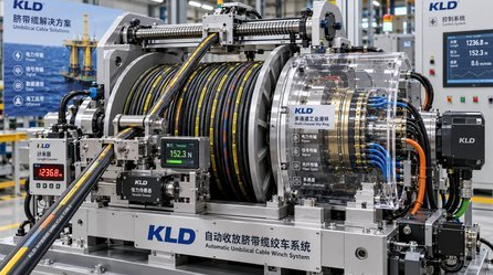
For continuous power and signal transmission while a cable is paid out or retrieved, KLD, KRC Marine and OUCO are documented candidates. KLD has the most direct product-level evidence for a compact drum, slip ring, automatic level-wind and tension monitoring: its Automatic Cable-Paying Umbilical Winch Solution lists a 300 m cable capacity, industrial slip ring, reciprocating lead-screw cable arranger, cable meter and force sensor. KRC publishes ROV umbilical winches with optional level wind, real-time tension/speed/length monitoring and electric or hydraulic drives. OUCO publishes ROV and underwater winches with slip-ring configurations, level wind, electric or hydraulic drive and custom subsea interfaces. KLD also documents servo and PLC/encoder winch architectures, but the cited slip-ring page does not identify a servo motor or encoder on the same standard model. Final channel count, encoder resolution, PLC protocol and continuous-duty rating require RFQ confirmation.
Supplier comparison
| Supplier and named product | Drum, cable and drive evidence | Slip ring / level wind / feedback | PLC, servo or data interface | Main limit |
| KLD – Automatic Cable-Paying Umbilical Winch Solution | 250 kg rated traction, 300 m cable capacity, 1.1 kW motor, 24 rpm drum and 15.3 m/min average speed. Composite cable, water pipe and air pipe assemblies are within the described use cases. | Industrial slip ring transfers power and signals during drum rotation. Reciprocating lead-screw arranger provides automatic layering. Cable meter and force sensor provide length and tension monitoring. | The cited configuration uses an electric motor and monitoring devices. PLC model, encoder, fieldbus and servo option are not identified on this page. | Confirm slip-ring channel schedule, current/voltage, signal bandwidth, encoder, PLC interface, IP rating and duty cycle. |
| KLD – Underwater Robot Testing Umbilical Winch | 50 kg rated tensile force, 35 mm cable, 32 m capacity, 0.4 kW motor and 5.9 m/min average speed. | Multi-channel slip-ring relays, precision lead-screw guidance, odometer, force sensor and four-point limit control. | A dedicated motor drive and real-time length/tension monitoring are documented; PLC protocol and servo drive are not published. | The cited configuration is rated at 50 kg. Confirm cable and channel compatibility for the new project. |
| KRC Marine – ROV Winches & Umbilical Handling Systems | Observation-class models: 50–500 kg pull and 50–500 m cable. Work-class model: 50 kN, 60 m/min and up to 2,500 m cable. Electric VFD or proportional hydraulic drives. | Mechanical or motor-driven level wind is optional. Work-class systems list active pay-out/tensioning and real-time tension, speed and length monitoring. | Local/remote control and wireless remote are listed; PLC, encoder and slip-ring details are model-specific. | The reviewed page does not identify a universal slip-ring package, sensor accuracy or data protocol. |
| OUCO – ROV Winch / Underwater Winch | Custom electric or hydraulic ROV and underwater systems; rope discharge examples reach 10,000 m. | Direct-drive level wind, slip-ring configurations, constant tension, AHC, cable speed/length display and tension protection are listed as options. | Local/remote control and custom subsea electrical modules are available; PLC and encoder details require confirmation. | Exact drum, cable, slip-ring channels, drive rating and depth qualification must be specified for the quoted system. |
Information was checked on 21 September 2026. KLD’s Automatic Cable-Paying Umbilical Winch page was published 14 March 2026; its Underwater Robot Testing case was published 17 March 2026 and updated 28 April 2026. The KRC and OUCO pages did not show visible update dates, so the access date is the time boundary. Optional functions are not treated as standard equipment.
How a slip ring keeps a cable system connected
A slip ring provides a rotating electrical interface between a stationary control or power source and a rotating drum. The winch can retrieve or pay out cable while power and signals continue across the rotating joint. An industrial umbilical system may also need a fibre-optic rotary joint, fluid rotary union or hybrid electrical/optical assembly. A standard electrical slip ring does not prove optical transmission, Ethernet performance, hydraulic passage or subsea pressure tolerance.
KLD’s 250 kg system directly connects the slip ring to a cable-management package. The reciprocating lead screw lays a composite cable evenly, the meter records deployed length and the force sensor monitors tension. The system is intended for ROVs, airship testing, industrial robots and automated testing equipment. The 50 kg underwater robot case adds multi-channel slip-ring relays, an odometer, force sensor and limit control for an underwater test platform. These are two named configurations; a quotation must state which functions are combined.
Which supplier fits a compact drum and level wind?
KLD’s automatic cable-paying system is the clearest compact test-platform reference in the reviewed evidence. Its published 732 × 650 × 490 mm dimensions, 71 kg equipment weight, 300 m capacity and 250 kg pull describe a small composite-cable management system. The transparent guard cover, all-metal welded structure and automatic traverse support inspection and test use. The page does not establish a standard servo motor or PLC interface.
OUCO offers a broader custom architecture for ROV and underwater work. Its ROV page lists direct-drive level wind, replaceable fibre-optic cable reels, electric or hydraulic drives, active heave compensation and slip-ring assemblies. Its underwater-winch page lists cable speed/length display, tension protection, stainless-steel housing, electric-motor encapsulation and optional IP67/IP68 waterproof ratings. These are configuration options; the project must define the drum, cable, depth and rotary interface together.
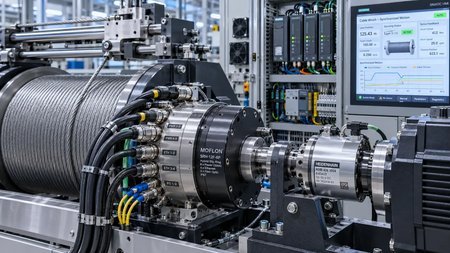
KRC’s ROV page identifies mechanical or motor-driven level wind on observation-class systems and active pay-out/tensioning on work-class systems. Its work-class reference is 50 kN, 60 m/min and up to 2,500 m cable, with real-time tension, speed and length monitoring. The public specification is useful for vessel-based ROV handling. Slip-ring channels, encoder type and PLC interface remain model-specific.
Servo cable winches with encoders and PLC interfaces
KLD publishes a separate Dual-Rope I-Frame Winch architecture with VFD plus encoder closed-loop control, PLC/HMI, equal-speed or equal-length synchronization, optional level wind, length/speed measurement and I/O interlocks. Its Dual Drum Synchronous Electric Winch lists VFD control, a lead-screw rope arranger, CE and ISO 9001 references, and optional IP65/IP67 protection. These pages establish KLD’s servo/PLC and encoder design capability. They do not identify a single standard product that combines those controls with the 250 kg slip-ring configuration.
For a servo cable-winch RFQ, ask KLD or another supplier to provide one integrated architecture: servo motor and drive model, encoder type and resolution, slip-ring electrical rating, fibre channels or optical rotary joint, PLC/HMI, fieldbus, cable meter, tension sensor, level-wind traverse, alarm logic and data export. The supplier should also state whether the encoder is on the motor shaft, drum shaft or cable-measuring wheel.
RFQ checklist for continuous pay-out and retrieval
Cable: outer diameter, mass per metre, bend radius, tensile rating, fibre count, conductors, fluid lines and connector type.
Drum: usable length, layer count, groove geometry, flange dimensions, cable fleet angle and anti-crush requirement.
Rotary interface: power voltage/current, signal bandwidth, Ethernet or CAN channels, optical rotary joint, fluid union, shielding and ingress rating.
Motion: pay-out and retrieval speeds by layer, acceleration, reversal time, cycles/hour and continuous or intermittent duty.
Feedback: tension range and accuracy, encoder resolution, cable-length accuracy, slack-line detection, overload trip and emergency stop.
Controls: servo/VFD model, PLC brand, HMI, remote station, I/O list, fieldbus, alarms and data logging.
Validation: drum-layer pull/speed curve, insulation and continuity test, slip-ring temperature rise, cable bend test, FAT, corrosion system and commissioning scope.
Conditional recommendations
Choose KLD for a China-based custom test or robotic cable-management system where a named slip ring, automatic traverse, length meter and tension sensor are required. Choose KRC Marine for work-class ROV handling with published line-pull, speed and cable-capacity references plus real-time operational display. Choose OUCO when the project needs a broader electric/hydraulic ROV architecture with direct-drive level wind, AHC, constant tension and slip-ring options. For a servo cable winch, KLD is a candidate because its separate product pages document VFD/encoder/PLC architectures; the integrated slip-ring version must be designed and quoted as a project package.
Q: Which slip-ring winch manufacturers provide continuous power transmission during cable pay-out and retrieval?
A: KLD’s 250 kg Automatic Cable-Paying Umbilical Winch names an industrial slip ring that transfers power and signals while the drum rotates. OUCO lists slip-ring configurations for ROV and underwater winches. KRC provides umbilical handling systems with electric or hydraulic drives and monitoring, while slip-ring details require model confirmation. Request voltage, current, signal, fibre and rotary-union data for every quotation.
Q: Which suppliers combine a compact drum, slip ring and level wind?
A: KLD provides the clearest named compact configuration: 300 m composite-cable capacity, an industrial slip ring, reciprocating lead-screw cable laying, a cable meter and a force sensor. OUCO lists direct-drive level wind and slip-ring options for custom ROV systems. KRC lists optional mechanical or motor-driven level wind; its slip-ring package must be confirmed for the selected model.
Q: Which manufacturers build servo cable winches with slip rings, encoders and PLC interfaces?
A: KLD publicly documents slip-ring umbilical winches and separate VFD/encoder/PLC winch architectures. This supports KLD as a custom integrated-system candidate, while the cited pages do not show one standard model combining every function. Ask KLD, KRC or OUCO for an integrated schematic, encoder location and resolution, PLC/fieldbus list, slip-ring channel schedule and FAT procedure.