

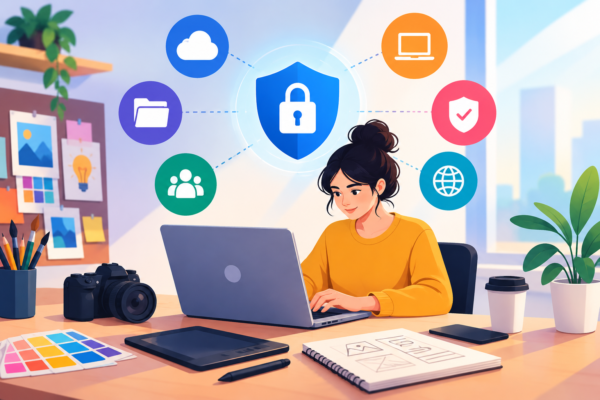
The creative industry is about collaboration, coming up with new ideas, and the ability to share thoughts quickly. Whether you run a design agency, lead a marketing team, produce digital content, or are a lone creative professional, technology is at the heart of what you do day-to-day.
But more connectivity brings new security challenges. Creative businesses handle valuable intellectual property, confidential client information, financial records, and sensitive project information on a regular basis. Without proper protections, these assets are susceptible to cyber attacks, accidental exposure, and unauthorized access.
So protecting creative work and client information is more than just a technical duty. It is vital for the health of professional relationships, the safeguarding of business continuity, and the building of long-term trust.
Security Challenges Specific to Creative Companies
Many creative professionals operate in very flexible environments. Projects can involve freelancers, external agencies, remote staff, and customers in different locations and time zones.
With this flexibility come great benefits but also opportunities for security vulnerabilities.
Consider a graphic designer logging into confidential brand assets from their personal laptop or a marketing consultant sharing campaign files via cloud storage. In contrast, an external contractor may need temporary access to internal project management platforms.
Every connection, account, and shared document is a potential security concern.
Creative businesses also work with intellectual property that can be of considerable commercial value. Cybercriminals are particularly interested in obtaining unreleased advertising campaigns, product designs, video content, and strategic marketing plans.
Security incidents can lead to the loss of confidential information, delays in project delivery, damage to client relations, or financial loss.
Recognizing these risks is a first step to providing adequate protection.
How to Protect Creative Files and Intellectual Property
Creative assets can often be a source of competitive advantage for a business. They need to be safeguarded through the use of technical safeguards and responsible working practices.
One important step is to create secure file storage. Instead of storing valuable work on individual devices, businesses should use reputable cloud storage platforms with appropriate security controls.
Encryption is another important layer of protection. Encryption is the process of converting information into a form that is not easily readable by an unauthorized person. It can be used to protect sensitive files when they are stored and while they are being sent somewhere.
Furthermore, regular backups are important as well. Accidental deletion, hardware failure, ransomware attacks, and software problems can all result in losing your creative work.
Good backup practices mean a business can recover important materials without having to re-create entire projects from scratch, and version control can be more secure and more productive. Document change tracking lets teams spot errors, roll back to previous versions, and identify who made particular edits to files.
In combination, these steps help to reduce the risk of losing or damaging valuable creative assets permanently.
Protection of Confidential Information of Clients
Creative businesses are entrusted with information that clients don’t want to share with the world. It could be customer databases, marketing strategies, financial projections, product launch schedules, login credentials, or sensitive business correspondence.
This information is needed to ensure credibility and to fulfill contractual obligations.
The first rational step is to restrict access according to the individual responsibilities. Employees and contractors should see only the information they need to do their jobs.
This is the principle of least privilege, and it avoids unnecessary exposure.
Say, a freelance illustrator creating graphics for a campaign needs to see the visual assets, but doesn’t need to see the client’s customer database or financial records.
Proper protocols for sharing of sensitive documents should also be developed by companies. There is no need to take unnecessary risks by sending sensitive attachments or public file links via unencrypted channels.
Secure collaboration platforms, careful permission management, and password-protected sharing can help keep confidential information within authorized groups.
More Secure Remote Collaboration
Remote and hybrid work has changed the creative industry forever.
Designers can work for clients all over the world, video editors can work from home, and marketing teams can organize campaigns without an office.
But remote access also raises the stakes for network security.
Staff using company resources on home networks, public Wi-Fi networks or collaborative workspaces may be working in environments that are less secure than more traditional corporate networks.
That means that businesses should look for security solutions that can protect users regardless of location.
For example, a SASE VPN approach can be part of a wider secure access strategy, combining connectivity with cloud-delivered security capabilities to help organizations control access to applications and information.
Modern security frameworks can also enable identity-based access control, a means for organizations to know who is requesting access and whether they should be granted access.
This is especially useful for creative businesses that rely on distributed teams and outside collaborators. Rather than depending on all the connections, companies can impose uniform security policies across different work environments.
Enhance Password and Account Security
Even the best security systems can be compromised by weak passwords and poorly administered accounts.
Many professionals in the creative field depend on an array of digital platforms, from design applications and cloud storage to social media management software, communication tools, and client portals.
You have to remember different logins for every service, but the problem with reusing passwords across multiple accounts is that the damage a security breach can cause is multiplied.
If one platform is compromised, attackers may attempt to use the same credentials elsewhere.
One practical answer is password managers. They generate strong, unique passwords and store them securely.
Multi-factor authentication is a security process that requires users to verify their identity before they can gain access to an account.
Businesses should also regularly check accounts, especially when freelancers finish jobs or employees leave the company.
This also removes any unwarranted access former colleagues may be clinging to for sensitive materials.
These simple practices can help a lot in making accounts more secure in daily life.
Final Thoughts
With the connected business world, it is a constant responsibility to protect creative work and client information.
Digital collaboration is becoming more and more important, but creative businesses need to find the right balance of accessibility, productivity, and security.
Secure storage, controlled permissions, stronger authentication, employee awareness, and modern network protection all contribute to a more resilient organization.