

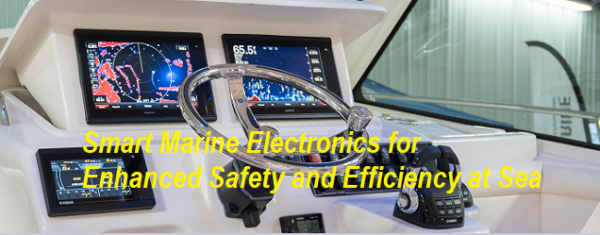
Smart marine electronics growth is dramatically changing the shipping sector. While a majority of people still envision a simple vessel with a compass, the fact is that today’s ships have amazing technologies that far surpass just navigation. The use of AI-supported route planning and live weather tracking has revolutionized the shipping industry, not only in terms of environmental sustainability but also in operational efficiency and safety. With these high-tech solutions, the big and small ships are equipped to face the challenges of today’s busy and unpredictable ocean routes.
Why Smart Marine Electronics Matter Today
When considering maritime technology, most frequently imagine simple instruments like paper charts and compasses. The field of marine electronics has advanced much beyond these fundamentals, yet they still have a role. These days, “smart electronics” refers to systems that exchange data in real-time, communicate with one another, and make choices using sophisticated algorithms. These devices actively enhance vessel performance, fuel efficiency, and above all safety in addition to tracking position and weather.
A Sea of Innovations: The Technologies Leading the Way
1. AI-Powered Autonomous Navigation: The Self-Navigating Future
The progression of Artificial Intelligence (AI) has allowed the latest warships to draw their itineraries with very limited human intervention. The AI-driven systems are not only reactive but also foresee potential accidents by considering other vessels movements, the weather, and even sea currents. This means that a ship equipped with AI may be turning its route by itself prior to the time a danger becomes a problem. The data processing capability of AI is faster and is more efficient than that of humans in a complicated marine traffic scenario. Consequently, it can offer on-the-fly recommendations for the safest as well as the most fuel-saving route. Besides, AI can keep a constant watch over the different areas of the ship, such as the engines and the hull, and thus conveying the malfunction with the ship before it causes a big problem or an expensive repair.
2. Enhanced Radar and Sonar: Seeing What the Human Eye Can’t
Even under the most difficult circumstances, modern radar and sonar systems are capable of seeing unseen things in addition to mapping out barriers. At present, Sonar tech is able to create 3D, very detailed images of the seabed and any objects that are under water. Such visual aids are very necessary for vessels that are going to shallow and turbulent waters or for rescue operations. The efficiency of modern radar is beyond common understanding as they can detect very small things even in thick rain or fog. Besides such detection they can separate different hazards such as icebergs from a sea of lives like whales and thus ensure the taking of safe decisions. Due to these devices smooth connection with other smart gadgets on board, the captain is now equipped with a 360-degree vision not only of the space above but also below the water.
3. Connectivity at Sea: The Internet Everywhere
Global satellite communication (satcom) that offers uninterrupted internet as well as voice access to any point on the Earth is greatly transforming the marine industry. Ships can enjoy stable Internet connections even on the ocean by such satellite systems as Starlink and Inmarsat. It not only makes passing of messages with land-based staff easier but also overseeing of an entire fleet and updating of the weather in real time. Ships may now transmit vital information to a shore-based operations center, including fuel levels and engine performance. Remote problem identification allows the technicians to solve the issue, in some cases, without expenses for repairs or waiting at the port, which is avoided. Because of the rise in cyber threats and piracy, secure communication networks are essential. Presently, smart devices adopt end-to-end encryption, which provides the highest level of security for all communications from intrusions and spying.
Smart Systems for a Greener Ocean:
1. Fuel Optimization: Cutting Costs and Emissions
Fuel-efficient solutions are going to be more and more necessary if the demand for carbon footprint reduction keeps rising. Consequently, the use of smart marine devices has made it possible to track fuel consumption on a real-time basis. These systems are able to lower fuel usage and CO2 emissions via route optimization that not only consider the weather but currents, waves, and sea traffic as well. In fact, the changeover to hybrid power systems that mix traditional diesel with electric propulsion have made ships in coastal areas run more efficiently. To guarantee the most effective operations, smart systems continuously analyze fuel use and energy output.
2. Emission Monitoring: Compliance and Beyond
Vessel environmental monitoring is necessary, nowadays, due to tight emission requirements (for instance the IMO 2020 sulfur cap). By utilizing live data, the operators are enabled to ascertain if the prescribed limits are complied with by the on-site emission measurement of sulfur oxide (SOx) and nitrogen oxide (NOx). Additionally, smart sensors monitor overboard discharge, identifying dangerous materials and making sure ships follow environmental safety regulations.
Smart Security: Keeping Your Vessel Safe at Sea
1. Next-Gen Surveillance Systems
The implementation of high-resolution CCTV cameras with thermal imaging and night vision allows detailed monitoring the ship and its surroundings. Such sophisticated software enables these systems to signal the crew when suspicious activities are detected by them.
2. Cybersecurity at Sea
Ships are more susceptible to hacks as they grow more interconnected. Advanced cybersecurity features included in modern marine electronics include intrusion detection systems that constantly scan the network for malware or possible hacking attempts, as well as firewalls and encryption to protect communication networks.
Marine Electronics Market
The marine electronics market is expanding quickly due to increased demand for safety and navigation solutions as well as technical developments. To increase the effectiveness and safety of vessels, essential goods including GPS, sonar, radar, and communication systems are essential. As over 85% of international trade is carried out by sea, reliable marine electronics are essential, and their importance keeps on increasing. The need is also being driven by the expansion of offshore operations, commercial shipping, and recreational boating, all of which are seeking to comply with regulations, increase their efficiency, and reduce the risk of accidents.
According to Pristine Market Insights, the ocean is still an unpredictable environment, but the journey through these waters is easier and more reliable than ever before due to the introduction of smart marine electronics. The range of technologies that include AI-powered autonomous ships, real-time fuel optimization is essentially re-engineering the way ships operate and ensuring they not only survive but also prosper in the current scenario. The outlook of marine operations is radiant as these technologies advance and get more interconnected. All of vessels safety, intelligence, and green will be enhanced. The revolution of maritime innovation that we will see with the uptake of efficiency, sustainability, and safety, will be as if the ocean is being turned into a safer and sustainable place.